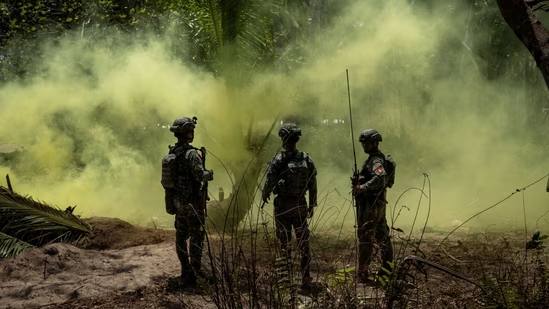
PALAWAN, Philippines—U.S. and Philippine Marines shared foxholes covered in palm leaves, machine guns pointing toward the sea off this tropical Pacific island. Australian and New Zealand soldiers were dug into the sand nearby.
The troops faced an imagined enemy attempting to land from the South China Sea, the disputed maritime thoroughfare that has become a hotspot in the confrontation between China and America’s allies.
To fend off the amphibious assault, U.S. troops launched missiles from the truck-based High Mobility Artillery Rocket System, or Himars. Philippines aircraft soared overhead. The troops on the beach shot their weapons.
“This was an amazing show of firepower,” U.S. Army Maj. Gen. James Bartholomees told the troops after they were deemed to have repulsed the invaders from the beach. “I’m incredibly impressed with what we saw today.”
The counterlanding drill was part of the annual Balikatan exercise, in which the U.S. and Philippine militaries showcase their combined capabilities. The exercise, whose name translates as “shoulder-to-shoulder” from the local Tagalog language, has also become the prime testing ground for expanded cooperation between America’s allies in the Pacific.
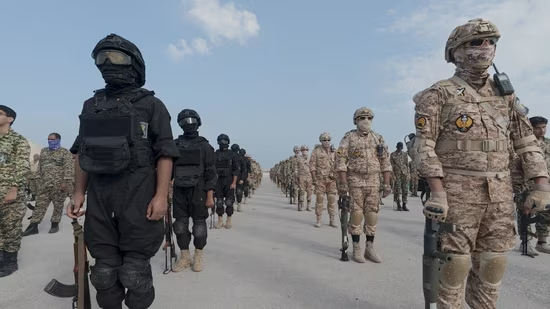
This year’s iteration of Balikatan, which runs for about two and a half weeks, has seen 17,000 personnel deployed from seven nations. Japanese ground troops are participating for the first time, while Canada and New Zealand joined as new active participants. The U.S. sent about 10,000 service members. France also participated with a small contingent.
For Washington, that multilateral show of force is the culmination of a yearslong effort to get its allies in Asia and the Pacific to work more closely together in the face of China’s growing military and territorial ambitions.
Chinese and Philippine forces have repeatedly clashed in the South China Sea, where Beijing’s claims overlap with those of the Philippines and other nations. China also aims to absorb the self-governing island of Taiwan and hasn’t ruled out the use of force to do so.
The exercise’s military planners said the maneuvers weren’t aimed at any one nation. But the missiles, drone and counterdrone systems and strategic islands involved in Balikatan would be crucial in any conflict with Beijing. Air-defense drills that included the Japanese took place in the Philippines’ main island of Luzon in the north, which would be an important staging ground in any fight over Taiwan.
The Trump administration has piled pressure on its allies around the world to take more responsibility for their own defense. However, in contrast to Europe, where the president has questioned the mutual defense provisions of the North Atlantic Treaty Organization, the administration has taken a less combative approach to its partners in the Asia-Pacific region.
In written testimony to Congress last month, Defense Secretary Pete Hegseth praised Japan and Australia for understanding the need to increase defense spending. He called South Korea a “model ally” for committing to the new global standard for defense spending and taking a more active role in defending against North Korea.
Beijing has denounced the multilateral exercises as groundless provocation. “The last thing the region needs is division and confrontation as a result of the introduction of external forces,” a Foreign Ministry spokesman said. Chinese forces recently conducted live-fire drills and held patrols near the Philippines, China’s state-run Global Times reported.
Arsenio Andolong, a spokesman for the Philippines Department of National Defense, rejected Beijing’s criticism. “China’s always been saying that we’re the bad guys, we’re the ones causing trouble,” he said. “But if that’s the case, why do so many other nations come to join us when we’re talking about the international rules-based order and deterrence?”
If the U.S. were to defend Taiwan against a potential Chinese attack or blockade, it would want access to bases, infrastructure and territory in the Philippines and Japan. Australian facilities could provide logistical support further in the rear.
At the same time, there is growing awareness among U.S. allies in the region that it would be difficult to avoid becoming entangled in any conflict over Taiwan or the South China Sea. The war in the Middle East and the economic disruption from the closure of the Strait of Hormuz have driven home the importance of international waterways for global trade and the allies’ interest in maintaining freedom of navigation.
Japanese Prime Minister Sanae Takaichi last year warned that Japan could deploy its military with other nations if China were to attack Taiwan. Philippine President Ferdinand Marcos Jr. has said his country would inevitably become drawn in, pointing to the presence of more than 100,000 Filipino workers in Taiwan.
Japan sent 1,400 personnel for the Balikatan exercise, its first deployment of combat troops to the Philippines since it invaded in World War II.
Lindsey Ford, a former deputy assistant defense secretary for South and Southeast Asia in the Biden administration, said Japan’s growing involvement in particular couldn’t have come at a better time, given America’s current deployments in the Middle East.
The U.S. and three key Asia-Pacific allies, the Philippines, Australia and Japan, need “to train and operate together more routinely—and with a focus on real-world, high-end scenarios,” she said.
The U.S. has alarmed some Asian allies by pulling assets out of the region for the Middle East in recent years, along with the Trump administration’s renewed focus on the Western Hemisphere, including the capture of Venezuela’s Nicolás Maduro and strikes on alleged drug boats.
“U.S. allies are worried about U.S. military ‘overstretch’ particularly with the Iran conflict,” said Markus Garlauskas, director of the Indo-Pacific Security Initiative at the Atlantic Council. But if allies respond by building up their own military capabilities and relying more on each other, “this is a net gain for deterrence, stability and U.S. interests,” he said.
In the Philippines, many officials said they remain confident in the U.S.’s commitment to their mutual defense treaty. The Typhon missile system, an American land-based weapon that puts key Chinese targets within reach from the Philippines, remains deployed in the country and is expected to be part of this year’s exercise, Marines Lt. Gen. Christian Wortman said at Balikatan’s opening ceremony.
The counter-landing drill on the island of Palawan also involved artillery, mortars, light armored vehicles and attack drones. Puffs of smoke hung over the ocean and machine-gun fire strafed the water.
New Zealand Army Capt. Will Hutchinson, whose country is also boosting defense spending, said the scale of the drill and the way the troops were dug in on the beach were new for his soldiers.
“We’re obviously a small nation,” he said. “Being able to project force across to other countries and interact with other armies is massive for us.”
After the guns fell silent, Philippines Brig. Gen. Willy Manalang said the planners had tried to make the scenario as realistic as possible.
The exercise “definitely shows that the Philippines has a lot of friends,” he said.
Write to Mike Cherney at mike.cherney@wsj.com