The Federal Reserve was breaking all the rules.
It was April 2020, with pandemic lockdowns producing some of the scariest moments for the U.S. economy in decades. The central bank had just rolled out plans to do things it would never ordinarily do: lending to midsize businesses, purchasing junk bonds and hoovering up Treasury securities at a pace it had never attempted. Fed Chair Jerome Powell was unapologetic.
“None of us has the luxury of choosing our challenges,” he said in a virtual speech. “Fate and history provide them for us. Our job is to meet the tests we are presented.”
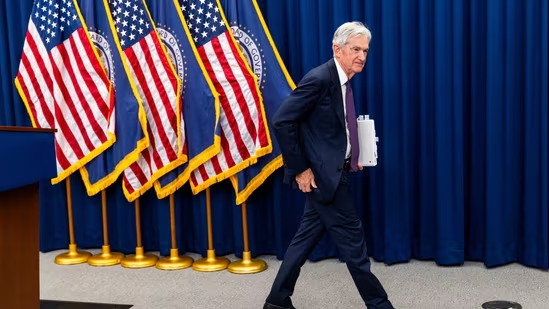
Six years later, the same sentiment explains a more personal reckoning: his decision to remain on the Fed’s board after his term as chair ends May 15—the first chair to do so since Marriner Eccles in 1948.
Powell had long been counting down the days to retirement. By April, he had concluded reluctantly that the days were no longer his to count. Powell’s decision was one he didn’t want to make and hoped he could avoid, according to interviews with current and former Fed officials and others who have worked closely with him.
At his final news conference last week, Powell said President Trump’s legal challenges had crossed a line that threatened to change how the Fed operates. “The things that have happened, really in the last three months, have left me no choice,” he said.
Staying on the board was his bid to ensure the central bank would continue to be able to conduct monetary policy without political interference. The legal actions were “unprecedented in our 113-year history,” Powell said. “I worry that these attacks are battering the institution.”
The January decision to pursue a Justice Department criminal investigation, in the view of people who know Powell well, reflected a fundamental misreading of the Fed chair—one they described as alarming, strategically inept and ultimately revealing about the administration’s intentions. Rather than push him out the door, the move reinforced Powell’s sense of responsibility to the institution and helped produce the decision he had hoped to avoid.
The probe wasn’t the only concern. Talk among the president’s allies about firing reserve bank presidents, who since 1935 have served as a structural check on White House influence over monetary policy, deepened the worry. The tactics might change, the thinking went, but the goal wouldn’t: seizing control of the Fed’s decentralized rate-setting committee outside of the legally established appointment process, in which a board seat opens every two years.
What the probe signaled about Trump’s willingness to pursue those aims, these people said, was the reason that staying was on the table at all. Without it, Powell wouldn’t have seriously considered remaining once Trump nominated former Fed governor Kevin Warsh to succeed him as chair.
Powell’s decision drew swift criticism from Trump allies. Treasury Secretary Scott Bessent called it “a violation of all Federal Reserve norms” and said Powell was acting as if “he alone can maintain the integrity of the Fed,” adding that it was insulting to Warsh.
Larry Kudlow, the former Trump economic adviser who used to meet with the Fed leader, said the decision reflected poorly on Powell. “Jay Powell’s not the martyr he thinks he is,” Kudlow said on his Fox Business program. “He has bad manners.”
Trump said Thursday that he wasn’t bothered by Powell’s decision. “I don’t care,” he told reporters.
Powell said he wasn’t staying to second-guess Warsh and that he would keep a low profile. “I’m not looking to be a high-profile dissident, or anything like that,” he said.
The pressure had been building for months. Verbal criticism from the White House turned to legal confrontation in August, when the Trump administration sought to fire Fed governor Lisa Cook in a case she has challenged. It is now pending at the Supreme Court.
Then in January, the Justice Department opened a criminal investigation of Powell’s oversight of building renovations. Powell challenged the effort in a behind-closed-doors legal battle, and a federal judge ruled the subpoenas improper. Lawmakers in both parties called the matter unworthy of criminal scrutiny. The blowback froze Warsh’s path through the Senate until April 24, when the U.S. attorney’s office announced the probe would be halted, just in time for the Senate to confirm Warsh on schedule.
Current and former Fed officials who have been appointed by presidents from both parties said they hoped they would have made the same decision Powell made if they had been in his position.
“Jay was in a really difficult situation,” said Loretta Mester, who as president of the Cleveland Fed from 2014 to 2024 served alongside Powell for a decade. “I think he did what he had to do given the conditions.”
The probe was resolved in a way that satisfied the key Senate Republican, Thom Tillis of North Carolina. With his one-man blockade ended, Warsh’s confirmation advanced through the Senate Banking Committee on a party-line vote last week.
Hours later, Powell said the resolution hadn’t met the standard he had publicly set weeks earlier, when he said it needed to end “with transparency and finality.”
The Justice Department offered private assurances that it would pursue a criminal referral only if the Fed’s inspector general—whose audit Powell had requested last July—found wrongdoing. The department also indicated that its forthcoming appeal of the subpoena ruling was about preventing adverse case law for the government, not about reopening the probe against him. But the U.S. attorney’s office didn’t issue a public exoneration, and officials suggested they could restart the investigation at any time.
Powell hasn’t said how long he plans to stay. His term as a governor ends in early 2028. Some of those who know him say he could be there a while because they have concluded the administration can’t be trusted to change its behavior.
“Given that Powell is looking for credible assurances from an administration that has shown repeatedly that it cannot be trusted to restrain its vindictive urges, I suspect Powell’s tenure may continue for a considerable period,” said Jon Faust, who was a senior adviser to Powell from 2018 to 2024.
Staying carries its own risks for the institution Powell is trying to defend. Every vote he casts as a governor will be parsed for political meaning. Powell’s mere presence gives the administration a target it wouldn’t otherwise have and complicates Warsh’s task of taking command of an institution his predecessor had run for eight years.
Warsh has laid out an ambitious agenda for the Fed that promises a rethink of how the Fed operates, manages its relationship with the Treasury Department and communicates with the public. Even without giving speeches or interviews, Powell will introduce an unfamiliar dynamic by sitting in the room as those debates unfold.
“He doesn’t want to be viewed as someone who is obstructing a new chair who’s coming in,” said Mester, the former Cleveland Fed president. “And if he was ever in a position where he felt like he had to dissent, then that’s going to be even more scrutiny: ‘Oh, the Fed’s acting political.’”
That Powell is willing to bear those costs reflects both how he reads the threat and how he reads his obligations, said former Philadelphia Fed President Patrick Harker. “He is doing what he has done from the start. He is absorbing pressure that the institution would otherwise have to absorb without him,” he wrote in an essay Saturday.
“He had every right to retire,” Harker added. “He earned it. He chose not to.”
On Wednesday, Powell said he wants to see more than just a resolution of the legal cases: He wants a return to a calmer relationship between the Fed and the executive branch. The Fed hadn’t lost the ability to make its decisions free of politics, Powell said, “but we’ve had to fight for it.” He added: “I’d like to think we can get out of that era and go back to respecting what the law says and what custom has been, which is to let the Fed do our thing.”
Write to Nick Timiraos at Nick.Timiraos@wsj.com