The US Treasury imposed sanctions on China’s Hengli Petrochemical (Dalian) Refinery on Friday, accusing it of buying billions of dollars in Iranian oil, in a significant escalation of Washington’s long-running effort to curb Tehran’s oil revenue.
The firm’s Shanghai-listed parent firm Hengli Petrochemical denied doing business with Iran and said the sanctions lack factual and legal basis, and that it will strive to have them lifted.
Following are key details:
Why is this an escalation?
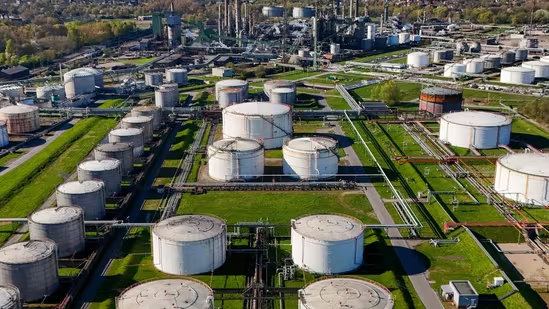
Hengli operates a 400,000 barrel-per-day refining complex in the northeastern city of Dalian, making it the largest Chinese refiner to be singled out for sanctions by the United States since it renewed its crackdown on Iranian oil exports in 2019.
The designation comes shortly after a 30-day waiver of sanctions on importing already-loaded Iranian crude oil had lapsed, and after U.S. Treasury Secretary Scott Bessent threatened on April 15 to sanction buyers of Iranian oil and said that the Treasury department had written warning letters to two Chinese banks.
The move comes ahead of U.S. President Donald Trump’s planned visit to Beijing in May.
Previously, Iran-related U.S. sanctions on Chinese entities had mostly targeted peripheral operators in the supply chain, including three small independent refiners and several import terminal operators.
Also Read | Decoding US reaction to Iran’s latest peace offer
What has been the impact thus far?
Shares in Hengli Petrochemical fell by 10% on Monday.
The Hengli Group also restructured its Singapore-based trading arm, Hengli Petrochemical International, reducing the sanctioned firm’s ownership stake from 100% to 5%, with the remainder now held by a Chinese local government entity.
Several trading executives said they were sceptical that the move would insulate the Singapore unit from the wariness of counterparties given its ownership when the U.S. measure was unveiled.
In its statement, Hengli Petrochemical said it has sufficient crude inventories to meet processing needs for more than three months, and it will continue settling oil procurement in Chinese yuan.
What are the precedents?
Last year, in separate actions, the U.S. imposed sanctions on several Chinese entities including three small refiners, moves that sources said created difficulties receiving crude and led two of them to sell product under other names.
Last October, the U.S. sanctioned an import terminal through which Chinese state refining giant Sinopec received one-fifth of its crude. That measure led to the terminal’s idling for months, disrupting crude flows and forcing cargo diversions as traders avoided it for fear of secondary sanctions, Reuters reported.
A logistics unit of Sinopec eventually sold its stake in the facility to a local port operator.
Another 400,000-bpd Chinese refiner with a Singapore presence, Shandong Yulong Petrochemical, last year saw non-Russian suppliers, foreign customers, banks and vendors stop doing business with it after it came under sanctions from Britain and the European Union for dealing in Russian oil.
The measures increased Yulong’s reliance on Russian oil.
What has been the impact of US sanctions on Iranian oil?
China, the world’s biggest oil importer, has been the dominant buyer of Iran’s oil shipments for years, bringing in a record 1.8 million bpd in March, according to Vortexa Analytics.
However, China’s giant state refiners have avoided buying Iranian crude since the U.S. reimposed sanctions in 2019, traders have said, with independent “teapots” the main buyers of discounted Iranian barrels that are shunned elsewhere.
Iranian oil delivered to China is often trans-shipped en route and is mostly branded as Malaysian or Indonesian.
Beijing has defended its trade with Iran as legitimate and has repeatedly rejected what it calls “illegal” unilateral sanctions. (Reporting by Tony Munroe; Editing by Raju Gopalakrishnan)