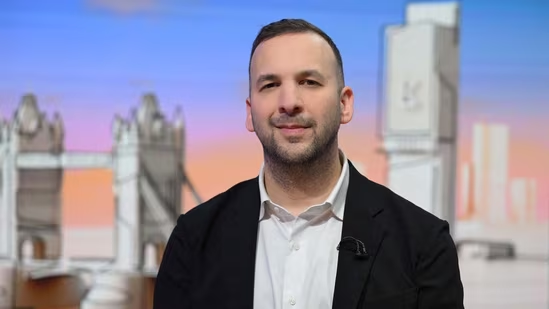
If you say “bloody Mary” three times in front of a mirror, a ghostly woman (Mary) will appear. So goes the popular children’s folklore. (Spooky!) Likewise, if you post the words “Zack Polanski” on Bluesky, a microblogging site, you might just summon the leader of Britain’s Green Party. (Even more spooky!)
Mr Polanski has a habit of searching for his own name, a practice known as “ego surfing”. (REUTERS FILE)
Mr Polanski has a habit of searching for his own name, a practice known as “ego surfing”. This distinctively digital behaviour is that of a politician who could be described as Britain’s first digital-native party leader. On Bluesky, Instagram, TikTok and X, the left-wing eco-populist is in constant back-and-forth with supporters. In one recent clip the Green Party leader danced to throbbing house music at a rally in Trafalgar Square; 2.7m people watched on Instagram. To get a sense of Mr Polanski’s digital drive, The Economist analysed 35,000 of his Bluesky “likes”.
Digital activism is not new to Britain. Enthusiastic supporters of Scottish independence, in the run-up to Scotland’s referendum in 2014, were dubbed “cybernats” for their online presence. Under Jeremy Corbyn, “Corbynistas” voiced their support for Labour on social media. Kemi Badenoch, the Conservative Party leader, has been described as “chronically online”.
Now the Greens appear to be the most prolific posters. Candidates for the local elections on May 7th have become micro-influencers. Clips of Mr Polanski are shared widely. Any critical content posted about the party will quickly be flooded with rebuttals (or abuse). And every day Mr Polanski himself interacts directly with his supporters—reposting, liking, replying.
Bluesky thinking
One platform where Mr Polanski communicates with supporters is Bluesky. He is one of millions who joined the site in November 2024, after the re-election of Donald Trump. Many of them disapprove of the right-wing drift of X (formerly Twitter) under the leadership of Elon Musk. Unlike X, Bluesky emphasises transparency, which means The Economist can view Mr Polanski’s online habits.
And they are prolific. Mr Polanski has liked a post on Bluesky every day since April 1st 2025—nearly 35,000 times in total (see chart). On a typical day, Mr Polanski likes his first Bluesky post at around 8.30am. His favourite times to scroll are between noon and 1pm, and from 6pm to 7pm. His last like of the day tends to happen at around 11.15pm. After that, presumably, it’s bedtime.
The content of the posts Mr Polanski likes varies but there are some recurring themes. Around a third of the posts include his name. They tend to be adoring. “I’m impressed with everything I’ve seen so far from Zack,” says one. “God how I love this man,” says another. Many of the posts liked by Mr Polanski celebrate the Green Party, or denounce Sir Keir Starmer’s Labour government. Many more condemn the government of Israel for what Mr Polanski describes as a genocide in Gaza. So far, so expected for a leader of the Green Party.
Yet Mr Polanski’s likes reveal another side to his personality. He appears thin-skinned and hostile towards journalists. On December 9th, for example, Marina Hyde, a centre-left columnist for the Guardian, wrote a mildly critical article about him. After its publication, he liked at least 20 posts criticising her by name. Some took on the arguments in her article; most attacked her character. “Marina Hyde is a total twat,” began one of the posts Mr Polanski liked.
Dozens of the posts liked by Mr Polanski criticise journalists, or the press as a whole. In October the Green leader liked a post which described the Guardian’s chief sports writer as “a smug, sanctimonious cunt”. In November he liked a post which described Sophy Ridge, a Sky News journalist, as a “sneering dickhead” (for asking Mr Polanski about his party’s policies).
Responding to the posts quoted above (for which Mr Polanski has since removed his likes), a spokesperson for the Greens said: “Zack manages his own social media and tries to engage with as much online as he can to motivate supporters. He’s often flicking very quickly through posts while on a train or between interviews and engaging as much as he can. He is sorry for any mistakes made when working fast.” With so many likes to his name, perhaps it is no surprise that Mr Polanski’s thumbs are working faster than his judgment.
The Greens’ social-media strategy seems to be working. The party continues to rise in the polls and Mr Polanski’s digital presence enthuses its activists. But social media have a tendency to amplify the best and worst of society. In an interview earlier this year, Mr Polanski described them as a “toxic cesspit”. He should know.
For more expert analysis of the biggest stories in Britain, sign up to Blighty, our weekly subscriber-only newsletter.