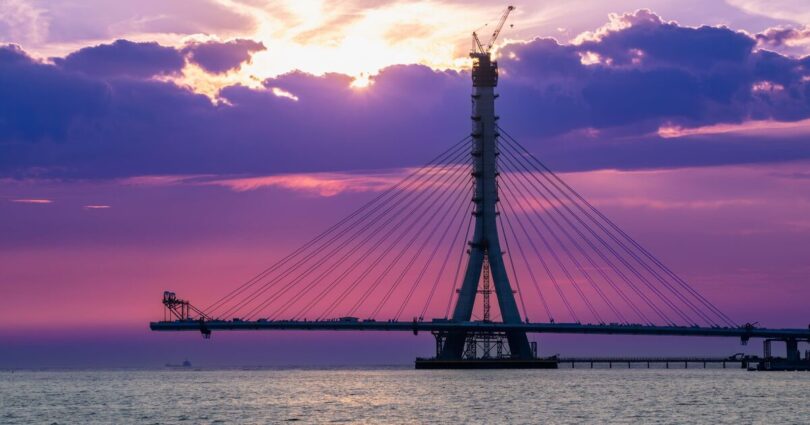
An “impossible” bridge set to be the longest of its kind in operation is set to open for road traffic in weeks. Danjiang Bridge is a vast infrastructure in underway in Taiwan that spans the Tamsui River. The structure, which links Bali and Tamsui in New Taipei City, Taiwan, stretches more than 3,000 feet and is the world’s longest asymmetric cable-stayed bridge.
Scaffolding systems firm PERI, which is involved in the project, said it will “connect the industrial zones of Tamsui and the Bali District opposite, which will lead to improved infrastructure and relieve traffic congestion in the region” and become a “new landmark for the city”. The structure was designed by Zaha Hadid Architects in collaboration with Leonhardt, Andrä & Partner and Sinotech Engineering Consultants.
Construction is being led by main contractor the Kung Sing Engineering Corporation (KSECO).
The practical challenges of constructing a colossal stable cable-stayed bridge of this scale, as well as other factors including its exposed location at the mouth of the river, had led some to believe that it could not be done.
Even KSECO deputy general manager Liu Yung-ching had doubts, admitting he was initially against embarking what he saw as “a mission impossible.”
The project has reportedly faced various issues during construction, including weather conditions preventing them from welding at one stage, and tweaks to stabilise unfinished sections during high winds.
It was originally supposed to open in 2024, but the timeline was pushed back due to Covid-related delays and worker shortages, Focus Taiwan reports.
The bridge’s long road is around 233 feet wide, with road and rail infrastructure running side by side, as well as pedestrian and cycling paths. The rails are to accomodate a future light rail line.
The bridge now scheduled to open to road vehicles on May 12.
With the strucure now ready for use, Liu is proud of the achievement, despite his initial reservations, telling Taiwan’s state-funded Central News Agency (CNA) if “I had the chance to do it again, I actually would.”
Estimates of the cost put it at around NT$12.49 billion (circa £295 million).