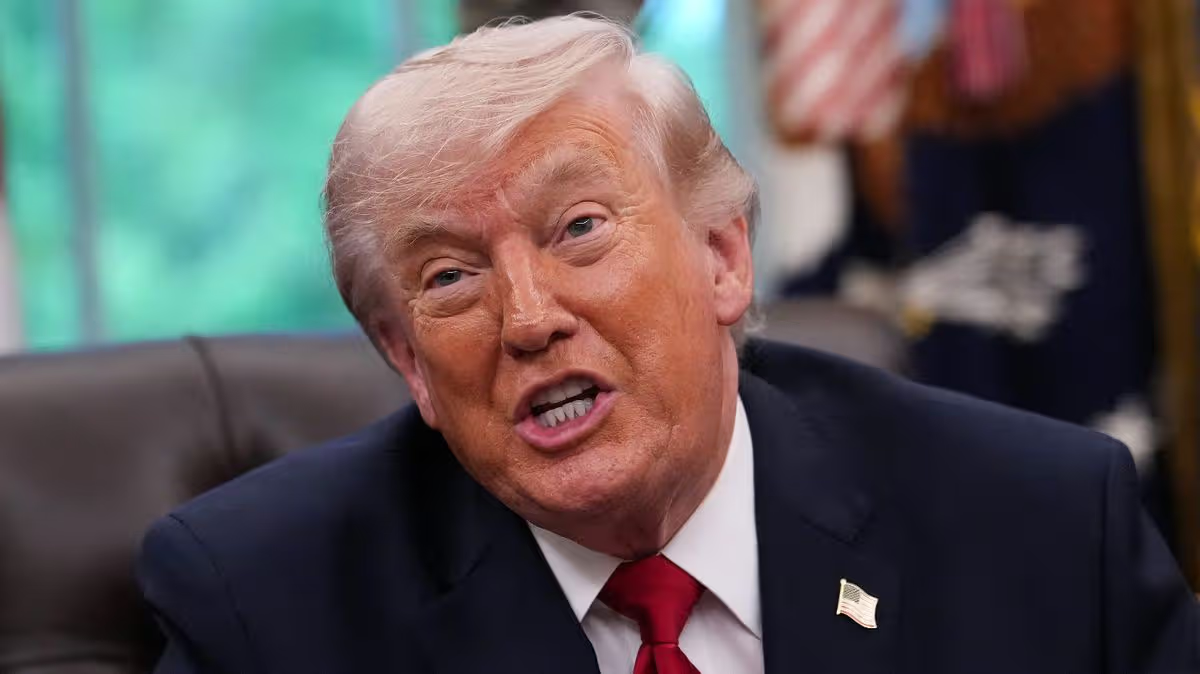
Since the bipartite US-Israeli attack on Iran began two months ago, US President Donald Trump has made declarations about stealing Iranian oil: “If it were up to me, I’d take the oil, I’d keep the oil, it would bring plenty of money.” Failing that, he has threatened to destroy Iran’s oil infrastructure.
Hoping for a repeat performance of the kidnapping of Nicolas Maduro and the Venezuelan oil theft, Trump’s triumphalist rhetoric turned out to be premature.
Iranian officials responded to Trump’s threats by reminding him several times that Iran is not Venezuela: “We tell the Americans clearly: this is not Venezuela, where you can loot resources,” and that the Islamic Republic and the Iranian nation “will stand firmly against such attempts”.
If the Americans and the British were able to pillage Iranian oil after overthrowing Prime Minister Mohammad Mosaddegh, who nationalised it in 1953, the possibility of a repeat performance today seems much less likely.
The US pillage of Third World resources is hardly a new development. It has continued US imperialist policies since the Second World War, and long predates it in the case of US theft of Latin America’s resources, let alone those of Native Americans within the US itself.
CLICK FOLLOW: TO FOLLOW US
Sign up to get the latest insights and analysis on
Israel-Palestine, alongside Turkey Unpacked and other eSPORTY
Indeed, the US and the former European colonial empires stood firm after the war and the onset of the age of decolonisation, insisting that the end of European and American direct colonialism did not entail granting economic sovereignty to the countries undergoing decolonisation.
This is something former Ghanaian President Kwame Nkrumah understood well when he explained that granting political independence to formerly colonised countries, while maintaining the same colonial global economic structure of pillaging Third World resources, changed very little in the economic lives of the colonised and ultimately denied them economic sovereignty and substantive independence.
Postcolonial challenge
The first major collective challenge by formerly colonised countries took place in 1955 at the Afro-Asian Bandung Conference in Indonesia. The conference asserted the right to self-determination of still-colonised countries and peoples, as well as those that had just won independence.
What transpired at Bandung was a reversal of the hegemony of western insistence on economic pillage. Asian and African countries had, in fact, been fighting for the inclusion of political and economic self-determination at the United Nations since the end of the Second World War.
A few months after Bandung, in November 1955, the Third Committee of the UN General Assembly had already agreed to the formulation of the right to self-determination for adoption in the 1960 resolution and the 1966 UN covenants.
Debates in the Third Committee had been raging since 1950, with colonising countries insisting on a colonial exemption clause in the future resolution.
In 1952, the US voted against a UN General Assembly resolution declaring self-determination a human right
In 1952, the US voted against a UN General Assembly resolution declaring self-determination a human right and “bitterly resisted requirements that colonial powers report on the progress of non-self-governing territories toward self-government”.
The imperialist countries were vehemently opposed by Asian and African delegates, prominent among them Arab delegates from Syria, Iraq and Saudi Arabia, among others, who played a crucial role in defeating the colonial clause and in pushing for self-determination as a human right.
This came after much agitation and opposition by the US and American corporations to any whiff of economic self-determination at the UN, insisting that the right only encompassed political self-determination.
US corporations went apoplectic when Guatemala’s President Jacobo Arbenz introduced land reform measures that threatened US businesses and referenced a 1952 UN General Assembly resolution supporting nationalisation of economic resources.
Chile, like the rest of Latin America, economically dominated by the imperialist US, sought during the same year to amend the draft human rights covenants to state that the “right of people to self-determination included the economic right to control all of their natural resources and not to be deprived of their use or their means of existence by the actions of any outside power”.
The Americans were so appalled by the moves to establish economic independence that they called the Soviet and Third World attempts to institutionalise economic self-determination for independent states a form of “hate language”.
Imperial coercion
By 1962, UN General Assembly resolution 1803 endorsed permanent sovereignty over natural resources in a move to affirm economic self-determination.
But that did not stop the US, which sponsored coups to overthrow leaders committed to pursuing economic sovereignty and removed them from power – including Syria’s Shukri al-Quwwatli in 1949; Mosaddegh in 1953; Guatemala’s Jacobo Arbenz in 1954; Congo’s Patrice Lumumba in 1961; Brazil’s Joao Goulart in 1964; Indonesia’s Ahmad Sukarno in 1965; and Ghana’s Nkrumah in 1966 – to name the most prominent.
Gamal Abdel Nasser was targeted by the Europeans and Israel in a tripartite invasion in 1956 after he nationalised the Suez Canal Company, and by Israel and the US in 1967 to end the Egyptian welfare state and Nasser’s experiment in asserting economic sovereignty.
As for Chile’s Salvador Allende, whom the US overthrew in 1973, Henry Kissinger’s famous justification was: “I don’t see why we need to stand by and watch a country go Communist due to the irresponsibility of its own people.”

From Venezuela to Iran, Trump’s ‘Donroe Doctrine’ is a push to control the world’s oil
Read More »
Despite these defeats, the formerly colonised continued to seek ways to reassert their economic sovereignty against the imperialist economic order.
The last collective attempt was made in the 1970s, while the world was on the verge of being taken over by economic neoliberalism and “globalisation” – namely the project of a New International Economic Order (NIEO).
The NIEO was a set of proposals made by Third World countries through the UN Conference on Trade and Development, established in 1964 by formerly colonised countries as well as imperialised Latin American countries and headed by Argentinian economist Raul Prebisch, to promote economic “equality” and remedy economic “injustices” among states to accelerate “economic and social development”. It came to nought.
Indeed, the US veto on the liberation of the peoples of southern Africa from apartheid and settler-colonialism – Angola, Mozambique, Zimbabwe-Rhodesia, Namibia, South Africa – continued until guarantees were given that the US and its European imperialist allies and the white settlers would maintain economic sovereignty over these countries after “independence”.
It was also Kissinger who was the architect of the “tar baby” option of strengthening US ties with the white supremacist settler-colonies in South Africa, Rhodesia, and the Portuguese colonies of Mozambique and Angola.
In the infamous and illustrative case of Zimbabwe-Rhodesia, this economic arrangement persisted for almost two decades after independence in 1980.
Neoliberal coercion
By 1990, 100,000 white settlers remained in Zimbabwe. Control of the commercial private sector remained in white hands. The opulent suburbs remained exclusively white while Africans lived in overcrowded townships. The white settlers maintained their superiority and their economic and, essentially, their political privileges.
The refusal of the UK or the Americans to subsidise the purchase of white land increased land hunger and economic frustration.
When the moratorium on nationalisation of white property ran out in 1990, President Robert Mugabe was advised not to frighten the neighbouring whites in South Africa, especially after the release of Nelson Mandela in February 1990 and negotiations underway to end apartheid while maintaining imperialist and white sovereignty over South Africa’s national resources.
Follow Middle East Eye’s live coverage of Israel’s genocide in Gaza
As a result, the best arable land in Zimbabwe remained in the hands of the white colonists. Meanwhile, already in the 1980s, the IMF and the World Bank had intensified their neoliberal policies by coercing Zimbabwe to cut social spending on education and food subsidies to end its welfare state system.
As Namibia finally obtained its independence in 1990 and South African apartheid ended in 1994, Mugabe remained on excellent terms with the British – so much so that he was awarded an honorary knighthood that same year.
The triumph of US imperialism and neoliberalism after the fall of the USSR was a bad omen for the people of Zimbabwe, whose social services were cut on the orders of the IMF and World Bank when the country adopted an “Economic Structural Adjustment Program” in 1991. Economic apartheid remained the order of the day, with the white colonists continuing to benefit financially.
The achievements in health, education and employment of the 1980s were quickly reversed in the 1990s, and corruption of government by the emerging Black business class became rife.
In this context, the government became more radicalised in response to the land-poor Black population, especially after 1997. It proposed taking over 800 white-owned farms and imposing taxes on commercial farmers to support the budget. The government’s new radicalised economic policies also meant that it suspended the structural adjustment policies imposed by the IMF.
Nothing Mugabe had done since 1980, or before, led to enmity with the British in the way that his government’s encroachment on the property of white colonists did. Relations with the UK deteriorated quickly.
Mugabe correctly pointed out that the original colonists under Cecil Rhodes had stolen land without any payment as part of the “right of conquest”, and that his government would therefore pay nothing to regain it.
Landless peasants had already begun to take over abandoned white farms in the mid-1980s, but by then, more of them were taking over not only mostly white-owned farms but also Black-owned farms.
Western outrage
By the year 2000, the increased western sanctions that began in 1997, along with the lasting effects of structural adjustment policies, had further impoverished both the population and the state.
The invasion of western-funded non-governmental organisations and the creation of a western-funded liberal opposition – such as the Movement for Democratic Change (MDC), established in 1999 – were expected to weaken the regime.
The liberal and pro-western opposition stood against the poor, land-hungry indigenous Zimbabweans’ takeovers of white farms. They hoped to topple the government and halt its belated attempt to finally reverse white settler colonialism and stem the tide of western pillage.
The achievements of this period included the redistribution of 80 percent of agricultural land without compensation to white settlers, the “liquidation” of settler politics, the ending of white colonial and racial privileges, and the broadening of land ownership.
The British huffed and puffed against Mugabe, who had become the target of western opprobrium… solely over the fate of white colonists’ ill-gotten property
This, however, facilitated the entrenchment of a Black bourgeoisie, which sought to end the country’s revolutionary situation through renewed accommodation with international capital after 2005, leading to a power-sharing agreement between the MDC and the ruling ZANU party in 2008.
The British huffed and puffed against Mugabe, who had become the target of western opprobrium – not for having presided over the country’s decline into poverty under the dictates of western instruments of economic control, nor for the corruption that ensued among the African elite in and out of government following the neoliberal turn, but solely over the fate of white colonists’ ill-gotten property, as only the latter threatened white privilege and western neocolonialism in Zimbabwe.
International capital began to abandon the country, and then came western condemnation. The World Bank suspended “aid”, and threats of sanctions quickly followed. Western media campaigns demonising Mugabe and his government, alongside British calls for regime change, were everywhere. Targeted western sanctions followed.
About 20,000 whites remained in the country and used all available legal means and international connections to regain “their” lands. Once a new government more accommodating to western and settler demands acceded to power through a coup d’etat that removed Mugabe in 2017, the first white farmer regained “his” land.
Continued pillage
The fate of independent Namibia and post-apartheid South Africa would be just as bad, as the end of apartheid in both countries was conditioned on the continued pillage of their lands and resources by settlers and imperialist capital.
While the apartheid political system was dismantled, economic apartheid was cemented in the new South Africa. By 1996, the ANC government joined big business in subjecting South Africa to neoliberalism.
The US and the European imperial powers, through their international instruments of economic control, especially the IMF, ensured that the new South Africa would not nationalise white wealth and redistribute it to its rightful owners, under the threat of new economic sanctions.
The deal the ANC concluded with the imperialist powers and the local white ruling class was clear: the price for ending racial political apartheid was the maintenance of racial economic apartheid and imperialist pillage of the country’s resources.

Suez was the death knell for the British empire. Hormuz may do the same for the US
Read More »
As for Iran, the insistence of its leaders that it will not face the fate of Venezuela and Maduro refers to the success of the US, alongside its European allies, in subverting Venezuela’s government for at least a decade and undermining its legitimacy. In 2019, they recognised the US-appointed replacement for Maduro, the illegitimate and exiled Juan Guaido, as the country’s legitimate president.
The Venezuelan business and upper middle classes, hostile to Maduro’s insistence on economic sovereignty and the welfare state, also constituted a capable fifth column – a class alliance that does not exist in the Iranian case.
More important is Iran’s much superior military capabilities compared to Venezuela, which enabled it to resist the savage bombing of the Americans and the Israelis.
In Iran, the legitimacy of the revolutionary regime has never been weakened, despite the Herculean efforts by Israel and the US to find alternative leadership, including the buffoonish son of the shah, and their recruitment of anti-regime Iranians inside and outside the country.
The ongoing US theft of oil from Venezuela and the attempt to subjugate Iran, which seem to upset some US liberals, are hardly innovations of the Trump administration. They are simply business as usual for US imperialism – under both Democratic and Republican Party rule.
The views expressed in this article belong to the author and do not necessarily reflect the editorial policy of Middle East Eye.