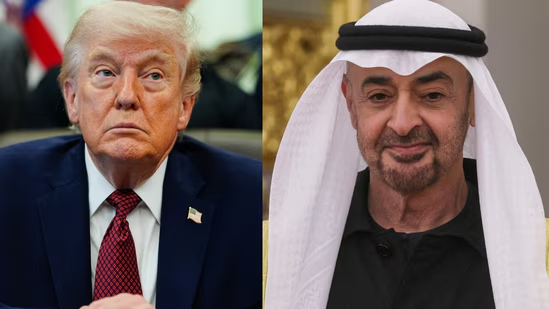
The United Arab Emirates has reportedly begun discussions with the United States over a potential financial safety net, as concerns grow about the economic fallout from the ongoing Iran war.
According to a report by The Wall Street Journal, the talks centre on a possible backstop if the conflict deepens and puts further strain on the country’s economy. Track US-Iran war live updates.
At the heart of these discussions is a proposal raised by UAE Central Bank Governor Khaled Mohamed Balama during meetings in Washington last week.
He floated the idea of a currency swap line with officials from the Federal Reserve and the US treasury, including treasury secretary Scott Bessent. The move signals early-stage planning rather than a formal request.
Concerns grow with no end in sight
Emirati officials told the WSJ that while the country has so far avoided the worst economic consequences of the conflict, the risk of escalation remains a concern. A financial lifeline could help cushion any sudden shocks if conditions worsen.
The discussions reflect growing unease within the UAE that the war could undermine its position as a global financial hub.
There are fears that prolonged instability may drain foreign currency reserves and trigger capital flight, even though no formal request for a swap line has been made yet.
War effect on economy
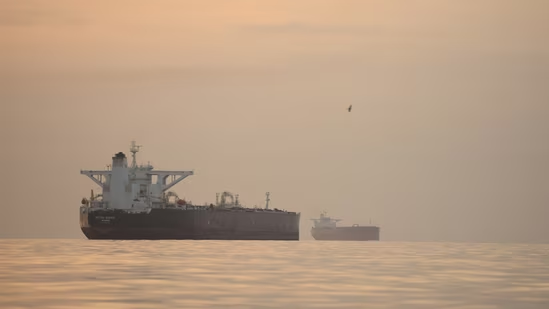
The conflict that began on February 28 has already started to leave its mark. Damage to energy infrastructure and disruptions to oil shipments through the Strait of Hormuz have cut off a key source of dollar inflows for the country.
Earlier, UAE President Sheikh Mohamed bin Zayed Al Nahyan held talks with Ruler of Fujairah, Sheikh Hamad bin Mohammed Al Sharqi, focusing on national priorities, reported news agency UAE.
During the meeting, the leaders reviewed key development issues, stressing that public welfare remains central to the UAE’s policy direction and long-term economic planning.
As part of the visit, the two leaders inspected operations at Fujairah Port, assessing measures aimed at maintaining business continuity and high operational efficiency.
The two described the port as a strategic national asset, crucial to supporting the UAE economy and global energy markets, and reinforcing the country’s standing as a key hub for international trade, according to a statement, cited by ANI.
In an interview on ABC’s This Week, UAE minister of state for international cooperation Reem Al Hashimy highlighted the scale of the attacks, saying the country has been hit by more than 2,800 missiles and drones since the US-Israeli war with Iran began.