“One strait”, Indonesia’s President Prabowo Subianto told his ministers in a televised cabinet meeting on April 8th, referring to the Strait of Hormuz, “determines the fate of many nations, of the price of oil. And the key to it is held by one country.” “But do we realise”, he asked them, raising the pitch of his voice and his eyebrows in a way that could only be described as coy, that “70% of East Asia’s energy needs and 70% of its trade pass through the Indonesian straits?”
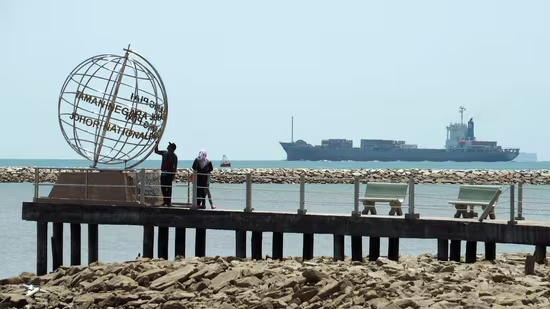
FILE PHOTO: A container ship enters the Singapore Strait for the Strait of Malacca, as tourists stand at mainland Asia’s southern most point in Johor, Malaysia November 12, 2016. (REUTERS)
Sitting in front of Mr Prabowo was Purbaya Yudhi Sadewa, his outspoken finance minister. On April 22nd, Dr Purbaya took Mr Prabowo’s remarks to their natural conclusion, complaining to an infrastructure investment conference that ships passed through the Strait of Malacca without being charged. “I’m not sure whether that’s right or wrong,” the minister continued. Noting that Iran had begun charging traffic through the Strait of Hormuz a fee, he wistfully added, “if only it could be like that” in the Strait of Malacca.
Mr Prabowo’s figures on the amount of energy and trade passing through the archipelago’s straits are imprecise. But he is right that Indonesia sits upon some of the world’s most strategic waterways. Modelling by The Economist estimates that blocking the Strait of Malacca would force around 21% of global seaborne trade to reroute, adding an additional 1,200km to ships’ journeys. However, blocking all of the Indonesian straits, including the Sunda, Lombok and Makassar straits, would affect some 26% of global seaborne trade, and require an average detour of 7,800km.
It is not the first time that Indonesia has raised the possibility of charging a toll in the Strait of Malacca. In the mid-2000s pirates hid out in the coves of the Indonesian island of Sumatra, on the west side of the strait, waiting to seize container ships and tankers sailing through it. Unable to police its own coastlines, Indonesia offered to charge passing vessels a fee in order to fund security in the strait.
The idea was shot down at that time by Singapore, which with one of the world’s busiest ports at the southern end of the strait stood to lose the most from such a scheme. It insisted that the right under international law to transit an international strait be respected. Indonesia eventually dropped the proposal. Instead it joined Singapore, Malaysia and later Thailand to conduct air patrols of the strait. Reports of piracy dropped.
But Singaporean officials have long worried that cash-strapped Indonesians, under a more assertive president, might return to the idea. Iran’s closure of the Strait of Hormuz has heightened those fears. Indonesia may lack a strong navy, but Iran’s use of cheap one-way drones shows that it need not possess one in order to shut down sea lanes.
For now, it is off the table. The foreign ministers of both Singapore and Malaysia spoke up on April 22nd to make clear that nothing could be done in the waterway unilaterally. “The right of transit passage is guaranteed for everyone. We will not participate in any attempts to close or interdict or to impose tolls in our neighbourhood,” Vivian Balakrishnan, Singapore’s foreign minister, told an interviewer.
Sugiono, their Indonesian counterpart (who goes by only one name), responded on the evening of April 23rd that Indonesia would keep the strait free. “We are not in a position to do that.” Indonesia, he correctly noted, made a deal during the negotiations that led to the un Convention on the Law of the Sea (unclos) to allow innocent passage through its straits in exchange for recognition of its claim to all of the waters between its 17,000 islands. “We are a country that must respect international law, especially unclos.”
But at a time when the world can rely less and less on international law, that will be cold comfort to those who must rely on Indonesia keeping its word. After the idea has been floated, and so prominently, expect the Malacca issue to drift back into view again before too long.