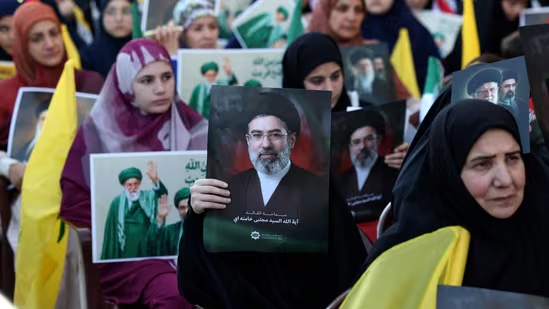
A severely injured Mojtaba Khamenei, who succeeded his father Ayatollah Ali Khamenei to become the Supreme Leader of Iran after the February 28 US-Israeli strikes assassinated him, is reportedly not very accessible now and remains in hiding since the attack, necessitating dependence of ancient methods like envelops and human chains for whatever limited communication remains.
Mojtaba Khamenei was chosen as the Supreme Leader by a council of senior clerics after the February 28 strikes which did not just kill his father, wife and son but also left him with injuries that now reportedly require prosthetic. Track Iran war April 24 updates
He had surgery on one hand and is slowly regaining function, said a New York Times report on Iran’s new power structure, with interviews with six senior Iranian officials, two former officials, two members of the Revolutionary Guards, a senior cleric familiar with the inner workings of the system and three individuals who know the Supreme Leader well.
“His face and lips have been burned severely, making it difficult for him to speak”, the officials said, adding that, eventually, he will need plastic surgery.
Handwritten messages, delivered through human chain
While Khamenei was gravely injured in the February 28 US-Israeli strikes, he remains mentally sharp and engaged, according to the NYT report which cited four senior Iranian officials familiar with his health.
One leg of Mojtaba was operated upon thrice and he is awaiting a prosthetic, the report mentioned, adding that he one of his hands was also surgically treated and is slowly regaining function.
His face and lips have been burned severely, making it difficult for him to speak, the officials said and added that he eventually will need plastic surgery.
Khamenei has not been publicly seen, neither has he recorded a video or audio message since the start of the war that is currently observing a temporary ceasefire.
Officials said he is away from public eye because he does not want to appear vulnerable or weak in his first address. He, however, has issued several written statements that have been posted online and read on state television.
Messages to Mojtaba are handwritten, sealed in envelopes and travel through a human chain from one trusted courier to the next, who use highways and back roads in cars and on motorcycles to reach his hide-out. His inputs on issues travel out similarly.
Neither senior commanders of the Iran Revolutionary Guards nor senior government officials visit Mojtaba Khamenei, fearing that Israel may trace them to him and carry out an assassination. President Masoud Pezeshkian, who is also a heart surgeon, and the minister of health have both been involved in his care.
Most power with hard-line military now
Mojtaba Khamenei’s health condition, concerns surrounding the same and the difficulty in communicating with him has reportedly forced him to delegate decision making to the generals for now.
“Mojtaba is managing the country as though he is the director of the board,” the report quoted as saying Abdolreza Davari, a politician who served as senior adviser to Mahmoud Ahmadinejad when he was president and knows the new Supreme Leader.
“He relies heavily on the advice and guidance of the board members, and they collectively make all the decisions… The generals are the board members,” Davari said.
US President Trump has also claimed that the war eliminated several top Iranian officials and has paved way for change in regime, under which the new leaders are “much more reasonable.”
In reality, the Islamic republic has not been toppled, power now wrests with an ineradicable, hard-line military, leaving the broad influence of the clerics waning.
“Mojtaba is not yet in full command or control,” Sanam Vakil, the director of the Middle East and North Africa for Chatham House who has contact with people in Iran, was quoted as saying. “There is, perhaps, deference to him. He signs off or he is part of the decision-making structure in a formal way. But he is presented with fait accompli presentations right now.”