The British government and military has been warned to get ready for war – and this time it is by the very man who has studied the UK Armed Forces long and hard
The UK military has been hugely depleted by successive post Cold War governments tapping into the peace dividend. Ex-NATO chief Lord George Robertson has blasted the “corrosive complacency” of previous leaderships, saying Iran marks a “rude wake up call” for the UK. And today the former Labour defence secretary plans to say in a speech in Salisbury that despite being “under attack” the UK is “unprepared” and “unsafe.”
Despite Lord Robertson’s warning the UK’s military remains one of the strongest in NATO and still stands out in Europe as a leading force. Its shortage of available troops has not been helped by 14 years of previous Tory-led rule during which Army recruitment was privatised in 2012. The job of attracting soldier recruits was given to Capita and proved to be a disaster with repeated shortfalls and inefficiencies. Now there are some 109,000 troops in the UK Army, although this only includes around 73,000 regulars and 36,000 reserves.
READ MORE: Israeli spies persuaded Donald Trump to ignore US intelligence and go to warREAD MORE: Putin’s Kremlin bomb plot to disrupt Hungary elections and blame Ukraine smashed
There are 37,900 in the Royal Navy and just under 35,000 in the RAF, with the majority of troops still men, who make up 120,700 of UK personnel, with 16,300 women. The average age of a Brit serving in the UK military is now 31. In all there are 173,270 military personnel serving in the UK Armed Forces, down from 192,000 in 2010, 321,000 in 1980, and over half a million in 1960. And the peace dividend has meant successive governments have depleted the military to its smallest since war in the Crimea.
Ministry of Defence strategists defend this from inside, claiming Army size is less relevant today since technological advances have replaced the need for huge numbers. But even though drone technology has become essential on the Ukraine frontline trench warfare and urban combat from building to building is still being fought daily. The government under attack says it is “delivering on the Strategic Defence Review,” which was largely led by Lord Robertson, giving him deep access to the UK military.
Since it arrived off Cyprus it has again been blighted with problems, apparently because six weeks of battle-ready preparation was completed in about six days. It has suffered power cuts, propulsion problems and the latest disaster is an issue with its water supply.
In 1982 the Royal navy prepared Task Force Falklands for war within a breath-taking four days but HMS Dragon may have proved that the UK has lost this efficiency. The UK’s flagship is the £3.5bn aircraft carrier HMS Prince of Wales which alternates foreign maritime missions to extend UK firepower, with sister ship HMS Queen Elizabeth.
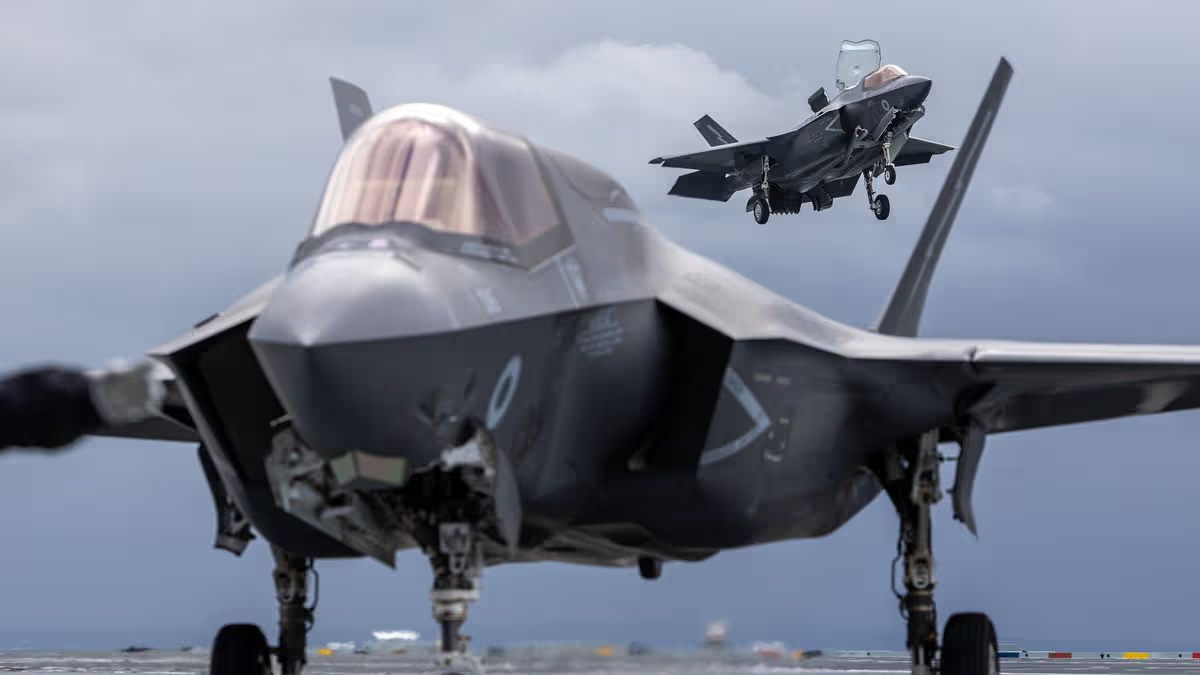
These are armed with F-35B Lightning fighter jets and could in theory carry 73 each, even though the UK only has 48 of these globally most potent fighter bombers. A further 15 of the F-35B’s are being bought and the UK also has squadrons of at least 120 Typhoon Eurofighter jets, provably brilliant air-to-air and air-to-ground attack fighters.
So how does Britain in the coming years deploy the number of troops it would need to wage war against attack from Russia? It is likely the UK would not be alone and would invoke NATO article five which means an attack on one state is an attack on all. So other member states would hopefully join the UK war efforts, whilst Britain may not rely any longer on help from the US.
The first wave to the front would be the professional fighting force of the Army, backed by the RAF warplanes and Navy vessels. Army reserves would immediately, according to sources, begin an intensive basic training for mobilised recruits, which would number some 500,000 in the first year.
Year two, including survivors of the first mobilisation, would see well over a million troops deployed. In year three well-over two million including previous deployed and year four would see well over three million mobilised troops including survivors of previous deployments.
The mathematics are brutal. Our arch threat Russia, by far the biggest danger to the UK in the short-term, is prepared currently to lose 1,000 troops-a-day on the Ukraine front. But increasingly the UK government is warning war may be coming and the UK has to wake up to dark times ahead.