US lawmakers across party lines on Wednesday renewed calls for stronger global action against terrorism, with Congressman Brad Sherman urging Pakistan to act against groups like Lashkar-e-Taiba (LeT), which has been linked to the 2025 Pahalgam terror attack.
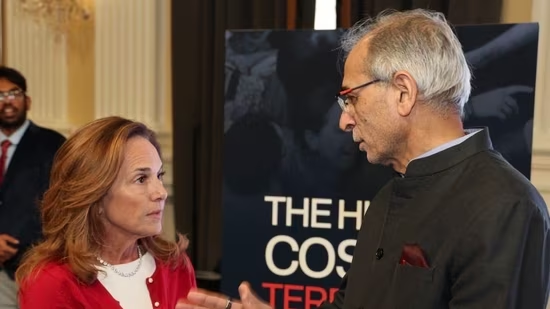
Speaking at an exhibition organised by the Indian Embassy at Capitol Hill on the “Human Cost of Terrorism”, Sherman remembered the victims of the Pahalgam attack on its first anniversary, where 26 people were killed.
“The attackers, identified as The Resistance Front, targeted innocent people, reportedly separating victims by religion. The group is widely seen as linked to Lashkar-e-Taiba, which has found sanctuary in Pakistan,” Sherman said at the exhibition on Wednesday evening.
“We must use this moment to demand that the Pakistani government clamp down on Lashkar-e-Taiba, Jaish-e-Mohammed and other terrorist groups,” the Democrat leader said.
The exhibition comes at a time when Pakistan is positioning itself as a peacemaker, mediating efforts to end the seven-week US-Iran war. It was attended by lawmakers from both Democratic and Republican parties.
Also Read | Pahalgam horror: Inside story of how India hunted terrorists & what security forces need to work on
Digital showcase highlights other attacks too
The digital showcase highlights major terror attacks across the world, including the 1993 Mumbai bomb blasts, the 2008 Mumbai terror attacks and the Pahalgam attack, and identifies the groups responsible, including Pakistan-based outfits such as Lashkar-e-Taiba.
“The special exhibition essentially serves to remind us of a few things. One, the scourge of terror upon humanity remains determined to destroy our societies. Countries around the world need to come together and remain resolute in defeating terrorism,” India’s Ambassador to the US Vinay Mohan Kwatra told reporters.
Kwatra said Prime Minister Narendra Modi has been clear about India’s unwavering resolve to deal with and defeat the scourge of terrorism.
Lawmakers who attended the exhibition included Michael Baumgartner, Bill Huizenga and Lisa McClain (all Republicans), and Julie Johnson, April Delaney, Ro Khanna, Raja Krishnamoorthi, Jamie Raskin, Shree Thanedar and Jonathan Jackson (all Democrats).
“We can share intelligence, ideas, policies and information to fight this threat jointly. When you work in silos, it is harder to coordinate and respond effectively. Through partnership, we can combine what each side is doing and build on what works,” McClain, chair of the House Republican Conference, said.
“That is the right way forward: working hand in hand, sharing information, learning from each other and acting together,” she added.
The exhibition used images, artefacts and narratives to depict lives disrupted and altered by acts of terrorism.
Also Read | One year since Pahalgam terror attack, tributes pour in: ‘We stand united’
US leaders on ‘global threat’ and ‘everyone’s problem’
“Leaders like Atal Bihari Vajpayee were warning about this threat back in the 1990s, but very few people took him seriously. After the September 11 attacks, the United States realised terrorism is not confined to one region; it spreads and threatens freedom around the world,” Khanna said.
“What Prime Minister Vajpayee said years ago was true: this is a global threat,” he added.
“I look forward to continuing to work as a co-chair of the caucus to support intelligence sharing, defence cooperation and the fight against terrorism, while standing up for freedom and democracy around the world,” Khanna said.
Congressman Richard McCormick described terrorism as a “unique evil” threatening both India and the US.
“We face extremist forces that seek to crush those who think differently and reject freedom, self-determination and unity. That is our common enemy,” McCormick said.
“Terrorism is everyone’s problem. Those who try to destroy our diversity through violence, and who do not accept us for who we are, are the true enemy. I stand with you, and I look forward to working together. We will have peace through strength,” he said.
May 7 and India’s Operation Sindoor
On May 7, 2025, India launched Operation Sindoor, targeting terror infrastructure across Pakistan and Pakistan-occupied Kashmir. The operation struck nine sites, including headquarters and training centres of LeT and Jaish-e-Mohammed, from where attacks against India were planned and directed.
Pakistan later launched counter-offensives, with the military conflict between the two nuclear-armed neighbours lasting nearly 88 hours before both sides reached an understanding on the evening of May 10.