Months after Nancy Guthrie disappeared from her home in Tucson, Arizona investigators are taking a fresh look at key evidence and hoping new DNA technology could finally bring answers in the case.
NewsNation reported on Friday that DNA samples, including hair from Guthrie’s home in Tucson have been sent to the FBI lab for further testing. This evidence was already tested at a Florida lab working with the Pima County Sheriff’s Office but investigators are now hoping that whole genome sequencing could lead to a breakthrough.
What is whole genome sequencing and why does it matter?
Whole genome sequencing is different from regular DNA testing. It can extract DNA even from a strand of hair without the root which means even small samples can be useful. This same technology helped solve the Gilgo Beach serial killer case involving Rex Heuermann, who admitted to killing eight women between 1993 and 2010 and pleaded guilty earlier this month.
Genetic genealogist Cece Moore of Parabon Nanolabs in Virginia told Fox News that, “I am pretty confident that they will want to use the lab that they have been extremely successful with, which is Astrea. DLI has been working to refine their own rootless hair analysis, but I haven’t seen any successful cases from them yet.”
She was referring to DNA Labs International, the Florida lab where the Pima County Sheriff’s Department first sent the DNA samples after Guthrie’s suspected abduction.
Moore added that the FBI trusts Astrea’s work. “The FBI used them for the Gilgo case. So they have a lot of confidence in Astrea,” she added.
Cece Moore also explained to NewsNation that, “Genetic genealogy came in 2018. The ability that Dr Ed Green created to extract this profile from rootless hair is even newer than that. So it’s another leap forward that opens up a lot more cases to potentially be solved.”
She also said that since the Guthrie case is still active, the DNA testing will be done quickly. “Sometimes they can get DNA the first time around, and sometimes they have to go through several attempts before they can get that viable profile,” she said.
Also Read: Nancy Guthrie update: PCSD clarifies FBI role in ongoing DNA analysis; ‘not new information’
Why experts say DNA is important?
Former CIA officer and FBI Special Agent Tracy Walder told NewsNation’s “Elizabeth Vargas Reports” that DNA evidence is very important in this case because there is not much other forensic evidence available.
“We need this information to be able to rule people out or rule people in, in this case. So, in a case like this, where we really actually don’t have a lot of digital forensic evidence, which obviously the FBI is very good at, really, this becomes very, very important,” Walder said.
She also pointed out that there is very little video or phone-related evidence. “We have a clear lack of video forensic evidence, as we have seen, as well as really phone and those kinds of forensic evidence and so I think in this case, there’s no question that that hair is going to be important in terms of ruling whomever that is in or out and the FBI is going to probably have to investigate if they can get a hook on who it is,” she added.
Also Read: ‘Nancy has been located’: Sheriff’s department faces backlash after ‘misleading post’ causes confusion in Guthrie search
What happened to Nancy Guthrie?
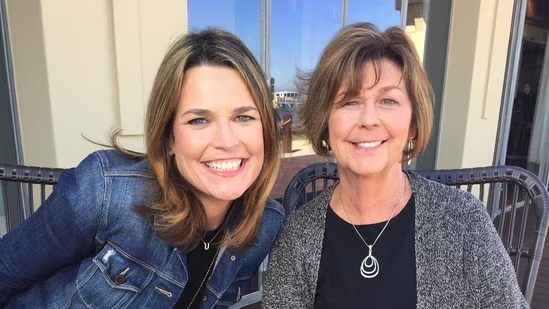
84-year-old mother of ‘Today’ co-host Savannah Guthrie disappeared from her Tucson home in Arizona on February 1. Authorities believe she may have been targeted before she was taken from her home.
Some of the DNA evidence has already been tested but has not helped identify a suspect. Blood found on the front porch was confirmed to be Nancy Guthrie’s. A glove found about two miles from her home, similar to one seen on a masked person in doorbell footage, also did not match any known criminals in the FBI’s CODIS database or any other DNA from the house. Pima County Sheriff Chris Nanos said the DNA so far has not led to any suspect in the kidnapping.
So far, there is no development in the case as investigation goes on.