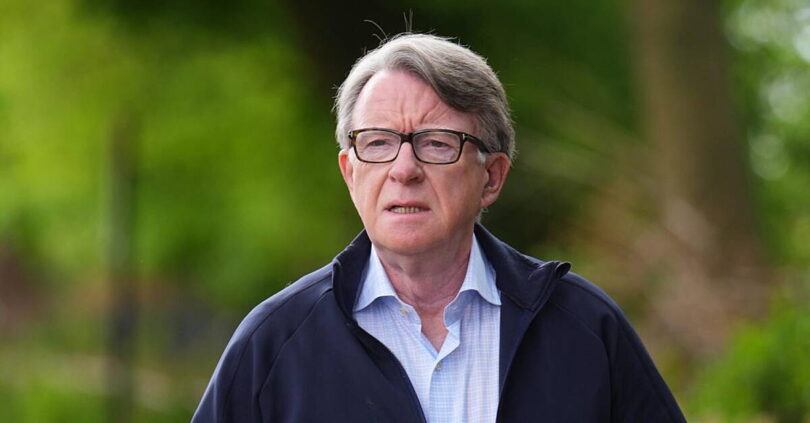
Sacked Foreign Office civil servant Olly Robbins has given bombshell evidence to MPs about the decision to grant Peter Mandelson security clearance as US ambassador despite red flags in his vetting.
Here are the key points from Sir Olly’s appearance before the Commons Foreign Affairs Committee (FAC) on Tuesday:
– ‘Constant’ pressure from Downing Street over the process
Robbins said there had been “constant chasing” from the private office at No 10 while vetting took place after Mandelson was announced as Keir Starmer’s pick for the Washington job.
The former civil servant, who was effectively fired for not passing on that the ex-Labour grandee had failed background checks carried out by UK Security Vetting (UKSV), would not disclose who had been involved.
But he said there was an “atmosphere of pressure” and a “dismissive” approach from Downing Street, suggesting there was “never any interest, as far as I can recall, in whether, but only an interest in when” the appointment had been cleared.
– Peter Mandelson was a ‘borderline’ case
Robbins said he had been briefed that UKSV considered the peer a “borderline” case but it was leaning towards recommending clearance be denied.
The risks identified did not relate to Mandelson’s relationship with paedophile financier Jeffrey Epstein, Robbins added.
– Cabinet Office ‘suggested vetting might not be needed’
The former senior official told MPs there had been a “debate” between the Cabinet Office and the Foreign Office over how to send Mandelson to Washington with the appropriate clearance.
“A position taken from the Cabinet Office was that there was no need to vet Mandelson,” Robbins said.
“He was a member of the House of Lords, he was a privy counsellor, the risks attending his appointment were well known and had been made clear to the Prime Minister before appointment.”
But the Foreign Office “put its foot down” and followed the process, Robbins said.
– Robbins ‘ordered not to tell Foreign Secretary Doyle was being considered for diplomatic role’
The former official also revealed that No 10 had been interested in making Doyle an ambassador, but that he was under “strict instruction” not to tell the Foreign Secretary, which he said made him “uncomfortable”.
Robbins said he had warned it would be “hard for me personally to defend” giving a role to the peer at a time when experienced diplomats were at risk of losing their jobs under potential departmental restructuring that was being discussed.
Mandelson was also asked about the prospect of a diplomatic role in Washington for Doyle, Robbins suggested.
– Records ‘unlikely to exist’ for every discussion with No 10
Robbins faced scrutiny from MPs over the extent of note-keeping on the appointment process.
He told the FAC that “I doubt there’s a record of every phone call” between No 10 and the Foreign Office while vetting was under way, arguing there may not be a need to make a note if the message was “not telling the department anything new”.
He also said he had not felt “under any obligation” to tell anyone immediately after Mandelson was granted security clearance because the decision would become apparent when he was imminently sent a contract to sign.
Committee chairwoman Emily Thornberry told him he was under an obligation to “keep accurate minutes and notes of decisions that you make, of actions that you take, and your reasoning”.
Robbins said he could probably “recite the (Civil Service) code” by memory and had “abided by it”.

– Robbins ‘never saw form’ showing Mandelson failed vetting
MPs said UKSV had ticked two red boxes on Lord Mandelson’s form, meaning they had “high concern” and recommended “clearance denied or withdrawn”.
But Robbins said he had never seen the document and had been briefed by Foreign Office security staff that the agency was leaning towards recommending clearance be rejected.
– Clearance decision ‘rigorously independent’ from pressure
Robbins was asked whether political pressure may have filtered down to the team with whom he was discussing the vetting, and whether the options presented to him were reached independently of this pressure.
“I am very confident in answering they will have been – they are clever people – they would have been very aware of the pressure,” he said.

“I also have complete confidence that their recommendations to me, and the discussion we had and the decision we made, was rigorously independent of that pressure.”
– Leak was ‘breach of national security and prosecutions should follow’
Robbins said it was deeply worrying that the story of Mandelson failing vetting was given to The Guardian within days of the Cabinet Office briefing Number 10 on the issues.
“I’m not making accusations at anybody, it’s not my business to do so,” he told the committee, adding: “I hope they’re being very rigorously investigated, and that prosecutions will result, because this is a grievous breach of national security.”
– Mandelson ‘should have been vetted before being announced as Washington pick’
Robbins said it would have been better for security clearance to be decided before the peer was public announced as Starmer’s pick for the Washington job.
“That’s a very, very sensible position to be in and it’s what I would have advised in this case too,” he told MPs.
Removing Mandelson from the process and trying to change the person nominated for the role would have caused problems because the US had already agreed the peer as an acceptable candidate while Joe Biden was still in office, he said.