THE US-IRAN CONFLICT has revealed something that many outside observers—and perhaps even some within—had underestimated: Iran’s strategic doctrine of resilience is not just rhetorical. For years, terms such as the “resistance economy”, “distributed deterrence” and “self-reliance under pressure” were often dismissed, both abroad and domestically, as political language rather than strategic reality. Yet in the face of sustained confrontation with a vastly superior military and economic power, these ideas have proven coherent in practice. The Iranian state did not fragment. The war did not paralyse the economy.
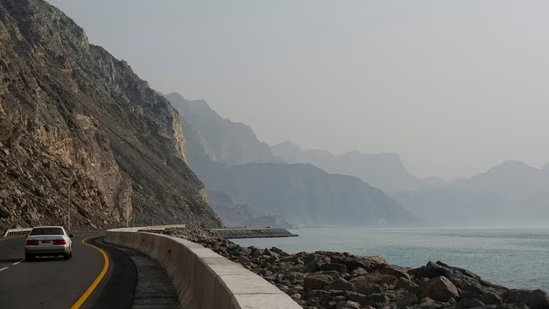
FILE PHOTO: A car rides along the coast of Musandam overlooking the Strait of Hormuz amid the U.S.-Israeli conflict with Iran, Oman, March 2, 2026.REUTERS/Amr Alfiky/File Photo (REUTERS)
This does not constitute victory in the conventional sense, nor does it negate the very real costs borne by the country and its people. But it shows Iran’s ability to absorb shock and maintain agency under intense pressure. The conflict has also shown that Iran is not a geopolitical actor that can be coerced through force. Its geography alone—bridging Central Asia, the Persian Gulf and major trade corridors—makes it difficult to isolate. Its institutional depth, built over decades under sanctions, has created a system capable of adaptation.
The question now is whether the doctrines that enabled endurance are sufficient for what comes next. A temporary cessation of hostilities has opened a narrow window—though recent developments show how quickly progress can stall or reverse, reinforcing the need for a framework that does not depend on momentum alone.
On one side, America has articulated a series of demands focused on nuclear restriction, missile constraints and regional de-escalation, tied to phased lifting of sanctions. On the other, Iran has set out its own framework: lifting of sanctions, security guarantees against further attack, and recognition of its sovereign rights, including its role in safeguarding regional waterways.
A workable framework is one that synchronises obligations. Instead of requiring Iran to act first and wait for relief, or America to concede in advance, steps are taken in parallel. For example, a freeze in uranium-enrichment levels can coincide with the immediate restoration of limited oil exports and banking channels. Verification mechanisms can be introduced alongside phased access to global financial systems.
Not all issues need to be resolved immediately. The most sensitive—such as long-range missile parameters or the long-term structure of the nuclear programme—can be stabilised initially and negotiated in detail later. This is consistent with how complex agreements are reached elsewhere.
Another element is prioritising a return to normal economic relations. The ability for Iran to export oil at scale, reconnect to international banking systems and attract investment into sectors such as petrochemicals, transport and manufacturing would have immediate effects. These, in turn, would reinforce compliance. Economic normalisation, therefore, is not a concession; it is a stabilisation tool.
For capital to flow will, above all, require stability: confidence that trade routes will remain open, agreements will be honoured and geopolitical risk will remain contained.
Nowhere is this more visible than in the Strait of Hormuz. The waterway is not simply a lever of geopolitical influence—it is one of the most critical arteries of global energy supply. The temptation to use such a position for short-term extraction, through tolls or restrictions, is understandable. But it is ultimately self-defeating. Any attempt to monetise transit in this way would accelerate efforts by others to bypass the strait, eroding its long-term strategic value.
A posture that guarantees open and secure passage, by contrast, positions Iran as a steward of stability. It builds trust not only with neighbouring states, but with global markets. It signals that Iran’s strength will be exercised through reliability, not coercion.
The alternative is clear. If Iran is perceived as a powerful but unpredictable actor, its neighbours will seek protection and alignment elsewhere. If it is seen as a stable and constructive centre, those same neighbours will be drawn towards economic integration. And that integration—through energy co-operation, transport networks, joint industrial projects and financial linkages—could boost economic growth across the region.
This is the point at which strategy must evolve. Iran has shown that it cannot be subdued through force. The next chapter is whether it can become a destination for capital, a hub for regional trade and a platform for industrial growth. These are not separate objectives. They are the modern foundations of power. The transition from deterrence to attraction is therefore not a concession, but can be made wisely as a strategic progression. It replaces short-term leverage with enduring influence. It positions Iran not only as a resilient state, but as an engine of regional development.
As they weigh their options, Iranian negotiators might also reflect that, financially, their country is in many ways singular, in a positive sense. Iran has no external debt; the story overseas is of assets, many of them frozen, not liabilities. And it has trillions of dollars-worth of oil to back any debt it may issue in the future. This underlines the point that digging in its heels over controlling the Strait of Hormuz is penny smart, dollar foolish.
Ali Amiri is an Iranian industrialist and investor.