Iran, which is yet to complete talks with US negotiators, is holding another card it could use to further disrupt the global economy if Islamabad talks turn sour
Cost of living fears sparked by Donald Trump’s war with Iran have been ratcheted up to a new degree as the defending regime eyes closing a second strait – which it could use to inflict maximum economic damage on western economies.
Uncertainty around the status of the Strait of Hormuz, the critical trade artery Iran has kept largely shuttered since entering a ceasefire with the Trump administration, has meant that prices of crude oil – and oil-based products like petrol – have remained sky-high. While peace deal negotiations are set to resume today in Islamabad, the capital of Pakistan, leaders on both sides of the divide have been flexing their muscles.
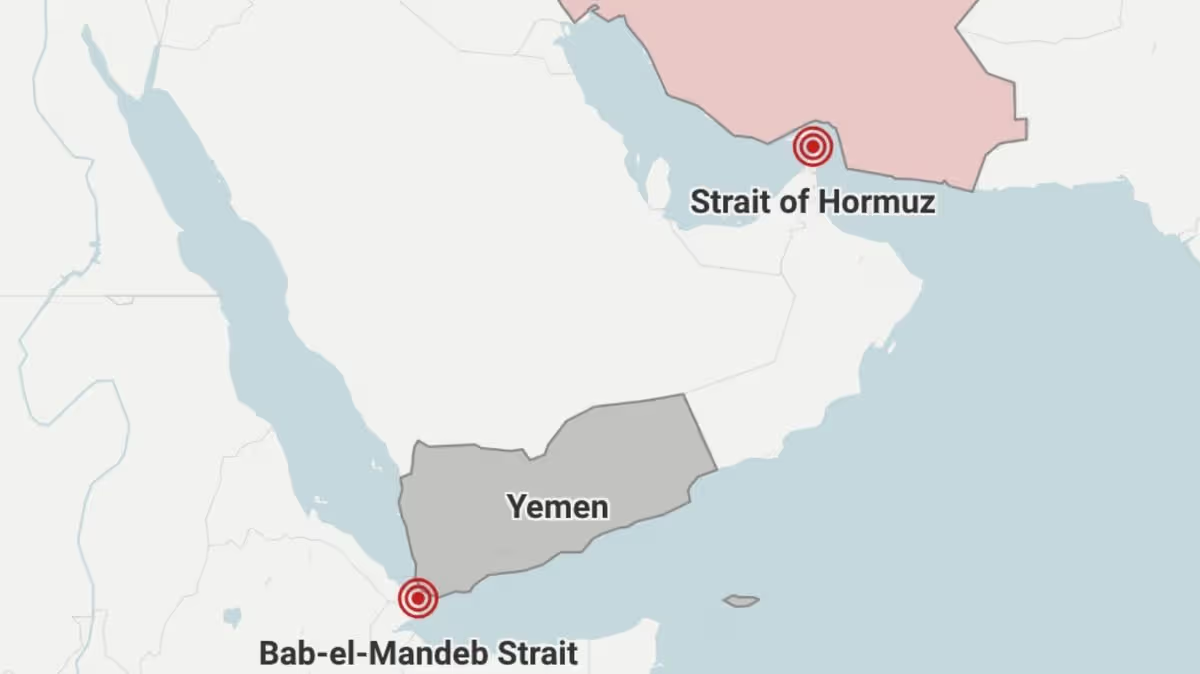
In Iran’s case, those muscles come in the form of the Hormuz strait and its western twin, the Bab el-Mandeb Strait, which translates to “Gate of Tears” in English, has become a critical alternative.
READ MORE: Iran war live: Trump says Starmer has ‘time to recover’ as Islamabad talks loomREAD MORE: Iran still has huge stockpile of weapons despite Trump’s claims he’s winning war
The Bab el-Mandeb Strait is being used as an alternative shipping passage while Hormuz is closed, with hundreds of ships passing through the area every day while traffic stalls in the latter. Unlike Hormuz, however, Iran does not have direct control over the alternative route, which is several thousand miles to the west, off the coast of Yemen.
The strait is however controlled by Iran-aligned Houthi rebels, who, a UK intelligence assessment report seen by the Mirror, states, have threatened to shut it down.
The report, which also warns that Iran is still bristling with ballistic missiles and a significant chunk of its drone arsenal, also outlines the importance of the alternative strait. It states: “US intelligence assessments have suggested that Iran likely still has access to around 70 percent of its pre-conflict ballistic missile stockpiles, and around 60 percent of its missile launchers.
“It also still retains around 40 percent of its drone arsenal. A senior official from Yemen’s Houthis has warned that the group could close the Bab el-Mandeb Strait if US President Donald Trump continues what he described as obstructing peace.
“The Bab el-Mandeb connects the Red Sea to the Gulf of Aden and is a key shipping route for global trade, particularly oil and other fuels moving between the Gulf, Europe and Asia.” Yemeni officials are well-aware of the cards they hold, with Abed al-Thawr saying in late March that closing the strait is among the country’s primary options in the event that the war escalates.
Should they take this move, experts have warned, the implications for the global economy could be stark, as the closure would immediately impact massive oil exporters.
Noam Raydan, a senior fellow at The Washington Institute for Near East Policy, told TIME Magazine last month that any closure “similar” to the Strait of Hormuz would “put further pressure on the global economy. She said: “If anything major happens in a battlement that’s similar to the Strait of Hormuz, it will have massive ramifications on regional countries like Saudi Arabia that are right now relying on the Strait to ship crude oil specifically to Asian clients.”
“It’s going to also put further pressure on the global economy. It will be restricting the movement of several commodities via key chokepoints in the region.”