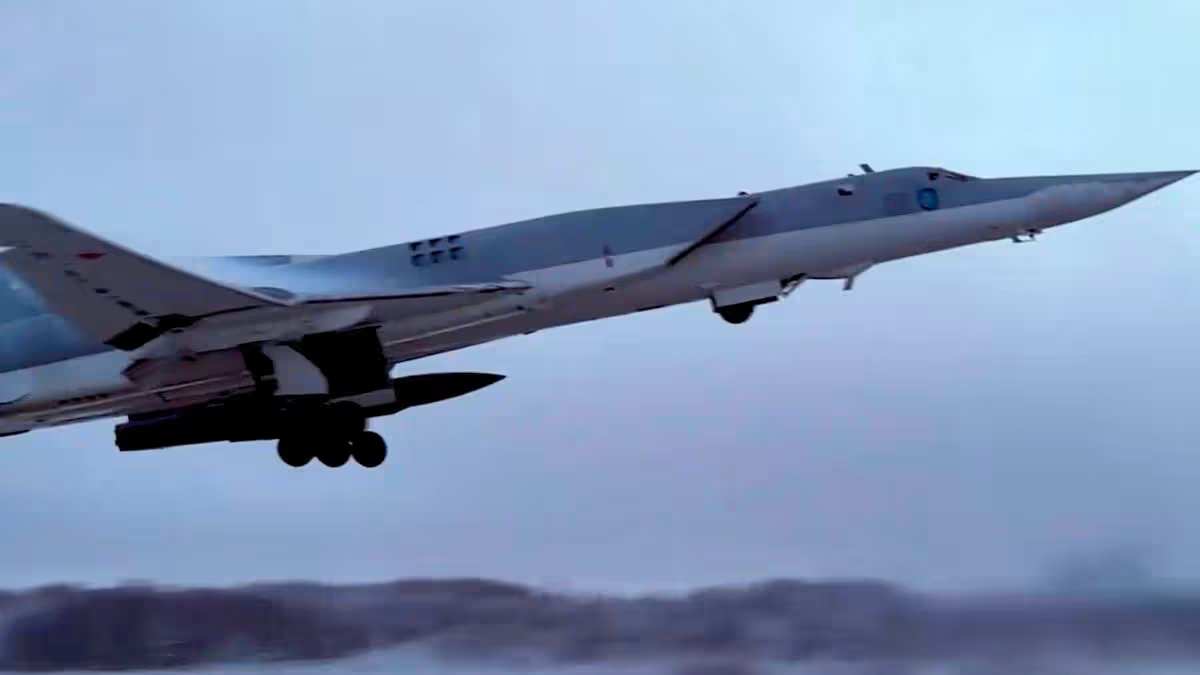
The Russian Defence Ministry confirmed Tu-22M3 long-range bombers were escorted by Su-35 fighters during a four-hour mission over international waters as tensions in the Baltic deepen
NATO warplanes were scrambled to shadow nuclear-capable Russian strategic bombers flying a mission over the Baltic Sea, as tensions in the region continue to run dangerously high.
Vladimir Putin’s air force flew the sortie over international waters, with the Tu-22M3 aircraft accompanied by Russian Su-35 fighter jets. The Russian defence ministry’s TV channel Zvezda acknowledged that NATO fighters had tracked the bombers. “At certain stages of the route, the aircraft were escorted by fighter jets from foreign states,” the channel reported. “All flights are conducted in strict accordance with international rules for the use of airspace.” An F-35, used by several NATO air forces, could be clearly spotted in Russian footage of the mission.
The Kremlin’s show of force came as Moscow levelled accusations that Finland and Baltic nations Estonia, Latvia and Lithuania had permitted Ukrainian drones to pass through their airspace to strike key Russian oil ports. Western nations have firmly rejected these allegations, as has Kyiv.
Nevertheless, senior Russian officials, including foreign minister Sergei Lavrov, have issued stark warnings to the West that Moscow could retaliate.
Russian security council secretary Sergei Shoigu invoked Russia’s “inherent right” to self-defence, in what many interpreted as a veiled threat of potential military strikes against Finland, Estonia, Latvia or Lithuania.
There are growing fears that Putin could put NATO’s Article 5 collective defence commitment to the test through a calculated, limited territorial incursion in the Baltic region – possibly targeting an island. Sweden’s Chief of Defence, Michael Claesson, has warned that Russia is plotting to seize an island belonging to a Western nation in the Baltic Sea as a direct challenge to NATO.
Among the larger islands considered to be at risk are Sweden’s Gotland, Denmark’s Bornholm, or Estonia’s Hiiumaa and Saaremaa.
Shoigu alleged: “Recently, there have been increasingly frequent cases of attacks by Ukrainian drones on Russia via Finland and the Baltic states. As a result, civilians suffer and significant damage is caused to civilian infrastructure.”
Either western air defences were “highly ineffective….. or the states in question are deliberately providing their airspace, that is, acting as direct accomplices in aggression against Russia”.
He insisted: “In the latter case, in accordance with international law, Article 51 of the UN Charter on the inherent right of states to self-defence in the event of an armed assault comes into force.”
Pointing to Ukrainian strikes that crippled the oil ports of Ust-Luga and Primorsk, another close Putin ally Nikolai Patrushev – a former FSB security service chief – accused NATO members of being “complicit in these crimes”.
Hardline MP Andrei Kolesnik declared that Shoigu was delivering a “final” warning, backed by Putin’s authority, cautioning that Baltic states should not make the “mistake” of acting with “impunity” against Russia.