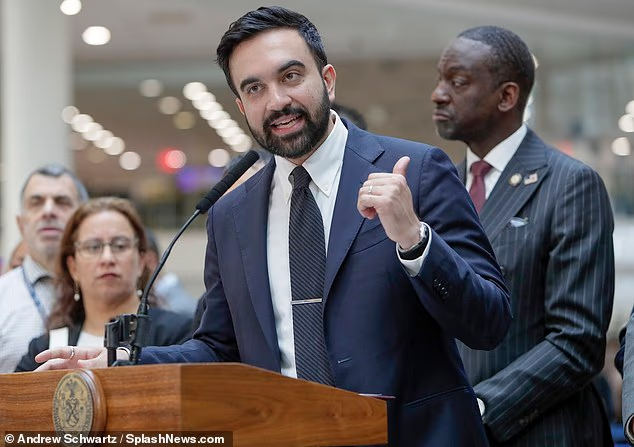
When Tony Bloom took the microphone inside the Brighton Museum and Art Gallery to open a new exhibition about his club’s first European adventure, he made it clear he did not expect it to be the last.
‘We don’t want this to be a one-off,’ said Brighton chairman Bloom. ‘We have huge ambitions to carry on. We want to make this a regular thing, to bring people joy, playing great football, working hard to bringing success to our club and city.’
This was October 2024, early days under Fabian Hurzeler and the proceeds of the Europa League windfall after making the last 16 where they lost to Roma were helping improve training ground facilities, the women’s team and a new £7million fanzone at the Amex Stadium.
Eighteen months on and Brighton fans are eyeing their passports again. Five wins in six games have banished the discontent around one win in 13 Premier League games from the start of December.
Hurzeler’s team, who go to Tottenham on Saturday, are back on a healthy roll and only two points behind misfiring Chelsea who are sixth with 48 points.
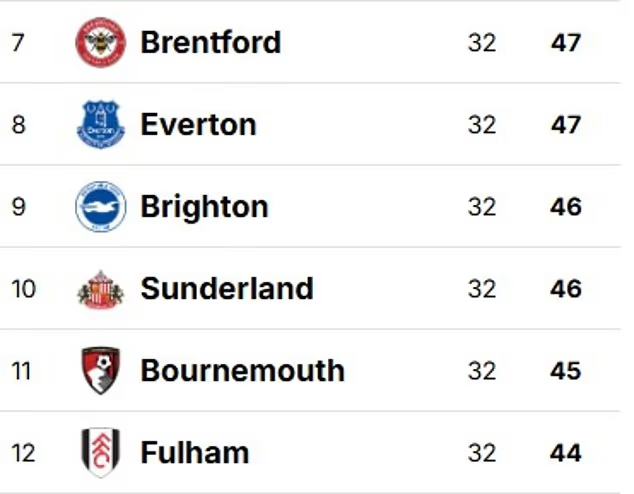
Europe beckons and with six to play others will feel the same. Brentford and Everton are best placed on 47 points. Sunderland trail Brighton on goal difference but also with 46 points. Bournemouth are one point behind on 45 and Fulham a point further adrift.
All within striking distance of sixth, which guarantees a place in next season’s Europa League if they finish with a flourish. Seventh or eighth might be good enough, depending who wins the FA Cup and the Europa League.
‘It is not, because we are 10th,’ said Sunderland boss Regis Le Bris, when asked if Europe was in his thoughts after beating Spurs on Sunday. ‘The main objective was to stay in the league and is now achieved. And the vision is to be a consistent Top 10 Premier League club. After that sometimes you can reach another level, we’ll see.’
It is straight from the Brighton playbook, to be consistent, stick to principles, don’t get carried away and don’t panic in the difficult times which are only ever a couple of injuries away.
Set these standards and there might be chances to strike when the established elite make mistakes or the equilibrium disturbed.
Brighton did it when finishing sixth in 2022/23, a season split by the World Cup in Qatar. West Ham finished sixth above Spurs and Arsenal in 2020/21, the first season after the covid pandemic with lockdowns in force and empty stadiums.
Aston Villa and Newcastle, who are the most financially ambitious of challengers and in a different tier to the likes of Brentford and Sunderland, have proved the Premier League’s traditional Big Six can be disrupted.
Villa are about to finish above Spurs for a fourth successive year.
The ‘middle six’ are battling for the chance to play European football next season

Brighton fans are eyeing their passports again after their 2023-24 Europa League campaign
Everton with their history, identity and fanbase might think they can create a similar momentum propelled by new owners and the financial power of a new stadium, which is about to host its first Merseyside derby.
David Moyes can be the strong and stabilising force Unai Emery and Eddie Howe have been.
The Big Six is not what it was. The Big Six were the top six for three years in a row after Leicester embarrassed them all by winning the title in 2016.
Chelsea won it the year after Leicester with 93 points and a team we now know was built with the help of illegal payments.
The Big Six amassed a collective 477 points in 2016/17. Then came City titles with 100 points and 98 points, the first two of their five in six years.
The Big Six were the top six again in 2021/22 but not since. And last season were down to a collective 378 points with Manchester United and Spurs in 15th and 17th respectively.
This season, five years on from the failed breakaway European Super League and with Spurs fighting to avoid relegation, the Big Six are projected to be sub-400 again and the title winners will be sub-90 points.
All of which creates space for others to grow, including the upwardly mobile new order of Brighton, Brentford and Bournemouth with their enviable data led recruitment and development strategies and modern working cultures.
And others, including Fulham established again in the Premier League and Sunderland back up with what seems to be a good formula and some smart signings.
Villa forge on under Emery but Newcastle have hit trouble, kept in check by Profit and Sustainability rules and the natural handicapping system of European football which is like an extra object thrown to a juggler.
Europe brings prestige and money but also pressure. Success attracts interest in players. More games, travel and emotional strain cause fatigue which can develop into injuries and inconsistent form which can trigger kneejerk reactions.
Be they managerial hirings and firings or panic buys and recruitment decisions out of line with best practice. They can make it everything even worse and once the chain of events is in motion can be hard to stop.
Newcastle, Crystal Palace, Nottingham Forest and Spurs have all found it tough to balance European football with domestic ambitions this season.

Brentford are among the surprise challengers for Europe after a superb season in the league
In trying times, it is more difficult to keep faith in the plan with the clarity to remember who you are and what it is you are trying to achieve and the bigger the club the more scrutiny there is and the more noise erupts. Spurs have lost their way. Chelsea might be doing the same.
Manchester United salvaged this season but questions lie ahead when they are back in the Champions League.
Brighton might be built to handle this better than others. Bloom with his clear vision and unyielding belief in the power of his algorithms was a steady and reassuring influence when Hurzeler was feeling the heat from fans in midseason.
His reward might yet be the return to Europe he promised, but it is shaping up to be quite a scramble over the next month for those clustering just outside the top six.