IN RECENT YEARS the sovereign-wealth pots of the six members of the Gulf Co-operation Council (GCC) have bestridden the world of investing. The hydrocarbon kitties of Bahrain, Kuwait, Oman, Qatar, Saudi Arabia and the United Arab Emirates (UAE) have between them deployed more than $430bn in capital since 2021. For every petrodollar they invest, 75 petrocents ends up abroad, in everything from artificial-intelligence darlings and private credit to Premier League football clubs and TikTok. They oversee over $5trn of assets globally, up from $3trn in 2021.
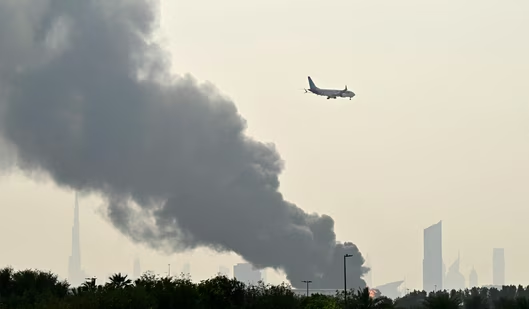
An Emirates aircraft flies past plumes of smoke from an ongoing fire near Dubai International Airport in Dubai on March 16 (AFP FILE)
Those farsighted efforts to plan for life after fossil fuels are suddenly being disrupted by the brutal reality of war. Iran’s retaliatory strikes against American allies in the region have already destroyed $25bn-worth of oil and gas infrastructure, according to Welligence, a consultancy. This will need to be rebuilt—and maybe supplemented with spending of $30bn- 50bn on pipelines to bypass the Strait of Hormuz, over which Iran has proven its grip. Amid growing regional instability, GCC countries will also need to spend more on defence, not least to restock interceptor missiles and other munitions. And all this needs to happen as their economies slow because of disruptions to economic activity, including energy exports. Dubai (part of the UAE) has already announced a stimulus package for businesses.
The deep-pocketed funds will almost certainly be expected to foot some of the bill, as they did in past crises. During the pandemic the Abu Dhabi Investment Authority (also from the UAE) withdrew $24bn and the Kuwait Investment Authority withdrew $25bn, equivalent to 3-4% of their assets under management, estimates Diego López of Global SWF, a research firm. Emirati and Qatari funds with stakes in their countries’ flag carriers bailed out the airlines to the tune of $4bn.
Such large capital calls tend to mess with funds’ target allocation and restrict investment in other asset classes in the following years, Mr López observes. And this time the exercise will be even more delicate. For one thing, over the past five years the funds have invested more in illiquid private assets. Emirati and Saudi vehicles have poured nearly $100bn and some $40bn, respectively, into AI startups and data centres. Between 2021 and 2025 about $140bn in GCC sovereign wealth went into property and infrastructure, and perhaps $80bn into private credit. Such investments are harder to liquidate in a pinch than bonds or public equities. Some of them could be sold only at a steep loss.
Other investments are tied to foreign-policy goals, such as ensuring food security and critical minerals. If funds sign deals as part of arrangements between governments, these, too, can be hard to unwind. The UAE’s kitties own stakes in mines and farms in several African countries. Saudi Arabia’s Public Investment Fund (PIF) has backed mining businesses in Brazil and agricultural ones in South-East Asia.
The last complication is the funds’ growing exposure to national ambitions to move GCC economies beyond petroleum. L’Imad, a vehicle created by Abu Dhabi in January that absorbed ADQ, the emirate’s existing wealth fund, has large stakes in national infrastructure operators, including TAQA, a utility, AD Ports Group, a port operator, Abu Dhabi Airports and Etihad Rail. Another Abu Dhabi pot, Mubadala, is funding the expansion of Al Maryah Island, the emirate’s financial hub, and Masdar, a renewable-energy firm.
As Iranian projectiles dent the allure of the wealthy Gulf states for foreigners and their money, domestic investments suddenly look rather risky. Diminished airline traffic through the region is already weighing on the income statements of local airport operators and airlines. Average occupancy and daily rates at luxury hotels in the funds’ portfolios have dropped every week since the war began. Emirates Global Aluminium, a big smelter co-owned by Mubadala and Investment Corporation of Dubai, has said it could take up to a year to repair the damage from missile debris. Property companies such as Aldar, also partly owned by Mubadala, face plummeting residential sales and leasing activity. All this is stanching cashflows and will decrease the dividends such businesses pay out to the funds.
Some of the region’s more pharaonic projects already seemed to be on shaky ground. In January construction was suspended on the Mukaab, a colossal cube-shaped skyscraper that was the centrepiece of a $50bn residential and commercial district in Riyadh, the Saudi capital. The war makes resumption of the project unlikely. In March, weeks into the conflict, Saudi Arabia cancelled some contracts for Trojena, a desert ski resort, and The Line, a futuristic wall-shaped city. At least for the PIF, which has backed many Saudi initiatives, big write-downs are inevitable.
At an investment jamboree organised by the PIF last month in Miami, the fund’s boss, Yasir Al-Rumayyan, was hoping to attract more foreign investment to the kingdom. “In the past, we tried to bring Saudi to the world,” he told a crowd of finance grandees. “Now we are in a stage where we want to bring the world to Saudi.” Given the various projects’ stumbles, that was already going to be a tough sell. The threat of periodic Iranian attacks does not make it any easier. Investment bankers report that foreign contractors are retreating from various Gulf projects and some Western investors are getting cold feet.
Mr Rumayyan also stressed that the PIF remains committed to its investments around the world. “We measure our returns not in quarters, but in decades,” he insisted. Indeed, no one expects a fire sale of assets part-owned by the GCC funds. Most of them do not appear to be rushing for the exits for the time being. An investment adviser in Singapore notes that of six Gulf sovereign funds involved in deals intermediated by his firm, only one has pulled out in the past month. With domestic profits dwindling, reliable foreign income is all the more critical, he says.
That may be true. But it also suggests that the funds’ attention may turn from risky bets on the future to duller assets generating cash here and now. At home, meanwhile, more of their money will go to rebuilding the old economy rather than erecting a new one. The longer the war drags on—and the deeper the scars it leaves—the harder it will be for the funds to pretend that nothing has changed.