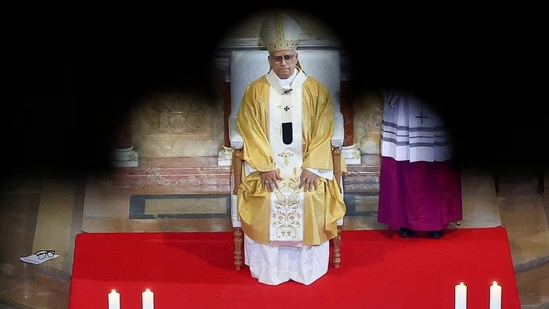
ROME—Not since Napoleon has a political leader taken on the pope as openly as President Trump. Like Pope Pius VII, who ultimately outlasted the French emperor, Pope Leo XIV is proving a challenging opponent for the president.
The mild-mannered pontiff from Chicago is facing the biggest test of his papacy in a fight with Trump over the Iran war—and he isn’t folding. So far, it is Trump—and not Leo—who has taken criticism from Roman Catholics in the U.S. and elsewhere over their public spat.
Trump accused Leo of catering to the left and posted an AI-generated image on Truth Social showing himself with Christ-like robes and healing powers, which offended the U.S. religious right. He later deleted the post.
Meanwhile, Leo has said he isn’t afraid of Trump and will continue to speak out against the war in Iran.
One of Trump’s challenges in dealing with Leo is that the pope isn’t a solo act like his predecessor Pope Francis, making it harder to dismiss or isolate the current pontiff, said Francesco Sisci, director of the Appia Institute, a Rome-based geopolitics think tank.
Francis was known for firing off provocative sound bites, but he sometimes alienated groups within the church—including American bishops.
Leo, by contrast, has been building broad support within the global church for his course, which combines advocacy for peace and dialogue with a stronger emphasis on traditional Catholic doctrines.
“This guy is systematic and methodical, he is active behind the scenes, and when he speaks, it’s the last step,” Sisci said. “Francis was a rock star, but Leo is the conductor of an orchestra.”
The growing disorder in world politics is an opportunity for the Catholic Church to repair its standing as a moral authority, which has suffered in recent decades from the long-running scandals over clerical sexual abuse, say some observers of the Vatican.
For Leo, “this is just a huge blessing,” said Sisci. “It’s wonderful for the church, all over the world, that he is the guy who can stand up to Trump.”
Leo is also considerably more popular in the U.S. than Trump, enjoying a 34 percentage point net-positive rating among registered voters, compared with a 12 percentage point net-negative rating for the president, according to a survey for NBC News in March.
White House spokeswoman Taylor Rogers said Trump had pursued policies that Catholics support, expanding religious rights, pardoning antiabortion activists and restricting medical treatments related to gender transition for minors.
“There has never been a greater president for Catholic Americans than President Trump,” Rogers said.
The public confrontation came after months of tensions between a U.S. administration that has sometimes presented its war with Iran as doing God’s work, and an American pope who is seeking to rebuild the Catholic Church’s moral authority in a war-torn world.
The clash between the world’s two most prominent Americans began over Trump’s hard-line immigration policies. It has escalated this year over the president’s growing use of military force—from Venezuela to Iran.
A drawn-out quarrel between the White House and the Vatican carries risks for both sides. But more of the risk is with Trump, say analysts of U.S. politics and religion.
The attack on the pope is alienating Catholic voters, who played a big part in his 2024 election victory, said the Rev. Robert Sirico, a Catholic priest and co-founder of the Acton Institute for the Study of Religion and Liberty in Grand Rapids, Mich.
“He’s put some of his strongest supporters in a very awkward position,” said Sirico, a self-declared conservative.
Said Ryan Burge, a political scientist at Washington University in St. Louis and a former Baptist pastor: “You’re seeing a lot of people who voted for Trump are reacting less favorably in the last couple of days, asking ‘why are you picking a fight with our pope.”
Catholics, who make up around one-fifth of voters, used to split about evenly in U.S. presidential elections, but around 56% of them backed Trump in the last presidential election, said Burge, compared with 42% who supported Democratic presidential nominee Kamala Harris.
Millions of Catholic voters still support Trump, but the level has slipped in recent months. A survey for Fox News in March found that 52% of Catholics disapprove of Trump’s performance.
To be sure, some conservative Catholics remain loyal to Trump. Robert “Bob” Unanue, the former CEO of Goya Foods who has been vocal about his Catholic faith and ardent support of the president, said Trump had a record of “saving and protecting life around the world” and had stood up for Iranian protesters killed by their government.
“If President Trump did not step in, the bloodbath would be even greater,” Unanue said in an email. “As the leader of the free world, he is the only person alive with the courage to stand up to protect and value life.”
Raids on immigrants by U.S. Immigration and Customs Enforcement, which have particularly affected Latino Catholics, are one source of disaffection. Leo and U.S. bishops have criticized the ICE crackdown for violating people’s dignity, which the White House has denied.
The advocacy group CatholicVote, which helped mobilize support for Trump in 2024, warned in February that “widespread distrust” of ICE among Catholics could cost the Republicans in midterm elections in November.
Trump isn’t backing down. On Tuesday, he repeated his criticism of the pope, telling Italian newspaper Il Corriere della Sera that Leo “shouldn’t talk about war, because he has no idea what’s happening” with Iran.
Vice President JD Vance, a Catholic who has expressed polite disagreement with the Vatican over immigration and foreign policy, took a less-confrontational approach than Trump on Monday, telling Fox News that occasional differences of opinion were natural. Still, the pope should keep to his core business, he said.
“I certainly think that in some cases it would be best for the Vatican to stick to matters of morality, stick to matters of what’s going on in the Catholic Church, and let the President of the United States stick to dictating public policy,” Vance said.
But Catholics say their faith has implications for public policy, from abortion to poverty to war and peace—and that these can be uncomfortable for all political parties.
“How to live the gospel in the real world?” Cardinal Michael Czerny, a senior Vatican official, said in a recent interview. “That is inevitably political. The role of the church hierarchy is to form people’s consciousness as much as possible in line with the gospel. When necessary we have to speak truth to power.”