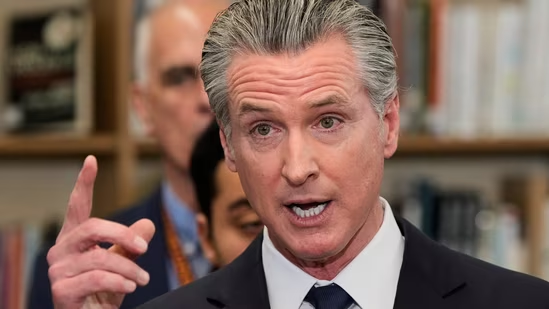
California’s already crowded governor’s race has been thrown into uncertainty after sexual misconduct allegations against Rep. Eric Swalwell derailed his campaign. This prompted fresh calls within the Democratic Party for Governor Gavin Newsom to intervene.
While the race is not formally his to manage, CNN reported that the political stakes, for both the state and Newsom’s own future, are raising questions about whether he will step in. He might also choose to continue to stay on the sidelines.
Why Newsom could step in
1. Risk of a Republican lockout
The most immediate concern among Democrats is the possibility that two Republican candidates could advance from California’s nonpartisan primary, effectively shutting Democrats out of the general election.
According to CNN, Newsom has been closely monitoring the situation, with one person familiar with his thinking telling the network he would “do everything he can to prevent a lockout.”
Swalwell was polling at around 17-19% before the controversy, but his exit has now shaken up the race. Advisers to several campaigns told CNN they are uncertain whether his support will consolidate behind a single candidate or fragment further.
Also Read: Did Gavin Newsom’s wife accidentally kill sister? Video of Jennifer Siebel empathizing with prisoners sparks backlash
2. Protecting his political legacy
As a term-limited governor with potential national ambitions, Newsom has a strong incentive to ensure a successor aligned with his policies. CNN noted that the next governor could either reinforce his record or scrutinise it in ways that may complicate his future plans.
3. Pressure from party leaders
Newsom has been fielding calls and holding meetings with top Democrats, including former House Speaker Nancy Pelosi. Party leaders are urging him to show leadership, even as there is no clear agreement on what that should look like.
Why Newsom may hold back
1. Reluctance to pick sides
Despite the pressure, Newsom has traditionally avoided endorsing candidates in crowded Democratic primaries. One person in his orbit told CNN that while many are asking him to “show some leadership,” he is “not someone who likes picking winners and losers inside his own party.”
2. No clear consensus candidate
Newsom had privately encouraged Sen. Alex Padilla to enter the race, seeing him as a strong unifying figure. CNN reported Padilla came close to running but ultimately declined, citing family considerations. The decision surprised Newsom and left the field wide open.
Also Read: Eric Swalwell resignation explained: What happens to California Governor race and congressional seat?
3. Concerns about the current field
The remaining candidates have struggled to generate strong enthusiasm. According to reports, he has reservations about several contenders, contributing to his hesitation in backing any one candidate.
4. Limited control over a fragmented race
Even if Newsom were to endorse someone, it is unclear how much impact that would have. Many candidates remain in the race despite low polling numbers, and ballots are already set, limiting the scope for consolidation.
There is also caution within the party after several Democrats withdrew their support for Swalwell following the allegations.
For now, Newsom appears to be taking a cautious stance: gathering data, consulting allies and assessing how the race evolves. His popularity among California Democrats remains strong.