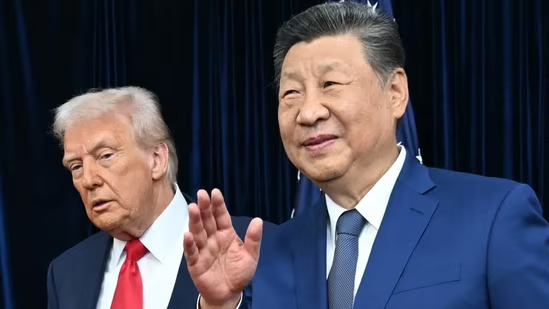
A month before President Trump’s scheduled trip to Beijing, China is ratcheting up pressure on the U.S., preparing legal tools for tit-for-tat retaliation against foreign companies it deems to be damaging Chinese interests.
Officials and state media said the measures were meant to send a message that China wouldn’t be pushed around by other powers and suggested Beijing wasn’t willing to compromise its interests to placate Trump ahead of his planned May 14-15 visit.
The Iran war is further complicating relations between the two superpowers. Chinese leader Xi Jinping issued a veiled rebuke to Washington this week, telling foreign dignitaries visiting Beijing that the world can’t return to the “law of the jungle” in which big powers run roughshod over international law.
This week, the Chinese Foreign Ministry offered a firm response to Trump’s threat to impose a 50% tariff if Beijing is shown to have supplied arms to Iran. A ministry spokesman, Guo Jiakun, said Tuesday that reports of Chinese military support to Iran were “purely fabricated” and “China will respond with countermeasures” to any new U.S. tariffs.
On trade, Beijing is responding to U.S. moves since the first Trump administration to curb China’s access to advanced technology and encourage companies to seek alternatives to China-based supply chains. China’s exports to the U.S. have declined, falling more than 26% year-over-year in March, as companies shift production of goods such as electronics and clothing to Southeast Asia and India.
New regulations released last week give Beijing more legal tools to resist such moves. Dated March 31, they empower authorities to investigate those who threaten China’s access to vital resources or who drop Chinese suppliers in response to political pressure. Penalties include restrictions on doing business and investing in China, as well as traveling to or from the country.
The regulations protect China from external pressures such as sanctions and other efforts to cut the country out of global production networks, said Wang Minghui, a researcher at a leading government think tank, in a post on the website of China’s Justice Ministry.
They mark “a crucial step in China’s efforts to counter the containment and suppression by the U.S. and the West,” Wang said.
The rules could put U.S. and other Western companies in a bind: They need to comply with U.S. restrictions on trade with China and often want to reduce their reliance on Chinese production, yet such actions expose them to punishment by Beijing and even possible expulsion from the world’s most important manufacturing hub.
The Chinese regulations feature vague provisions that make it hard for foreign businesses to judge what would trigger Beijing’s reaction—which may be part of the point. The lack of specificity leaves “open the possibility that several legitimate commercial decisions could be interpreted” as threatening Chinese supply chains, the European Union Chamber of Commerce in China said.
The rules require Chinese companies and research institutions to step up security protocols governing key technologies and data. And they hinted at a tighter leash on foreigners who analyze Chinese business, saying officials should police misconduct involving “information-gathering activities related to industrial and supply chains” in China.
On Monday, Beijing published another set of regulations against those who assert “unjustified extraterritorial jurisdiction” over Chinese entities and people.
Under these 20-point rules, offending foreign organizations and individuals would be added to a “malicious entity list” and face penalties including entry bans, expulsion and asset seizures. These rules also applied broad definitions on the kind of actions that would trigger punishment.
China has condemned the U.S. for asserting “long-arm jurisdiction” over Chinese companies and individuals, such as imposing sanctions to curb access to advanced semiconductor technology and penalize alleged human-rights abuses. Beijing has also accused Washington of citing “even the flimsiest connection” such as the use of an American bank to assert jurisdiction over transactions that don’t primarily involve the U.S.
The 20-point rules said Chinese entities targeted by such measures needed to seek Beijing’s approval before complying and could file lawsuits in Chinese courts seeking compensation.
In addition to these rules, Beijing recently opened investigations against U.S. trade practices in response to similar American probes.
Write to Chun Han Wong at chunhan.wong@wsj.com and Yang Jie at jie.yang@wsj.com