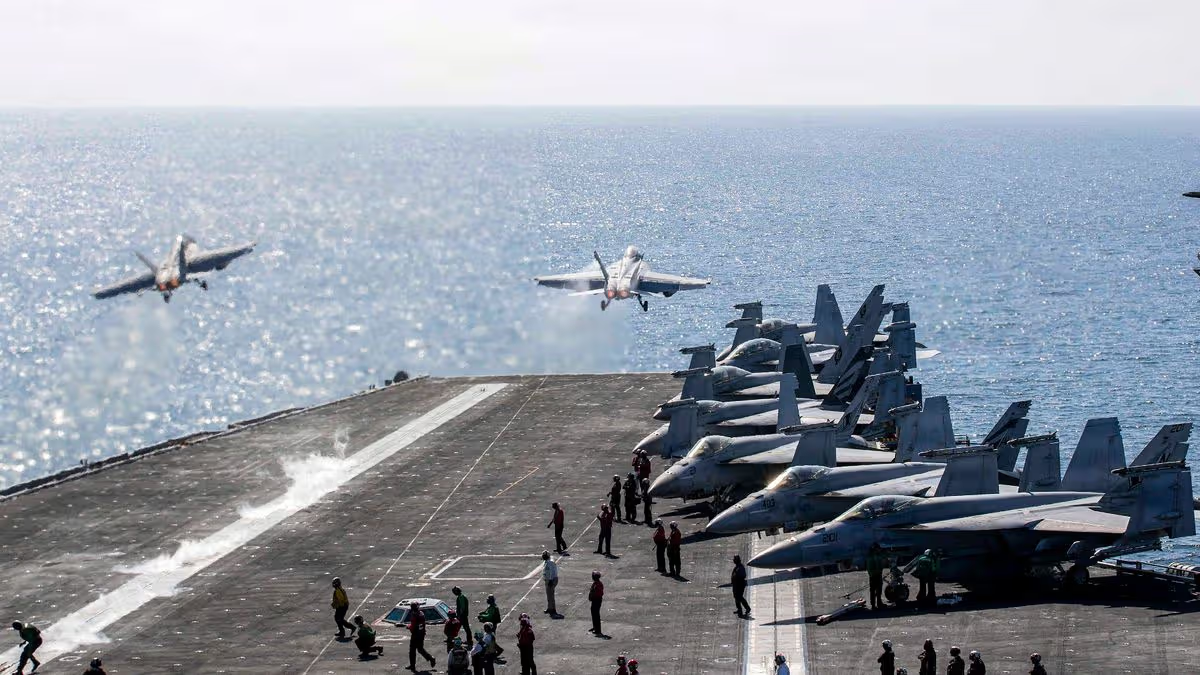
President Trump is pitching a U.S. naval blockade of the Strait of Hormuz as an opportunity for American oil-and-gas exporters. The squeeze on supplies is a bad omen for prices at the pump.
The U.S. plan to wrest control of the key waterway from Iran would potentially cut off the roughly 2 million barrels of oil that Iran has continued to ship through the Strait each day, most of which was headed to China.
With 20% of the world’s daily supply of oil and liquefied natural gas already trapped behind the Strait, Japan, South Korea and other Asian countries that rely on the Middle East are looking elsewhere to replenish their dwindling energy supplies. Here’s what that means for the U.S. energy market:
Will more countries turn to the U.S. for oil and gas because of the bottleneck in the Middle East?
Yes. On social media this weekend, Trump applauded a picture of a map showing a conga line of vessels sailing to the U.S. In another post, he said large numbers of empty oil tankers were heading to the U.S. to load up “with the best and ‘sweetest’ oil (and gas) anywhere in the World.”
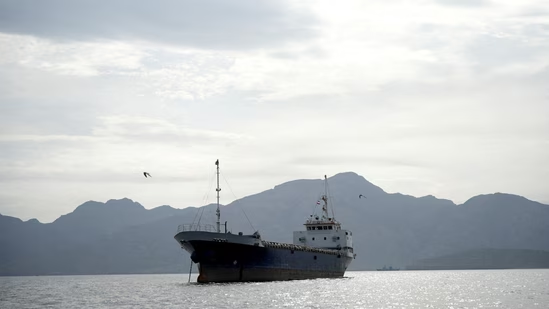
Market intelligence firm Kpler is tracking 70 supertankers, known as Very Large Crude Carriers, or VLCCs, that are due to arrive in Gulf Coast ports in April and May. Last year, an average of 27 supertankers loaded up on U.S. crude each month.
Each vessel can carry about 2 million barrels of oil. The massive oceangoing vessels are designed for long trips, such as the 11,700 nautical miles between Houston and Singapore.
How much oil does the U.S. export?
U.S. crude exports are on pace for a record 5 million barrels a day this month, according to Kpler, which projects May is likely to set another record based on current tanker traffic.
The U.S. exported 4 million barrels of crude a day on average last year, down from its prior record of about 4.6 million in February 2024, according to the Energy Information Administration. The U.S. also ships roughly 3 million barrels of gasoline, jet fuel and diesel each day.
Although the U.S. is the world’s largest crude producer, it still imports oil—mostly from Canada and Mexico—for refineries designed to process heavier crude. It imported 6.2 million barrels a day on average last year, according to the EIA.
Does the U.S. have the capacity to send more supply overseas?
The answer is complicated. The U.S. produces about 13 million barrels of oil a day, but most of that supply is already spoken for.
The nation’s four major oil-export facilities in Texas and Louisiana have a little wiggle room each month to fill up more tankers—but not much. Unlike the LNG market, which is underpinned largely by 20-year contracts, oil shipments are arranged mostly on the spot market. That means the upper limit of U.S. oil exports is determined by the physical limitations of the nation’s ports, which have run close to their top capacity in recent years.
The U.S. has been working to add to its export capacity. Enbridge is expanding its Ingleside terminal in south Texas to store an additional 2.5 million barrels of crude. The Port of Corpus Christi, the main oil-export hub in the country, finished a $625 million expansion last year to deepen and widen its ship channel.
A new terminal that chills and exports LNG just came online on the Gulf Coast. The Golden Pass plant, which is jointly owned by Exxon Mobil and QatarEnergy, will eventually churn out about 18 million metric tons a year in much-needed LNG supplies. Cheniere Energy, another gas exporter, has said it is considering deferring maintenance at some of its units to produce more supplies.
Other projects have run into regulatory and market roadblocks. During the first Trump administration, Phillips 66, Enterprise Product Partners and other companies proposed building giant deepwater crude-export terminals off the Gulf Coast to fill up tankers more quickly. In some cases, permitting challenges followed. In others, buyers failed to show up in large numbers.
What does this mean for the U.S. economy?
In short, prices at the pump are poised to keep rising if the U.S. exports more oil and gas and drains its inventories.
The national average for a gallon of regular gasoline was $4.13 on Monday, down 3 cents from last week but up $1.15 from the start of the war, according to AAA. Trump’s weekend blockade announcement sent oil prices rallying again—U. S. crude climbed 2.6% to $99.08 a barrel on Monday.
The jump in exports doesn’t yet correspond to an increase in U.S. oil production. In fact, shale producers have been reluctant to add new rigs because they aren’t confident the jump in prices will be sustained. That means inventories of oil and other petroleum products are likely to fall, leading to another leg up in prices.
Energy producers are scrambling to figure out how high prices can go before buyers start cutting back, a phenomenon called demand destruction. A sustained rise in energy prices could trigger a recession that also hurts demand. Already, U.S. demand for gasoline dropped last week by about 100,000 barrels a day, or 1.4%, from the prior week, EIA data show.
“It may be a win for U.S. exporters who are collecting fees for loading vessels and traders who may be making money by selling oil,” said Andy Lipow, president of Lipow Oil Associates in Houston. “But I don’t think the consumer feels like it’s a win for them in the face of rising prices.”
Write to Collin Eaton at collin.eaton@wsj.com and Benoît Morenne at benoit.morenne@wsj.com