Wars have continuously changed the course of history, and victors hold the sword and the pen. Throughout history, wars have changed its course, and the victor has rewritten it to provide the future generations a narrative laden with purported justifications, and righteous causes. When it specifically comes to wars between countries whose people pursue different faiths, then the rewriting is often done by erasing and repurposing cultural monuments (religious or secular). In fact, the history of the Levant, Persia and Arabia, for instance, is littered with the graves of examples such as monuments. Be it the holy city of Jerusalem itself or Istanbul’s Hagia Sophia, or even in distant Rome, with new conquerors implied mean the destruction or repurposing of old monuments get a new avatar.
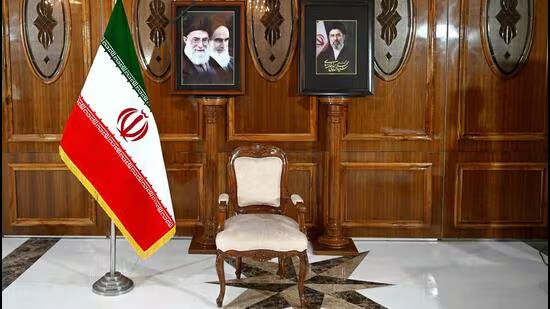
An empty chair sits under the portraits of Iran’s late supreme leader Ayatollah Ali Khamenei (left), the late Ayatollah Ruhollah Khomeini (centre) and the new supreme leader Mojtaba Khamenei (right). (AFP)
But, recent decades have shown that modern warfare has been somewhat crueller to mute cultural monuments. Beginning with the Taliban’s cannonading of the nearly 2,000 years old statues of the Buddha in Bamiyan province in 2001 and similar acts by Daesh (also known as Islamic State) in Palmyra, the destruction of culture or culturicide has been a feature of wars particularly those in West Asia and north Africa. Therefore, when US President Donald Trump says the US will bomb Iran back to the Stone Age or threaten the existence of an entire civilisation, there’s an ominous and blatant disregard for shared histories and diverse cultures that have survived in Iran for longer than recorded history.
The targeting of cultural monuments during armed conflict is not merely condemned by international norms, it constitutes a war crime. Iran, Israel, and the United States are all signatories to international conventions obligating the protection of cultural heritage even in wartime. That legal framework now sits awkwardly alongside statements from US defence secretary Pete Hegseth, who has publicly dismissed what he calls “stupid rules of engagement”: the very conventions and protocols designed to shield civilians and their history from the violence of war.
Hegseth and Trump are repeating what has been a recent tactic in the American war plan. But, Trump’s strategy of destroying Iran’s civilisation pride has been brewing for a while now. Six years ago, after Iran struck US bases in Iraq following the killing of Qasim Soleimani (Head of Quds force) by a US drone strike in Baghdad, US President Donald Trump (then in his first term) had made it clear that targeting Iran’s rich cultural heritage was kosher. Six years later the warning has come true, the ongoing war which has taken the lives of more than 2,000 Iranians and hundreds of people in Lebanon over the last month and a half, has also caused significant damage to more than 130 sites, including the 18th century Golestan palace in Tehran.
This has happened despite the United Nations Educational, Scientific and Cultural Organisation (UNESCO) stating that it has “communicated to all parties concerned the geographical coordinates of sites on the World Heritage List as well as those of national significance, to avoid any potential damage”.
Selective outrage over targeting of cultural beacons
Beyond the destruction of the Bamiyan Buddha’s, ISIS’ systematic dismantling of the ancient city of Palmyra across 2015 and 2017, evoked a strong response from Western governments and media; swift, visceral, and sustained. Now, reactions are strikingly different. No footage is played on loop. No anchor has called it barbaric. The same States that once led the chorus of condemnation have been largely silent, or have reached instead for the language of military necessity. What was once a crime against humanity is now, it seems, collateral damage, a rebranding all too often seen in history but one that future generations, inheriting a diminished world, should not easily forgive.
According to Professor Markus Hilgert, “cultural objects always and invariably point to the past and evoke history. In fact, they are the material anchors of all of our narratives about the past. Thus, cultural objects aid us in the creation of lasting identities. They frame historical narratives and are material witnesses to past greatness or failure. For some, they even embody values and beliefs… Thus, when you destroy or displace the culture of a community, you erase its history, you negate its achievements, you take away its common point of reference, its orientation. But there is something else: By destroying or displacing the cultural heritage of a community, you also reduce its chances for sustainable development, cultural diversity, post-conflict rehabilitation and reconciliation. The history of humankind abounds with examples for the wilful destruction of cultural heritage as a strategy of war. The earliest recorded cases reach all the way back to Ancient Mesopotamia…”
So far, Tehran has borne the heaviest toll, with 63 affected sites recorded within the capital alone. Isfahan followed with 23, and Golestan province with 12. Behind each number lies a monument, an archive, a mosque, a palace, some standing for centuries, others for millennia, reduced in a matter of seconds to rubble or ruin. The full accounting, when it finally comes, will almost certainly be worse. Trump’s civilisational threat, then, was delivered over the course of these weeks: not through civilians, but through symbols of history and heritage.
The loss of Iranian civilisational history
The cities that absorbed the heaviest bombardment: Tehran, Isfahan and others, are not merely urban centres but living repositories of Persian imperial history. Tehran served as the seat of Qajar power for over a century, and its streets, palaces and institutions still bear the imprint of that dynasty’s long reign. Isfahan, once the resplendent capital of the Safavid empire, which ruled from 1501 to 1736, remains one of the most architecturally rich cities in the Islamic world, its skyline defined by domed mosques, royal squares and intricate tilework that have endured for half a millennium.
In Isfahan, 16th century Safavid splendour can be seen most exquisitely in the great friday mosque the Jame Abbasi, in March 2026 its turquoise dome and tiles were damaged when a missile hit buildings nearby. The second affected site in Isfahan is the 17th-century Chehel Sotoun Palace, which has a strong connection with India. In the 16th century, Safavid king Tahamasp hosted the beleaguered Humayaun here, one of the four major frescoes in the palace commemorates this meeting between the would-be emperor would be emperor of India and his harbourer and protector the Shah of Iran.
Amongst the most devastating losses is also the Golestan Palace, Tehran’s only UNESCO World Heritage Site and the former seat of Qajar royal power, with roots stretching back to the sixteenth century. The UN agency confirmed that the palace sustained damage from the shockwave of an airstrike on the adjacent Arg Square, built by Shah Tamasp, at the centre of Tehran’s historic downtown. Videos circulating in the aftermath showed masonry crumbling from its walls and shattered glass strewn across the celebrated Hall of Mirrors, though the main structure is reported to be standing. In the days that followed, large concrete blocks were quietly positioned around the complex, obscuring the full extent of the damage from view.
Iranian officials had, in the course of the conflict, attempted to invoke the protections of international law by placing Blue Shield markers, i.e., blue-and-white emblems recognised under cultural heritage conventions as signals to attacking forces to spare a site. They were ignored.
Further, the Khorramabad Valley in western Iran is among the country’s most archaeologically significant landscapes. Comprising five caves and a rock shelter, the site contains evidence of continuous human habitation stretching back roughly 63,000 years, a distinction that earned it a place on UNESCO’s World Heritage List in 2025. Nearby stands the Falak-ol-Aflak Citadel or the Shapur Khast Castle, a fortress whose origins trace to the early third century and the height of Sasanian imperial power. It was this ancient citadel that was struck in a recent attack. Several structures within the castle complex sustained damage, among them the archaeology and anthropology museums housed inside its walls. The main fortress, however, is reported to have survived structurally intact. Five staff members and heritage protection workers were injured in the strike.
(HistoriCity is a column by author Valay Singh that narrates the story of a city that is in the news, by going back to its documented history, mythology and archaeological digs. The views expressed are personal.)