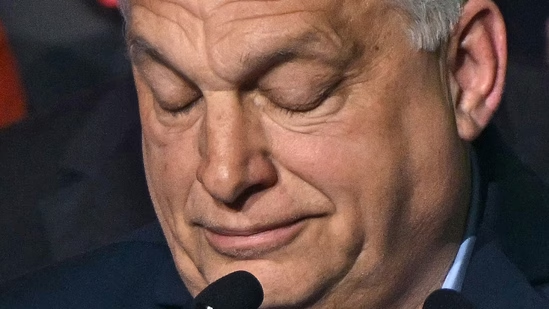
After dominating Hungary’s political landscape for over a decade and a half, Viktor Orban conceded defeat in Sunday’s parliamentary elections, as a surge led by opposition’s Peter Magyar upended the country’s politics after 16 years.
However, his loss, as experts say, did not come overnight, but was shaped by a steady erosion of authority, growing discontent of public, and the emergence of a formidable challenger from within his own system.
‘Built political system around himself’
For 16 years, Orban was both the architect and the face of Hungary’s political order. Since returning to power in 2010, he reshaped institutions and governance, creating what he himself described as an “illiberal state” in 2014.
“He managed to build up the political system around himself,” political scientist Attila Gyulai from ELTE University’s Centre for Social Sciences told news agency AFP.
Under this model, political debates increasingly revolved around a single question: support for Orban. His government faced repeated accusations of weakening judicial independence, curbing press freedom, and restricting civil liberties — criticisms that often put him at odds with the European Union.
Yet, Orban turned these clashes into political capital, framing himself as a defender of Hungarian sovereignty against “Brussels”.
The challenger from within
The turning point came in 2024, when Peter Magyar, a former insider in Orban’s ruling ecosystem, entered the political arena.
Magyar, a 45-year-old lawyer and leader of the Tisza party, had spent years within the Fidesz establishment, holding senior roles and maintaining close ties to key figures. According to the local media, his deep understanding of the system he once served became a key advantage.
On Sunday, that insider-turned-critic led the opposition to victory, ending Orban’s long grip on power.
“Together we liberated Hungary, we took back our country,” Magyar told tens of thousands of his jubilant supporters at a victory party alongside the Danube River in Budapest late on Sunday night, reported the Associated Press.
“You gave us a mandate to build a functioning and humane home for all of us,” he added.
Ties with Trump, friction with EU
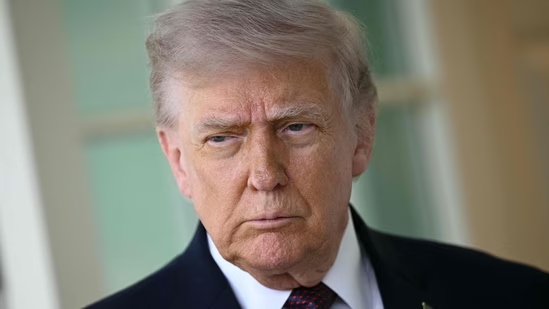
Even as Orban strengthened ties with global leaders like Donald Trump and maintained relationships with China and Russia, while frequently clashing with the European Union establishment.
He was widely seen as a distinct figure among European leaders, with Emilia Palonen, an associate professor at the University of Helsinki, telling AFP that he stood out “as someone different.”
After his 2022 victory, Orban increasingly positioned himself as a geopolitical player. His government invested heavily in promoting his political model, and he used Hungary’s 2024 EU presidency to pursue a controversial “peace mission” to Moscow – a move that angered European allies.
But critics argue this outward focus came at a cost.
“Orban’s focus on external alliances, particularly his ostentatious closeness to Trump and Vance was less effective,” Bulcsu Hunyadi, an analyst with Political Capital told AFP.
At home, economic challenges and political scandals chipped away at his support base. Public pushback also grew, exemplified by record turnout at Budapest Pride marches that his government had sought to ban.
The slow “wearing out” of power
Analysts suggest that Orban’s long-standing strategy of reshaping Hungary’s political and ideological landscape, ultimately contributed to his downfall.
“All of Orban’s domestic and foreign policy since 2010 were about changing the prevailing liberal values and political logic in Hungary, and beyond,” political analyst, Gyulai said.
“He certainly succeeded on leaving his mark,” he added. “But he acted as a battering ram… so he could be the one who wears out first.”
A campaign that struck home
While Orban’s messaging often centred on external threats, including the war in Ukraine and broader geopolitical tensions, Magyar focused on everyday concerns.
His campaign tapped into voter frustration over inflation, stagnant wages, declining public healthcare, transportation issues, and corruption. This shift in narrative, it seems, resonated with a population increasingly disillusioned with economic stagnation.
Magyar’s rise also reflected fatigue with a fragmented opposition.
Throughout the campaign, Magyar avoided taking firm stances on several polarising issues, including Orban’s anti-LGBTQ policies and Hungary’s role in supporting Ukraine.
This cautious approach helped him sidestep attacks that had previously weakened opposition figures.
His personal life, however, drew scrutiny. His ex-wife, Judit Varga, accused him of abusive behaviour. But he denied the allegations, calling them part of a political effort to discredit him.
EU leaders cheer Magyar’s win
European leaders swiftly welcomed Peter Magyar’s victory, framing it as a boost for democratic values across the continent.
French President Emmanuel Macron said, “France welcomes this victory for democratic participation, for the Hungarian people’s commitment to the values of the European Union, and for Hungary in Europe,” after speaking with Magyar.
While Germany’s Chancellor Friedrich Merz posted, “I am looking forward to working with you… Let’s join forces for a strong, secure and, above all, united Europe.”
UK Prime Minister Keir Starmer called it “an historic moment, not only for Hungary, but for European democracy,” and Spain’s Prime Minister Pedro Sanchez said, “Today Europe wins and European values win.”
European Commission President Ursula von der Leyen declared, “Hungary has chosen Europe… Europe’s heart is beating stronger in Hungary tonight.”
Italy’s Prime Minister Giorgia Meloni also congratulated Magyar on his “clear electoral victory”.
Meanwhile, Ukrainian President Volodymyr Zelensky pledged to work with Hungary’s new leadership.
(With AFP, AP inputs)