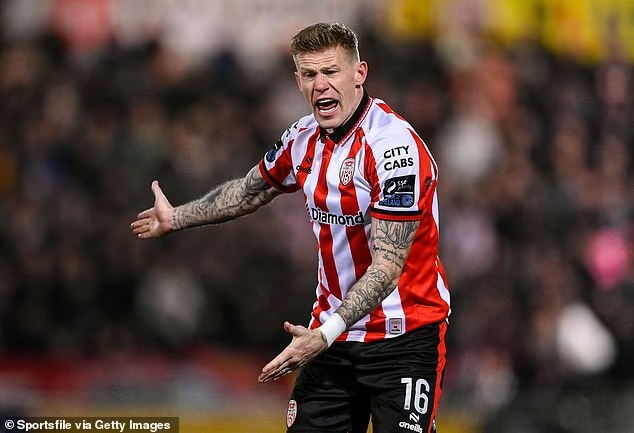
The ugly dispute between James McClean and Derry City is finally over after his contract was torn up.
Earlier this month, McClean, 37, branded it ‘incomprehensible’ and a ‘dangerous precedent’ for the club to try and terminate his deal due to his physical issues when they claimed he was ‘permanently incapacitated’.
But the Republic of Ireland international, who refused to wear a poppy on Remembrance weekend while representing English and Welsh clubs at the height of his career, has now come to an agreement with his boyhood side. He had two years left on the deal.
It is a nightmare end to what was supposed to be a fairytale homecoming having signed in January and McClean had not been included in a matchday squad since July as the relationship soured.
‘I am pleased that we have reached a resolution to settle these matters, his statement read. ‘While my return to the Club did not work out as I had hoped, Derry City FC will always hold a special place in my heart.
‘I want to thank the fans for their support, and I wish the squad, the management, staff, and the supporters the very best for the future. In particular, I want to wish the team the best of luck in the FAI Cup Final against Waterford FC.’
James McClean’s return to Derry City is over after his contract was torn up
Derry City chairman Philip O’Doherty thanked McClean for his ‘dedication’.
‘His achievements extend far beyond the Brandywell; amassing 103 senior caps for the Republic of Ireland is a remarkable milestone, and we want to formally acknowledge his immense contribution to Irish football as a whole,’ he said.
‘We wish him the very best for the future. Neither the club nor James McClean will be making any further comment on this matter.’
Derry attempted to axe McClean in August – despite signing him in January on a multi-year deal – reportedly claiming he is unable to fulfil his contract’s terms because he is not fit enough to play or train.
The former Wrexham man insisted he was ready to feature when called upon in a defiant statement.
‘This has been one of the most difficult periods of my life, both personally and professionally,’ McClean said in a statement on the PFA Ireland website on October 6.
‘When I agreed to come home from Wrexham, I did so in good faith, based on commitments made to me both playing wise and regarding my future after football. I uprooted my family midway through the school year because I believed in the vision presented to me, both for the short term and the long term.
‘I accept that some of my actions over the past few months were misjudged, and my frustrations should have remained in-house. I take responsibility for that – and I apologise. Derry City is my club, and I respect everyone who cares about it as much as I do.
‘I was asked to help drive standards, to speak up, and to use my experience to further professionalise my hometown club. From the start of the season, I tried to do this to the best of my ability, but I felt when I did my opinions were not well received.

McLean is pictured alongside Adam O’Reilly before Derry City’s UEFA Conference League game against HNK Rijeka back in July

McClean has regularly made headlines throughout his career for his refusal to take part in Remembrance Day commemorations
‘While I’m happy to hold myself accountable when I am wrong and when my performances have not been to the levels I expect of myself, I cannot understand or accept that I have been treated this way over the past few months.
‘For any club to feel it is OK to attempt to terminate a player’s contract without any due process or just cause is incomprehensible, and it sets a dangerous precedent for every player in this league.’
But now that fractious relationship is over, with a mutual agreement over the contract termination reached.
McClean is most famous on these shores for his refusal to take part in wearing a poppy and has previously spoken out about his reasons for not doing so, a decision he first made while playing for Sunderland in 2012.
He maintained that stance throughout his career in England, despite being regularly targeted with abuse.
The winger grew up on the Creggan estate in Londonderry, an area that was directly affected by the Bloody Sunday massacre in 1972 when British soldiers shot 26 unarmed civilians during a protest march, with 14 killed.
A quote in the 37-year-old’s biography The Walls sheds light on his thinking, speaking about the IRA.
It reads: ‘I’m not claiming that every action was justified. Obviously, I don’t support anyone innocent being killed. But I am saying that I supported the original end goal, even if that involved bloodshed ‘
After being asked about those comments in this interview, McClean added: ‘When you grow up listening to the stories there’s a part of you thinking: “These are heroes. I wish I was part of that or born a decade earlier”. I’d be a hypocrite if I sat here and said I didn’t support their cause.
‘Don’t get me wrong; I don’t believe that anybody innocent deserved to be killed, right? Unfortunately, it was a dirty war, and there were a lot of casualties on both sides.’

McClean pictured in action for West Brom against Huddersfield in 2017 not wearing the poppy
He also spoke at length about his decision not to wear the poppy two years ago: ‘The poppy which originally stood for World War 1 and 2 has now been adopted into honouring and remembering British soldiers that have served in all conflicts throughout the world including those who opened fire and murdered 14 innocent civilians on Bloody Sunday Jan 1972, in my home city, as well as many other brutal crimes throughout Ireland,’ McClean explained in 2024.
‘That is why I never have and never will wear a poppy. If the poppy’s sole purpose was to honour World War 1 and 2 then I would have no issue wearing it, but that’s not the case.
‘I respect those who do as I am fully aware we have different beliefs and upbringings, I would never force my beliefs on others, I’m not naive or stupid enough to expect the matter to be reciprocated, especially as the poppy is forced now on everyone in the UK and god forbid someone doesn’t wear it, the abuse they have to endure. The irony of all of this is that the poppy originally stood to honour those who fought for the right of freedom in both World Wars.
‘Some people, no matter what, will not educate themselves or want to educate themselves, so to those who throw abuse about (matters they know nothing about), with insults like ‘hates our country’ – well I don’t. Some of my best relationships I’ve made through the years are with people born and raised in England and have completely different beliefs to me … One thing I never have and never will do, is bend the knee to compromise my convictions.’
McClean, who has won 103 caps for the Republic of Ireland since choosing to play for them rather than Northern Ireland whom he represented in the Under 21s, said he had received ‘death threats’ for his stance over the poppy.
Last October, speaking during an episode of Virgin Media’s Living with Lucy, he told presenter Lucy Kennedy how his family feared he would be shot while away on international duty after he first refused to wear a poppy on his shirt in 2012.
‘I was getting death threats, people were saying I should be shot,’ he said. ‘I was getting bullets in the post, bullets sent to the club.
‘That night, I met up with Ireland. The club had received threats that basically I was going to be shot. The game was on TV. I was going to be shot, this and that. (My wife, Erin) is back up in Newcastle, she’s panicking, she’s s*****g herself. They had to put security outside my hotel room door the whole night.
‘Then, obviously, we’re playing the game, Erin’s watching the game, she’s panicking, she’s thinking, “He’s going to be shot on TV”. Thankfully, nothing happened or nothing ever has happened.’

McClean, who has won 103 caps for the Republic of Ireland since choosing to play for them rather than Northern Ireland, said he has received ‘death threats’ for his poppy stance
He added: ‘I was getting death threats, people were saying he should be shot and dragged across the Cenotaph.
‘I could have easily just said, “I’ll wear a poppy”, and sold myself out and be known for my football or “I’ll not wear a poppy” and be known as that but I’ve stayed true to myself.
‘Six or seven people from the Creggan estate (where he grew up) died on Bloody Sunday that day so for me to wear a poppy in support of the people who carried out those atrocities…
‘It frustrates me how people can’t see that. How is it even a debate of why I should wear the poppy?’