For the casual browser, a synopsis of Celtic’s official history makes for interesting reading these days.
Last published in 2017, just after Brendan Rodgers’ side had completed an invincible Treble, any prospective buyer of the publication is told: ‘The story of Celtic continues — of success on the field, backed by strong organisation off it…’
Whether that statement rings as true now as it did when the tome was last updated is certainly a matter of some debate.
While Celtic’s domestic success in the interim years is beyond dispute, so is the club’s inability to make an appreciable impact in Europe.
The Parkhead club has now lost eight out of its last ten Champions League qualifiers and six on the spin.
The recurring theme has been a lack of planning and an absence of any long-term strategy – save from selling prized assets to the highest bidder at the earliest available opportunity.
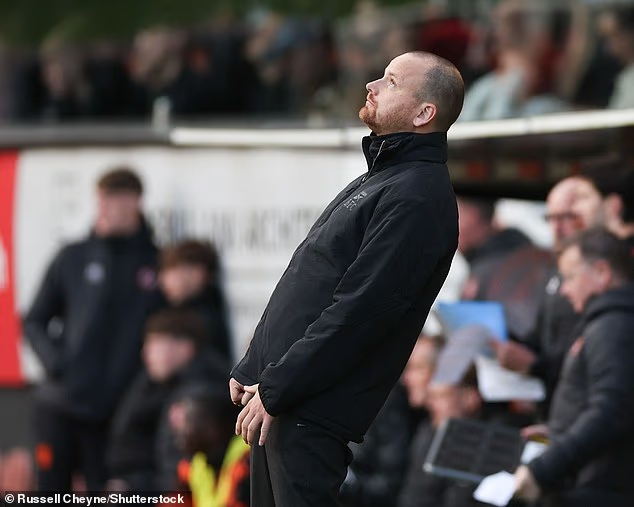
Jens Berthel Askou won plaudits aplenty during an eye-catching spell in charge at Motherwell
With lifting cups in Scotland no longer papering over the cracks, few supporters now subscribe to the notion that there’s ‘strong organisation’ underpinning it all.
The perceived hollowing out of the side in each transfer window and the lack of ambition and direction from the hierarchy has brought many to the point of insurrection. It feels like the conflict is only really beginning.
It’s to be hoped that the author of Celtic: The Official History is planning to have a new edition on the shop shelves in time for Christmas. It would make for quite the read.
The individual in question, of course, happens to be none other than Brian Wilson, a former Labour Party politician who, since December 17, has filled the role as interim chairman.
Good luck to Wilson if he ever attempts to commit events of the past 12 months to print. As tempting as it might be, skipping to the glorious finale in which the side somehow lifted the Double just isn’t going to cut it.
Aside from Martin O’Neill twice riding to the rescue, almost everything which happened in that time pointed towards a club that was increasingly dysfunctional and on the slide.
Rodgers may have done himself no favours with his infamous ‘Honda Civic’ remark that October day at Dens Park, but no one felt compelled to ask him what he meant.
Ill-prepared yet again for the biggest match of the season, Celtic’s defeat to Kairat Almaty in the Champions League qualifier was entirely of their own making.

Askou’s side were generally accepted to have been the most entertaining team in the top flight
Using the official club website to publish a blistering attack on Rodgers as his departure was announced, Dermot Desmond, the club’s largest shareholder, proved himself to be no loss to the diplomatic corps. But we hadn’t seen anything yet.
Despite O’Neill returning to Parkhead two decades on and winning six out of seven matches including a victory over Rangers in the League Cup semi-final, Desmond still pushed ahead with the appointment of Wilfried Nancy.
The hiring of a manager who’d made his name in the MLS would have raised red flags at the best of times. To appoint him mid-season while knowing he would attempt to completely change the side’s style of play was staggering.
It was always bound to end in tears. And it did so at the turn of the year after just two wins in eight matches with O’Neill again parachuted in at short notice.
The extraordinary thing is that the messy divorce from Rodgers and the hiring of the hapless Frenchman weren’t the most glaring shortcomings of the hierarchy in that period.
Unlike those voluntary acts which O’Neill – to his eternal credit – atoned for by galvanising a beleaguered squad, it was Celtic’s failure to make the one decision which was staring them in the face which may prove more damaging in the long-term.
By the time Nancy’s Celtic travelled to Motherwell on December 30, Jens Berthel Askou’s reputation as a modern manager of serious pedigree was already established.

Celtic struggled badly under Wilfried Nancy and were taught a footballing lesson at Fir Park
After an indifferent start in which the Steelmen had drawn their opening five league matches, Motherwell not only won games but did so in a swashbuckling style which no supporter of the club could remember.
On a shoestring budget, the Dane transformed his side into a potent outfit by getting the squad to completely buy into his vision. Veterans including Paul McGinn and Stephen O’Donnell found levels no one believed they had. Motherwell were so much more than the most stylish team in the land.
Amid a string of superb performances, the victory over Celtic in that festive match stood out. Motherwell, simply, played the champions off the park, bettering them in every department. The final score of 2-0 was no reflection on the balance of play.
If there was one crumb of comfort to be had for the shell-shocked Celtic directors that night, it was surely that they would be spared a lengthy search for the next manager in the summer.
Unlike Nancy – who’d spent the past four years managing Columbus Crew – Berthel Askou, a former IFK Gothenburg manager, had proven his worth in the Scottish Premiership.
As Motherwell closed in on a return to Europe, Celtic were presented with an open goal. For reasons which defy belief, they didn’t take it.
Given that rarity in football – the Hollywood ending – they could have let the credits roll and allowed O’Neill to ease into retirement with his legacy enhanced.

Martin O’Neill has worked wonders but many question the logic behind overlooking Askou
The arrival of Berthel Askou, aged just 44, would have provided the necessary reset – a younger man with a different voice who would have captured the imagination and, potentially, filled the role for several years to come.
Did Celtic simply feel that going back to the well with a 74-year-old was the best course of action? Or, as several sources have suggested, did they procrastinate for too long and discover that the Dane had already agreed a deal with Toulouse?
Either way, as O’Neill prepares to take his side back to Fir Park, it’s hard not to feel that the Parkhead club missed a glaring opportunity to hire a manager of substance who advocates his teams playing with the kind of style which Celtic always crave.
To suggest as much is in no way a slight on the veteran Northern Irishman, a man whose place in the pantheon of Celtic’s all-time managerial greats is assured.
It’s just that his reappointment on a one-year contract – with the option to extend by another – just wasn’t the long-term solution everyone concerned was crying out for.
O’Neill’s job this season feels distinct from the one he was twice tasked with when Desmond called him up last season.
If last year was all about galvanising players who’d largely been signed by other people, this year has been about building something in his own image and owning it.

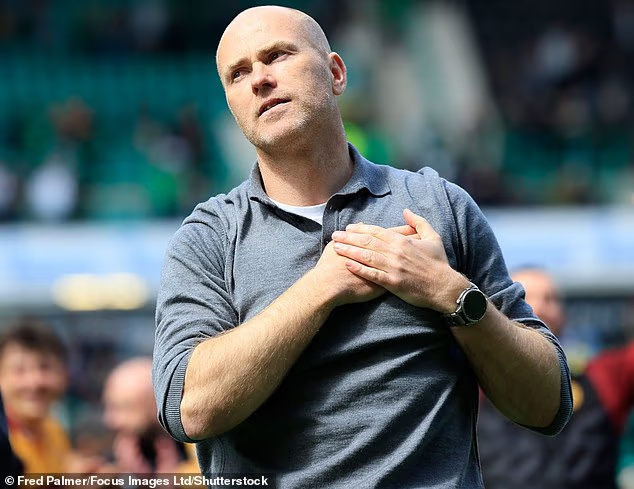
Askou watches a match from the stands at Celtic Park last term and would have been a good fit
While any side and any manager can hit a bad patch, the nature of the three straight defeats Celtic suffered prior to the international break was alarming.
A man who was recently hospitalised after a brief period of ill-health, it’s only correct to question the wisdom of the club asking him to go again.
While Toulouse’s form to date under the Dane – a win and two draws in five Ligue 1 matches – is hardly sparkling, it’s worth remembering that it took a while for Motherwell to catch fire under him last season.
‘We have a new playing philosophy, so naturally it takes time to implement,’ said midfielder Cristian Casseres.
‘The dressing room is calm. We’re aware of where we are in the process of building our team.’
With a trip to table-topping Monaco on Saturday night, Berthel Askou can tune in from afar to events at Fir Park on Sunday lunchtime if he so pleases.
Having earned a new life and a new challenge in sun-kissed south-western France, he’s unlikely to spend much time these days dwelling on what might have been.
He can rest assured, though, that many Celtic supporters will reflect on his departure to France with deep regret. In their eyes, he’ll always be the one who got away.