THE PROVENANCE of the quote isn’t clear, but its popularity is. Whether it was Arnold Palmer, Lee Trevino or Gary Player who said ‘the more I practice the luckier I get’ it has become a touchstone in the language of high-performance sport.
And it came to mind as Irish athletes and swimmers held the nation rapt with their achievements in Birmingham and Paris.
The ecstatic expressions of the nation’s finest as they crossed the line or touched the wall filled the front and back pages.
Tearful young women stood proudly for Amhrán na bhFiann, transformed into beloved national figures in the space of a few days.
But if the week felt dizzying for Kate O’Connor, Ellen Walshe, Rhasidat Adeleke and the rest of the stars of another thrilling athletic summer, it was only made possible by these stars dedicating their lives to their sports.
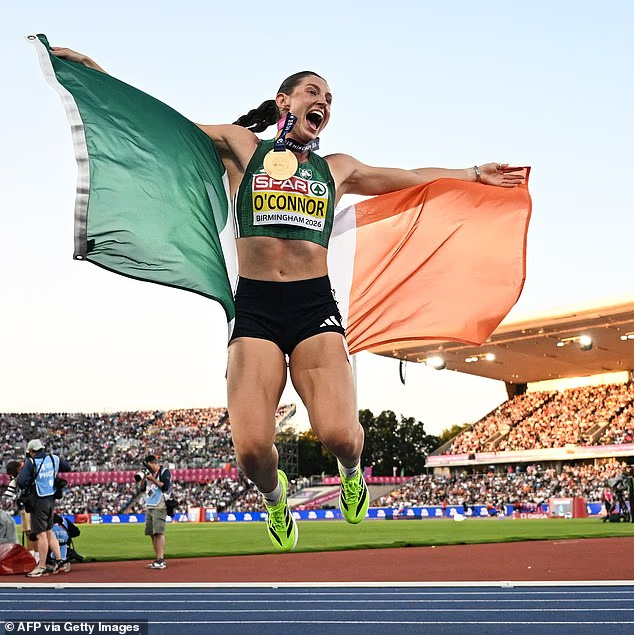
O’Connor’s dizzying week ended with gold
Athletes fail far more often than they succeed, which makes the wins so special, but which also puts a lifetime of sacrifice into perspective.
They pour everything into a dream that isn’t likely to be realised at all.
Athletes are built differently.
And it’s that unwavering commitment to excellence that people returned to again and again in conversations about why the glory of last week happened in the first place.
Individual excellence and the determination to maximise its potential is common to all of the heroes of the European athletics and swimming championships.
But it’s also obvious that for decades the country has produced single-minded and occasionally gifted athletes who haven’t stood on podiums.
What has changed?
Everything.
The change, to borrow a phrase from Yeats, came dropping slow, and it manifested itself in different sports.
Boxing was turbocharged by a high-performance unit designed by Gary Keegan and led by Billy Walsh, that turned the country from a punchline in the sport into an example of international best practice.
Swimming survived sexual abuse scandals that threatened to sink it, as well as the notoriety that followed the Atlanta Olympics and was turned around by strong leadership and, in common with all the other success stories, an increase in the number of coaches and the quality of their coaching.
The modern story of Irish athletics is over 20 years in the making, driven now by an explosion in numbers that, at juvenile level, is nurturing the success stories of recent years.

Adeleke is a beloved national figure
But underpinning all of the glory is a realisation at political level that the relationship between Irish sport and the State had to change and, in particular, how sport was funded.
For too long sport provided the occasional photo opp for an opportunistic minister and otherwise was left to its own devices.
The GAA, soccer and rugby dominated participation numbers and the nation’s affections, and people then got distracted for a fortnight every four years when the Olympics came around.
A once-in-a-lifetime talent like John Treacy or Sonia O’Sullivan might illuminate Irish efforts on the biggest stage in global sport, but there was no vision for Irish sport within the Olympic movement here or beyond it.
Boxing provided glorious memories at the 2008 and 2012 Games, but it was in the aftermath of the 2016 Rio Games that a determination to overhaul State support for Irish sport was realised, as it dawned within government that countries of a similar population size were consistently outperforming Ireland.
Denmark and New Zealand were regularly cited, and it didn’t take much investigation to reveal that funding was at the heart of their successes.
More money for sport meant more coaches, better facilities and a culture of excellence would follow.
‘The critical point we made in the proposal was that we needed to increase the level of investment. We were underinvested,’ reflects Paul McDermott, director of high performance with Sport Ireland and a man who has been at the coalface of elite sport in this country for more than quarter of a century.
‘We needed more money and we were falling behind.
‘The second piece was consistent, sustained investment over time, not up and down; a commitment over time that we would invest in these programmes and not flipflop or lose confidence if we had a bad year.
‘We know with a boxing programme you can charge it forward in four to eight years, but we know that swimming takes 12 years (to build a successful programme).
‘We know that athletics takes that long.

Conistent investment helps bring success like Andrew Coscoran’s bronze medal
‘This is the point we’re trying to make now, and when we said it at the time, we were pretty clear that we could get to those medals, which is in our high-performance strategy.’
Record funding for high performance sport of €28.5 million was announced in April of this year; a decade ago, the figure was €11 million.
The link between money and medals is by now long established, but the near tripling of high-performance spending in the past decade came after years of painstaking work in setting the foundations for such a culture in this country.
The miseries of Atlanta – Sonia O’Sullivan excepted – and Sydney prompted reviews that led to the Sports Council, latterly Sport Ireland, laying the groundwork for high performance systems in Irish sport.
In tandem with that is the Sport Ireland Campus in west Dublin, one of the incontestable successes in Irish infrastructure in the 21st century.
In a country wearied by stories about our failure to build what the people need, where they need it and at a cost that isn’t ruinous, the development of this enormous site in Abbotstown has been important in the glories we saw last week, too.
Not only is there a 50-metre pool, the absence of which for years in the country was one of the most eloquent commentaries on how seriously we actually took Olympic sport, but there’s an array of facilities including an indoor athletics track as well as training bases for gymnastics and a host of other sports.
Crucially, too, there are medical and physiological supports that are world-class, housed at the Sport Ireland Institute.
Its work was acknowledged by Rhasidat Adeleke in her comments after winning silver in the 200m in Birmingham. She paid tribute to weeks of intensive work with Martina McCarthy, a strength and conditioning coach at the Institute, as well as sessions with physio Ciara McCallion.
Adeleke’s year was haunted by recurring hamstring injuries, but she credited the work with McCarthy and McCallion at the Institute in getting her right for Birmingham.

Adeleke credited Martina McCarthy, left,
‘If we have athletes at the top level praising the support they get from our team, that will encourage more athletes to seek out the services we offer,’ says Liam Harbison, director of the Institute.
‘The more athletes speaking about it and openly commending the support they receive in glowing terms, that builds more demand for our services.
‘That’s fantastic.’
Convincing athletes to engage with the services offered by the Institute was a significant development, says Harbison. That happened post-Tokyo, and he credits McCarthy with changing the relationship between the Institute and the sport.
She is one of a number of staff working with various athletic disciplines, patiently building the relationships that ultimately lead to medals and joyous headlines.
The Institute’s work is the epitome of the diligent, background preparation that doesn’t make the news bulletins, but which is critical to championship success.
In the Institute, experts in strength and conditioning, physio, diet and mental and psychological supports are available to work with high-performance athletes.
Their services are now a key part of the preparations of our biggest stars of track, field and pool.
‘Everyone is in the building together with the athlete at the centre,’ says Harbison of their role.
‘No discipline would take precedence. In some countries, the S&C coach might think their role is more important than that of a physiologist.
‘That doesn’t happen in the Institute. Ultimately, it’s about the needs of the athlete and the need of the sport, and ultimately our job is about allowing that athlete and that sport to achieve the objectives they set for themselves.’
Funding is again relevant here; the Institute works because of a State commitment to its success, which goes for the entire campus facility.
The brilliance of Birmingham and Paris means that expectations are already rocketing ahead of the Los Angeles Olympics. The effect of Ireland’s glorious Paris games was profoundly felt in Irish life.

English winning in Birmingham
Athletics Ireland expects to reach a membership of close to 80,000 this year, for instance; it stood at 18,000 20 years ago.
The enormous growth in juvenile membership raises some logistical issues, as any parent with a child on a waiting list at their local club understands.
But it’s also creating a pool of talent from which the next O’Connors, Adelekes and Mark Englishs and Andrew Coscorans might emerge.
‘We’re not here to say we’re going to win 30 medals,’ says Paul McDermott of Irish ambitions for the years ahead.
‘What we want are eight, nine, 10 programmes that are high functioning, that have good coaches, good athletes and that can go abroad and, when the green shirt is put on, it’s respected.
‘I can’t predict what will happen in LA, but I can say we’ll have a strong athletics team, a strong swimming team, a strong boxing team, a strong rowing team, a strong sailing team, a strong golf team, a strong equestrian team.
‘That’s a good position to be in.’
Liam Harbison is equally confident of a bright future.
‘We can go much further,’ he says of the Institute’s role. ‘Our aim is to sustain this over the long term.

Aim is for O’Connor’s success to be sustained
‘We have a long way to go until I feel we’ve reached our peak, but those little peaks through the various years like we saw last week are very helpful.
‘And it’s good to remind people that there is a system behind this.
‘This didn’t just happen out of nothing. It’s built on the basis of strategy, investment from government, from sports, but fundamentally it’s because of the athletes and the work they are doing.’
Behind every dream made real are countless hours, plenty of tears and a share of doubts, too.
And behind them, too, is a network of excellence and expertise that has transformed Irish ambitions, and Ireland’s reputation in global sport.