Having spent the past three years plying his trade in Belgium and Sweden, the prospect of alighting in the capital of Andalusia was never going to perturb Robbie Ure.
Yet the forward is bound to feel settled in Seville even before the La Liga season gets underway with a home match against Rayo Vallecano a week on Saturday.
The Caledonian connections with Sevilla FC are significant. They run though the club’s entire 136-year history. They are a cause for thanks and celebration among the Blanquirrojos.
Of all the sides in all the leagues which could have paid big money to take him from IK Sirius, there’s something that will feel just right about Sevilla coughing up an initial £5.5million to make him theirs.
In an age when the tradition of new signings posing with a scarf aloft seems no more, it was always going to be intriguing to see what the Spanish club’s social media team produced when the 22-year-old was unveiled yesterday after signing a five-year deal.
Suffice to say, it did not disappoint. And it did not spare the horses,
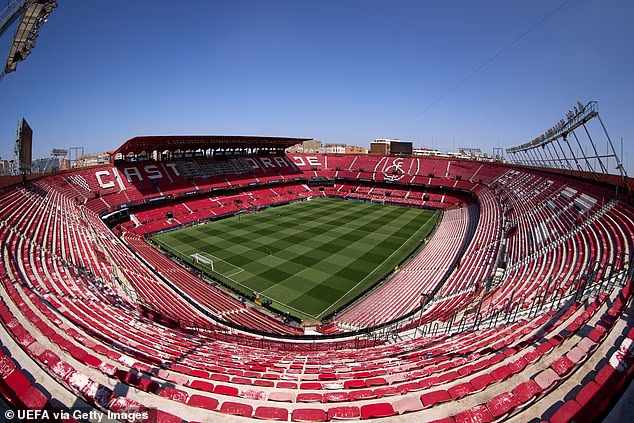
Sevilla’s Ramon Sanchez-Pizjuan stadium is a ground proud to celebrate Scottish heritage
To the skirl of the pipes, with images of lochs and glens interspersed with footage of Jock Wallace and Ted McMinn, the slightly surreal video informed us: ‘We are the sons of the bagpipes and the kilt.
‘We were brought to life on the night of the poet and our echo was heard even in the Highlands.
‘The sons of Saint Andrew raised us. And we walked a long road, bathed in your blood, answering those who sought to insult us and wound us until we carried glory to the land of our founders.
‘Your essence runs through our veins.’
Cutting to an image of the former Rangers academy player, it adds: ‘Now this is your city and this is your shield.’
It all began for Sevilla FC when some Scottish migrants met over a beer on Burns Night 1890.
A report ‘from a Seville correspondent’ in the Dundee Courier on March 17, 1890, read: ‘Some six weeks ago, a few enthusiastic young residents of British origin met in one of the cafés for the purpose of considering a proposal that we should start an Athletic Association, the want of exercise being greatly felt by the majority of us, who are chiefly engaged in mercantile pursuits.

Jock Wallace managed Sevilla for one season but was sacked after failing to learn Spanish
‘After a deal of talk and a limited consumption of small beer, the ‘Club de Football de Sevilla” was duly formed and office-bearers elected. It was decided we should play Association rules. Goalposts were duly rigged up. We were about half and half Spanish and British.’
Those in attendance included Edward Farquharson Johnston, who was originally from Elgin.
Johnston was the British vice-consul in the city and co-proprietor of the firm MacAndrews & Co, ship owners with commercial lines between Spain and the UK.
A keen sportsman, he was involved in golf, tennis and, bizarrely, a pigeon shooting society. He became the club’s first president.
Glasgow-born Hugh MacColl, a marine engineer who at that time had moved to Spain to work as the technical manager of Portilla White foundry, was its first captain. One of MacColl’s colleagues in the foundry, Isaias White, became the first secretary. White organised Sevilla’s first match against the Huelva Recreation Club, which they won 2-0.
While Huelva existed before Sevilla, the latter remain the country’s oldest club formed purely for football.
To this day, the newspaper cutting detailing how the club was formed takes pride of place in Sevilla’s museum.

Ted McMinn became something of a cult hero in Spain after joining Sevilla from Rangers
It’s believed it was found on a steamship which was used to transport oranges between the city and Dundee, which were then turned into marmalade.
The story behind Wallace replacing Manolo Cardo as manager of the club in 1986 is also extraordinary.
While Terry Venables and John Toshack had already blazed a trail by taking charge of Barcelona and Real Sociedad, respectively, Wallace was – to put it mildly – a left-field choice for the post at the Ramon Sanchez-Pizjuan.
‘Jock loved Spain,’ recalled agent Bill McMurdo of the legendary Rangers manager. ‘He had a holiday home there. The problem was that he didn’t speak a word of Spanish.
‘But, as luck would have it, we had kept in touch with a guy who ran a Spanish restaurant in Leicester which Jock used to go to when he was manager at Leicester City. He helped us out as an interpreter and Jock got the job.’
Wallace only spent one full season at the Sanchez Pizjuan, leading the side to a mid-table finish, and was sacked – officially – because he reneged on an agreement to learn the language.
Legend has it that at one of his first training sessions, he robustly chastised one of his players for a lack of effort only to be told that it was actually the club masseur. For all that, he is still fondly remembered.

Sevilla famously claimed the UEFA Cup on a rain-lashed night at Hampden in 2007
‘Wallace’s team played a beautiful game and had great players,’ said club historian Javier Terenti. ‘He was a coach who believed and bet on young players from the club’s youth academy, which today is one of the most important pools of young players in Europe.’
Wallace is said to have particularly relished the derbies against Real Betis, a side whose green and white colours came about because their founder, Manuel Ramos Asensio, studied in Scotland and was a supporter of the Parkhead club.
‘He enjoyed every minute of it,’ added McMurdo.
Despite breaking his leg in a squash game three weeks after following Wallace to Seville following a fall-out with Graeme Souness at Rangers, McMinn’s short spell is also warmly recalled.
The first Scot to play for the club since Glaswegian Duncan McVean Thompson in 1915, the unorthodox winger managed 22 games after recovering from that injury and turned into something of a cult hero among Sevilla fans.
‘With his inelegant Tin Man running style, erratic crossing and unquenchable zest for lager, he was the soul of football,’ wrote one Spanish journalist.
But Wallace’s departure unsettled him and he resolved to return to the UK where he signed for Derby County.
Some 20 years on, McMinn was being ushered down memory lane by both Spanish and Scottish media when Sevilla came to Glasgow to contest the 2007 UEFA Cup final. A barnstorming match against Espanyol ended 2-2 after extra-time with Juande Ramos’s side eventually prevailing 3-1 on penalties.
That triumph in the incessant Mount Florida rain saw them retain the trophy. Incredibly, five have since been added. None are recalled more fondly than the night they cemented their Scottish roots.

Robbie Ure has become the latest Scottish player to land a big-money European transfer
They weren’t present in the final four years ago when they were set to enjoy home advantage. A loss to West Ham in the last 16 saw to that.
Instead, Rangers and Eintracht Frankfurt fought it out for the big prize, with Giovanni van Bronckhorst’s men losing out on penalties.
Three months previously, Ure had played against Sevilla in the UEFA Youth Cup. Now, after moving to Anderlecht and tearing it up at unfashionable IK Sirius, he’s leading their line and hoping it leads to a first full Scotland cap.
The saltire is still flying in Sevilla. The gentlemen who set the ball rolling when they met to honour the bard all those years ago might even have described it as poetic.