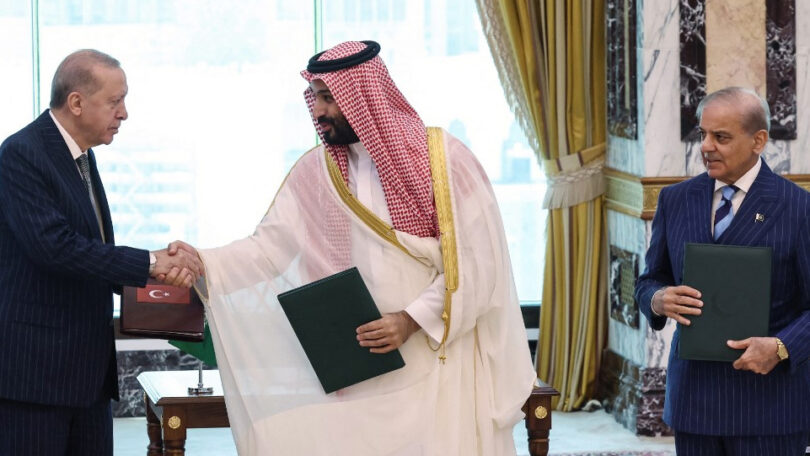
The Mecca Joint Defence Agreement, a trilateral pact announced last week between Saudi Arabia, Pakistan and Turkey, marks a significant and hugely symbolic step for the region.
Penned in the holy city of Mecca rather than the Saudi capital, and accompanied by visuals of the leaders of the three nations praying, the agreement sent a clear message to the world.
Yet while the Saudis swiftly denied that the deal aimed to establish a sectarian or military bloc, there has been much speculation as to what purpose it ultimately serves, especially after Riyadh recently announced the formation of an international axis to protect Red Sea shipping.
In addition, the Islamic Military Counter Terrorism Coalition (IMCTC), dubbed “Muslim Nato”, had already brought dozens of states together in an alliance a decade ago.
The Mecca pact comes at a time when uncertainty reigns over the future of several ongoing conflicts, including the US-Iran war; Israel’s aggressive military advances in Lebanon, Syria and the occupied Palestinian territories; and indeed, Saudi Arabia’s own battles against the Houthis in Yemen and other Iran-backed militias in Iraq.
CLICK FOLLOW: TO FOLLOW US
Sign up to get the latest insights and analysis on
Israel-Palestine, alongside Turkey Unpacked and other eSPORTY
While Turkish and Pakistani media have gone into overdrive speculating on the notion of a new Middle East order, it remains unclear as to how the three militaries could actually fight a war together, side by side – and against which enemy?
We have been here before. In 2017, similar fanfare greeted the appointment of former Pakistani army chief Raheel Sharif as the first commander of the Saudi-led IMCTC. Then as now, countering Iran and its proxies seemed to be the focus of the fledgling alliance.
Self-fulfilling prophecy
Questions are now being asked as to whether the Mecca deal is a pointed warning, aiming to deter Iran and its proxies from further attacks on Gulf states.
Turkey, Pakistan and Saudi Arabia have all had proxy conflicts in the region, from Syria, to Yemen, to the volatile Pakistani province of Balochistan. All three countries have had, or continue to have, major differences with Iran over how the region should be run.
At the same time, it is no surprise that Israeli media have been particularly vocal over this announcement. For Tel Aviv, it marks the culmination of a self-fulfilling prophecy: for months, top Israeli officials have warned of the threat of a new Sunni axis shaping up to replace Iran as Israel’s main enemy.
India, Israel and Greece have certainly raised alarm bells. As to whether they will translate into battle-defining realities, only time will tell
From the former and potential future prime minister, Naftali Bennett, to former government spokesperson Eylon Levy, many Israeli figures have highlighted the supposed threat of a Pakistani-Turkish partnership backed by Saudi and Qatari money.
Almost weekly, there is a new column touting the risk of Turkey invading Israel or becoming the “new Iran”. After an Israeli strike recently landed near the Pakistani embassy in Tehran, a Pakistani think tank close to the military issued a stark warning to Israel. And the Jerusalem Post recently published an article discussing how a reported Pakistani troop deployment to Saudi Arabia could shift the power balance of the Middle East.
US President Donald Trump has made Pakistani military chief Asim Munir his go-to guy on Iran, calling him his “favourite field marshal”. Trump has also given Pakistan a front seat at the Gaza peace talks – all of which has made Israel nervous, particularly in light of a now-deleted post from Pakistan’s defence minister calling Israel “evil”, alongside resurfaced Turkish threats to intervene in Gaza.
The announcement of the Mecca agreement, if nothing else, serves to justify Israel’s exaggerated concerns over a “Sunni axis”, giving form to what had once been an imagined enemy. This is where the agreement will face a major test.
Turkish media outlets are already pointing to Greece as the first potential target of this new alliance. Greece, having become Israel’s main Mediterranean ally, has publicly raised the issue of Pakistani military assets in disputed waters as a sign of Turkish and Pakistani joint military preparedness.
Open question
It is also no coincidence that India, another ally of Israel, is teaming up with the Greeks to potentially counter a Turkish-Pakistani military alliance in the Eastern Mediterranean. Greece has raised the issue of Pakistani pilots training their Turkish counterparts, while India last year lashed out at Turkey for supporting Pakistan during the recent India-Pakistan conflict.
Yet beyond symbolism, the extent to which Turkey can support Pakistan in combat remains an open question; as a Nato country, Turkey cannot go to war without impacting the entire military alliance.
Why the Mecca Agreement is a necessary show of force
Read More »
In addition, both Pakistan and Saudi Arabia are buyers of US fighter jets and helicopters, and Washington has wielded its power to veto prior deals. In 2022, the US stopped Turkey from selling Pakistan 30 attack helicopters, in what would have been the largest Turkish-Pakistani aviation deal in history. Any potential future deals will thus come under significant American and European scrutiny.
Saudi Arabia has never openly sided with Pakistan in its endless war against India, seeing itself more as a neutral peacemaker; indeed, India is one of Saudi Arabia’s largest trading partners, while Pakistan is the recipient of Saudi aid.
Similarly, Saudi Arabia is unlikely to take sides in any Turkey-vs-Greece conflict. Just last month, an air-defence system operated by Greek military personnel in Saudi Arabia intercepted missiles launched from Yemen towards oil refineries in Yanbu, according to a Reuters report.
So the question remains: beyond Israel’s fears and the ongoing Iranian threat to Saudi Arabia, is this alliance predominantly symbolic – a card to forewarn enemies that bilateral conflicts will now be multilateral, spilling across different geographies?
India, Israel and Greece have certainly raised alarm bells. As to whether they will translate into battle-defining realities, only time will tell.
The views expressed in this article belong to the author and do not necessarily reflect the editorial policy of Middle East Eye.