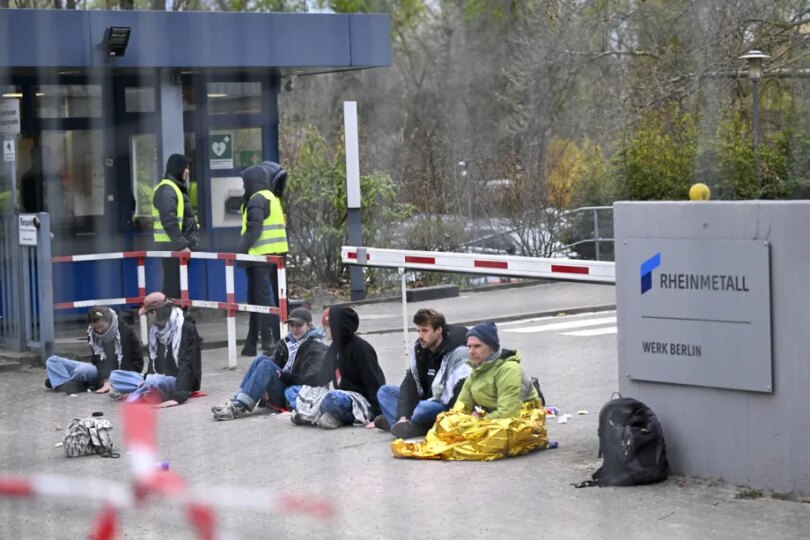
Rheinmetall CEO Armin Papperger wasn’t boasting when he said, “Cowardice is not an option in this business.” He wasn’t celebrating personal bravery either. He was simply acknowledging a reality: he no longer has the luxury of being afraid. Papperger has lived under police protection for years due to suspected Russian assassination plots. Armed security accompanies him everywhere—even inside Rheinmetall’s headquarters in Düsseldorf—under a protection protocol comparable to that of the German Chancellor. Not because he is a criminal, but because he manufactures weapons in a world where retaliation has become a currency.
Rheinmetall supplies large quantities of arms to Ukraine and is building factories there. The company’s CEO now lives as if he were in a permanent war zone, even when seated behind his desk.
But Papperger is not alone. There are people who fear for their lives simply because they write.
Take Salman Rushdie, who paid for a single novel with decades of hiding and near‑fatal violence. Or Italian writer Roberto Saviano, author of Gomorrah, who has lived under round‑the‑clock protection since the book’s release. He describes his existence as “dying while alive.” A man who wrote about the mafia now lives as if he were one of its potential victims. Even Israel—where he was invited to relocate—could not offer him a sense of safety.
Then we arrive at the world of Big Tech, where bullets are not fired, but hostility is. Why do the CEOs of major tech companies fear for their lives? Why does Mark Zuckerberg require more than $27 million annually for personal security? Why does Elon Musk travel with up to twenty security specialists? And why did security budgets for ten major tech executives exceed $45 million in a single year?
READ: Ali Al-Zaidi may be the failure Iraq needs
Because the digital utopia we were promised has mutated into blind dominance and unregulated greed. Companies now control desires, money, voices, and daily routines. Many people see these billionaires as direct contributors to what is wrong in the world: inequality, monopolies, manipulation, exploitation, and the collapse of public trust.
One U.S. security firm executive who oversees protection for Musk and Jeff Bezos put it bluntly: “We have never seen this level of threat or anxiety before.” This is not a security statement—it is a political one. A summary of a global mood that has lost faith in promises, institutions, and anyone who holds power without accountability.
What does it mean to possess immense wealth yet be unable to walk down a street without guards? What does it mean for a writer, a CEO, or a weapons manufacturer to live in constant alert, as if their life were a postponed assassination attempt? Wealth that deprives its owner of movement is not wealth—it is a burden. A fortune without freedom, without peace, without life.
This is the core paradox: These individuals are not criminals, killers, or thieves. Yet they live as though they were, because the world that produced their wealth now views them with suspicion, anger, and a desire for retribution against the invisible power shaping people’s lives.
This anger no longer targets governments alone; it extends to anyone who holds power without accountability — the writer who exposes corruption, the novelist who reveals the mafia, the CEO who controls a digital platform, the arms executive who shapes wars from behind a desk. In a world that has lost trust, every influential figure becomes a potential target. Fear has become the unavoidable surcharge of modern authority: not merely a tax paid by those who speak truth or command vast digital networks, but a structural consequence of a global mood that sees power itself as suspect. It is no longer about who these individuals are, but what they represent — systems that feel distant, opaque, and indifferent to the anxieties of ordinary people.
Between Tehran’s defiance and Trump’s volatility: When falsehood becomes political reality
Fear is no longer an exception—it is the new tax on power. A tax paid not with money, but with life itself: with living under protection, with avoiding public appearances, with anxiety over every unknown message, with the sense that the world watches not with admiration, but with anticipation.
They do not enjoy their wealth because wealth is no longer a guarantee—it has become a liability. They do not enjoy their lives because life lived inside a security perimeter is not life—it is a temporary stay in a world that neither trusts them nor is trusted by them.
The question today is not: Why are they afraid? The real question is: What has driven the world to this level of distrust? What made writers live like fugitives? What made CEOs live like political leaders? What made arms manufacturers live as if in perpetual conflict? What made people see these figures as symbols of injustice—even when they are not personally unjust?
Perhaps because the world is experiencing a moral rupture: a moment when people feel wealth is built on their suffering, technology on their data, wars on their silence, and power on their vulnerability.
In such a world, fear becomes the only shared language— between those who have everything and those who have nothing.