Apparently, the best World Cup you saw was the one you watched when you were 11 years old. Mayo’s All-Ireland win has sparked a similar debate about the comparative merits of various GAA wins and famine-ending victories.
Even allowing for recency bias and the undoubted power of Mayo’s long-awaited triumph which became international news within hours, it’s amazing how easily the pre-social media impacts of Donegal in 1992, Derry in 1993, and Armagh and Tyrone later have been forgotten.
In case anyone suggests this is an exclusively football thing, we haven’t even got to the Clare hurlers in 1995 and Wexford the following year.
Mayo’s incredible win has been elevated to not just the greatest All-Ireland win ever, but, according to one publication, ‘One of the most joyful national episodes since (the) Republic’s foundation’.
Mayo’s All-Ireland victory over Kerry was described in one media outlet as one of the ‘most joyful national episodes since the Republic’s foundation’
Now I’ve seen some outlandish headlines in my time, maybe even produced a dozen or two, but it does seem a stretch to brand a single county’s win – at the expense of all other counties remember – in such terms. And you don’t have to be an anti-partitionist to raise an eyebrow at the choice of ‘Republic’s foundation’ for what is a genuine all-island competition.
But this is meant to be a TV column, and for all the international recognition the Mayo story has received, Andy Moran and co haven’t been quoted in the betting for any BBC Sports Personality of the Year awards. Not yet anyway.
TG4’s recent rerun of last year’s GAA 70’s – Réabhlóid Shóisialta (GAA 70’s – A Social Revolution) offers some timely perspective. And, on the basis of this documentary, when it comes to the significance of All-Ireland victories, Dublin’s 1974 win makes a compelling claim.
Hands up, everyone’s favourite All-Ireland win is their own county’s. As Arsene Wenger famously said ‘everyone thinks they have the prettiest wife at home’. But the programme makes a persuasive case for that Dublin win, an All-Ireland that kickstarted an era dominated by them and, more accurately, their 1975 vanquishers Kerry.
Dublin had been in the doldrums, its status in the Gaelic football world a reflection of a city which was struggling economically and socially. The UVF bombs in May 1974 had brought the devastating reality of terrorism right into the heart of the city.
The GAA was practically invisible in Dublin. The county last won an All-Ireland in 1963, and hadn’t even won Leinster since 1965, as Robbie Kelleher summed up bluntly: ‘I was in college between 1969 and 1974 and I never told anyone I played for Dublin.’

The 1974 final deserves to be remembered as one of the greatest – if not THE greatest
Amid the grimness, there was huge interest in sport, it’s just that with access to BBC and ITV, kids in the soccer-mad city were now able to follow cross-channel heroes via Match of the Day and the Big Match.
The appointment of Kevin Heffernan in 1973 was the spark Dublin GAA needed. It’s a sliding doors moment, but one that undeniably altered Gaelic football history, and not just in the capital.
‘Without Kevin Heffernan, the GAA would have struggled to get a foothold in the city,’ says John Costello, former CEO of Dublin GAA.
By the time of the 1974 final against an experienced Galway side, Dublin were a changed team. Michael Hickey, who had been around the panel before heading off for the summer, tells the story of how he got home days before the final and noticed his teammates were now superstars. People had woken up to the sporting heroes on their doorstep. There was even a hit single. If Mayo 2026 have the Saw Doctors, the Dubs had the Memories, whose song The Likes of Heffo’s Army became an anthem for Hill 16.
Heffo’s genius may be directly responsible for the Dubs’ revival, but he can’t be credited with Kerry’s reawakening, which saw Mick O’Dwyer’s side pick up an unprecedented eight of the next 12 Sam Maguires following Dublin’s breakthrough.
However, Kerry’s 1975 captain Mickey Ned O’Sullivan is in no doubt as to the impact of Dublin’s ground-breaking win and its role in kicking off the most-storied rivalry in Irish sport: ‘1974 changed everything’.
And that no doubt made 1975 all the sweeter in the Kingdom. That’s the way of sport.

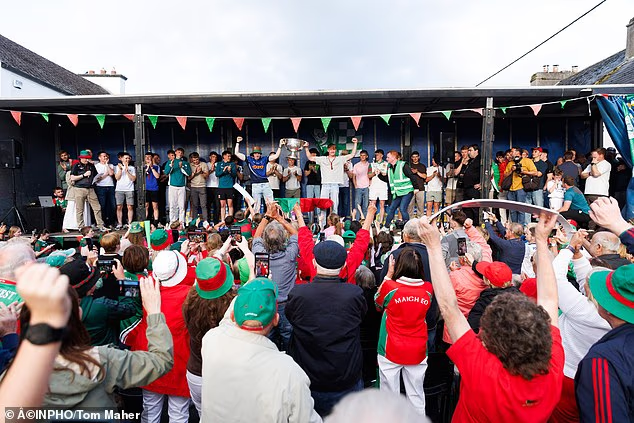
Mayo celebrate their All-Ireland, ending the county’s 75-year wait to lft the Sam Maguire cup
For all the talk of how gracious Kerry were when losing to Mayo two weeks ago, the overriding feeling down south will not be delight at Mayo ending their famine. Paul Galvin said as much in an interview with Gordon Manning of the Irish Times during the week.
‘I’m still disappointed because what has got lost in probably the significance of the Mayo win is the significance of the Kerry loss. It’s a bad loss for us… and hopefully the analysis will happen whereby there’ll be a few bits, maybe look back at 2023 and maybe look at 2019 and 2011 to see if there are any threads tying these losses together.’
The three other defeats he mentions are illuminating for a couple of reasons. Each of those defeats was at the hands of Dublin, most notably 2011, when Galvin could only watch as Stephen Cluxton’s winning free sailed over his head. Probably the one consolation in defeat to Mayo was that at least it wasn’t another final loss at the hands of the Dubs.
The other is, despite Kerry’s 39 All-Irelands, how the years of crushing disappointment roll off Galvin’s tongue just as easily as those franked with success.
For me, my favourite All-Ireland actually was the one when I was eleven, 12-man Dublin’s much-derided 1983 win over Galway. Well…my favourite All-Ireland of the BC (Before Cluxton) era.
Where does Mayo’s rank?
Easily my tenth favourite since 2011.