
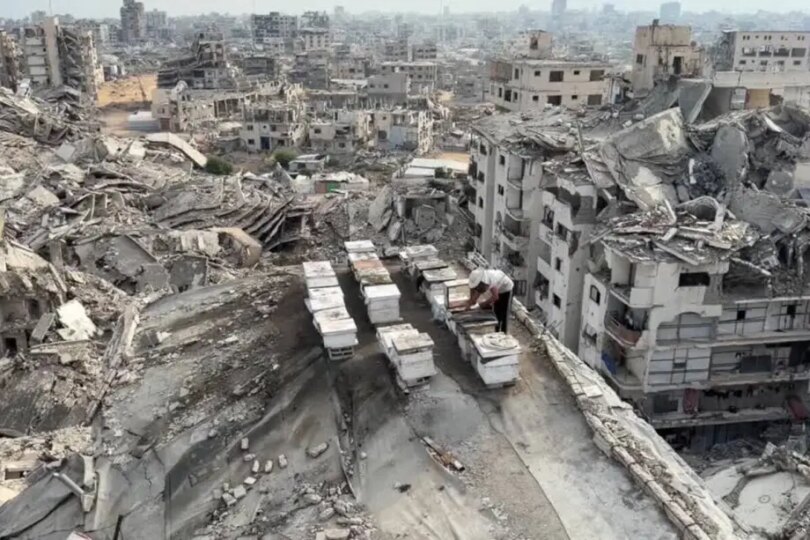
Beekeepers in Gaza who lost their apiaries and livelihoods in Israeli attacks are developing unconventional solutions to revive their profession and recover from the devastation caused by the war, Anadolu reports.
Displaced Palestinian beekeeper Ibrahim al-Dabba has resumed production by placing beehives on the roof of a damaged apartment building in the Tel al-Hawa neighborhood of southern Gaza City as security risks prevent him from reaching agricultural land.
Al-Dabba, who also heads the Gaza Strip Beekeepers Cooperative, told Anadolu that the beekeeping industry provided a livelihood for about 10,000 people across Gaza before the war.
Around 1,000 beekeepers were active in the territory before the attacks, with approximately half large-scale and half small-scale producers, he said, adding that Gaza previously produced significant quantities of honey.
Like most other productive sectors, beekeeping was almost entirely destroyed by the Israeli attacks, according to al-Dabba.
Beekeepers attempted to resume production following the ceasefire but received insufficient support, he said.
The number of beehives in Gaza fell below 500 after the war but has since increased to about 3,000 through a recovery plan developed by the cooperative. More than 100 beekeepers have also returned to production.
READ: Israel rejects Gaza ‘roadmap’, raises reservations over international force role: Channel 14
Despite the improvement, the sector continues to face severe difficulties because almost all essential beekeeping equipment is prevented from entering Gaza.
“Nearly all the equipment used in beekeeping, particularly frames, wax foundation sheets, medicines, treatment supplies and wooden hives, is not allowed into the territory,” al-Dabba said. “Everything we need is in short supply.”
Al-Dabba said he restarted his own operations with just three beehives after the war but has since expanded to more than 35.
‘Seeing the bees survive gave us hope’
Agricultural areas are largely inaccessible because many are situated near border zones, forcing al-Dabba to move his hives to the roof of the damaged apartment building.
Wooden hives placed in open areas are also vulnerable to theft and destruction, he said. Wood itself has become increasingly valuable because of restrictions affecting the entry of fuel and other essential supplies.
Reaching the rooftop hives presents another challenge, but the bees’ successful adaptation to the unusual setting has encouraged the displaced beekeeper.
“When we saw the bees clinging to life here, it gave us hope too,” al-Dabba said.
He added that Gaza’s beekeepers remain determined to continue their profession and restore the sector despite the severe conditions across the Palestinian enclave.
READ: Israeli ministers call for renewed Gaza attacks, rejection of Trump’s ceasefire roadmap