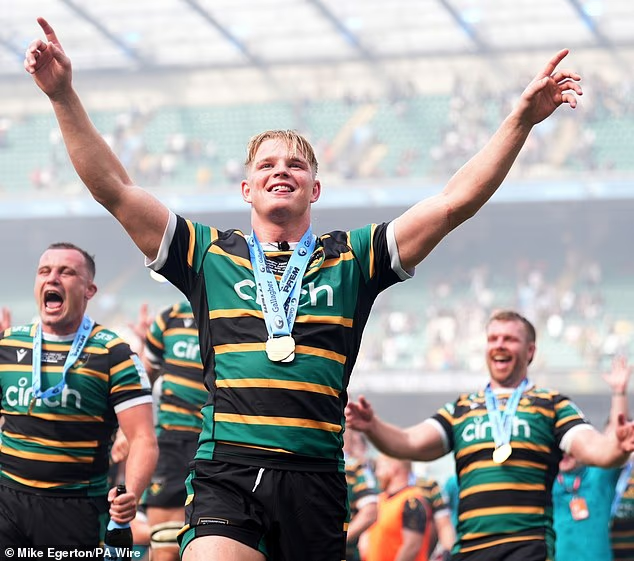
Eddie Hearn sent shockwaves through the rugby news cycle recently when he proclaimed that Henry Pollock should be earning £1m (€1.16m) a year.
‘He’s certainly a seven-figure player,’ the prominent and bombastic sports promoter told the Daily Telegraph recently.
‘The way rugby’s going and what Pollock is doing, his value over the next couple of years will skyrocket, and I think the value of rugby will.’
Ah here. Hearn knows what he’s doing. Like every good agent, he’s trying to get the best deal for one of his clients. Pollock, as it happens, is out of contract with Northampton next summer.
The 21-year-old is clearly a rising force in the game. The all-action openside flanker already has 13 England caps to his name. He was part of Andy Farrell’s Lions squad that toured Australia last summer.
Hearn reckons Pollock is a £1m player
Pollock is understood to be earning £150,000 (€175,000) per year from the English Rugby Football Union (RFU) as an enhanced elite player squad member with England.
Having signed up with Hearn’s Matchroom agency in March, Pollock has already secured some lucrative commercial deals, including Nike. A big character, he is prominent on social media and it is telling that Pollock describes himself as a ‘digital creator’ on his Instagram account, with no mention of his rugby exploits. He is a card-carrying member of the TikTok generation.
He’s a good player with a high ceiling, but a marquee signing who could command a whopping seven-figure sum, going forward?
Hearn has never lacked ambition, but the recent chat around Pollock’s future pay packet is fanciful, for several reasons.
For starters, the Northampton backrower is not in the world class bracket, yet. He’s become a fan favourite at Franklin’s Gardens, but he has yet to nail down a starting spot with England. Head coach Steve Borthwick has preferred to utilise Pollock as an energetic impact sub. And it suits him at the moment.
He is not currently in a position to demand such a deal. There is also the small matter of the salary cap in England. And English rugby is hardly flush with cash at the moment either. It’s an issue across professional rugby and has been for some time. Few clubs are turning a profit these days and Hearn’s assertion that multi-million contracts are suddenly going to land at negotiating tables is delusional.

Eddie Hearn has never lacked for ambition
It’s also worth stating that only a handful of top Test stars are earning these kind of eye-watering sums.
It is believed that Finn Russell, who is also represented by Hearn, is the only player in the English Prem who is commanding a salary of £1m a year.
The mercurial Scotland out-half, 33, is closing in on a century of international caps while he started all three Tests in last summer’s victorious Lions tour.
Russell is the real deal. Bath had to break the bank to lure him away from Racing 92, who aren’t short of a few bob, and that is reflected in his contract.
Pollock can’t make any of those claims at the moment. He would need to go abroad to significantly boost his take home pay, but England’s stance on selecting overseas-based players is a powerful bargaining tool. The IRFU applies the same rules.

Russell, right, is the real deal unlike Pollock
As for Pollock’s supposed marketability, we’re not so sure about that argument either.
‘Northampton have to recognise what they have got,’ Hearn argued.
‘Henry Pollock drives season ticket sales. Henry Pollock puts bums on the seats. Henry Pollock drives viewership. Henry Pollock sells shirts, right.’
Is he really that much of a superstar at the moment? We’re also talking the club game in England.
It’s a fairly small market, particularly when it comes to finances. This isn’t the Premier League or the NFL.
There are a handful of England players who would be earning six-figure deals at the top end, namely Maro Itoje, George Ford and Marcus Smith.
Even in the Top14 in France, with it’s big-money backers, sold-out arenas and bumper TV deals, there are only a few players who are on seven-figure deals. Toulouse star Antoine Dupont, a generational talent, is believed to be one of the chosen few.
Japan’s League One is another competition which attracts blockbuster names with the lure of big pay deals. Springboks stars such as Pieter-Steph du Toit, Jesse Kriel, Damian de Allende and Malcolm Marx are all understood to be earning salaries in the region of €750,000 per season. None are on seven-figure deals, mind.
When it comes to Ireland’s top players, none of Farrell’s frontliners are likely to break the €1m threshold anytime soon.

Pollock’s marketability is open to question
The likes of Caelan Doris, Dan Sheehan, Tadhg Beirne, Andrew Porter and Josh van der Flier are all earning healthy salaries, believed to range from €500,000 to €700,000 a year.
The big question is whether any of the current Ireland regulars are worth seven figures?
There is one player who could make a strong case. At this point in time, Jamison Gibson-Park is the most valuable Irish player in the system.
Now 34, the New Zealand-born scrum-half has been the fulcrum of Farrell’s Ireland since his breakout season in 2021.
Dupont is undoubtedly the premier scrum-half in the game, but Gibson-Park is a close second. On his day, he has the ability to bend matches to his will. Twickenham in the Spring a recent example.
Ireland are a simply a different team when Gibson-Park is on the field. Farrell’s main priority to keep the Leinster half-back fit and firing over the next 16 months, with the 2027 World Cup on the horizon.
He is undoubtedly the most important player in Farrell’s plans. That’s been the case for a while. Gibson-Park is now a Test Lion as well. Another big claim to add to an already burgeoning CV.
If push came to shove, Gibson-Park would have a serious case to make at his next round of contract negotiations. Luckily for the IRFU, he is locked into his current deal until the conclusion of the 2027/28 season. A player worth his weight in gold.

Dupont is a generational talent
We won’t be seeing an Irish player on a seven-figure deal for a long, long time. Maybe never.
Pollock, meanwhile, needs to park all the off-field stuff, particularly his salary demands, and focus on what really matters: delivering for his club and country.
When he has achieved the same body of work as the likes of Russell and Gibson-Park, he can start talking about the big bucks.