IT’S been a long season for Irish rugby and its recent conclusion marked a significant anniversary — 30 years since the first term of professional rugby ended in 1996.
The game in this country was in a much poorer state back then — with the IRFU embroiled in a desperate game of catch-up as Irish rugby staggered around uncertainly throughout the grim 1990s. Things eventually began to solidify and turn with the new century and from there to here has been largely a tale of progress and success.
So, to mark the occasion, we thought it fitting to compile a list of the top 50 Irish rugby players over the last 30 years – some who straddled both eras.
These subjective compilations can never be definitive and it is important to add the qualifier that ‘top player’ does not simply equate to ‘best player’, in some cases it also factors the individual’s overall impact on the game here – especially in the context of when they played.
So, that said, here we go…
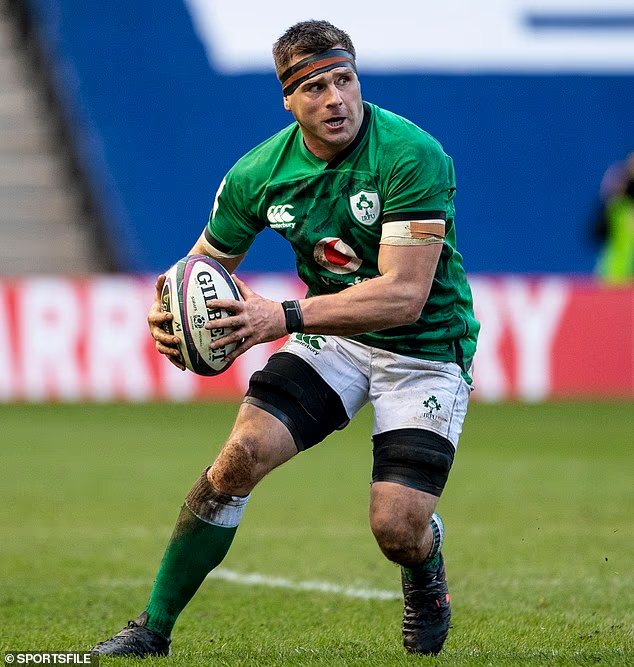
South African CJ Stander had an incredible work-rate when he played for Ireland
50 CJ Stander
The South African gave his all for Munster and, once he qualified through residency, Ireland. Not the most nuanced of No8s, nor the biggest (the reason he left South Africa in the first place), Stander made up for it with his incredible work-rate and will power. It won him many admirers among team-mates and supporters and, while his ‘head down and charge’ philosophy was quite limited, it proved hugely effective for province and country.

For a period in the mid-2000s, Denis Leamy was among the best backrows in the world game
49 Denis Leamy
There was a period around 2005-06 when the Tipperary man was playing at a level that set him alongside the elite backrows of the era – the likes of Richie McCaw, Schalk Burger and George Smith. Injury issues and stiff competition for the Ireland backrow slots were challenging through his career, and there were consistent debates over whether he was best positioned at blindside, openside or No8. But when Leamy was on form, he was irrepressible.

Paul Wallace lining out for Ireland in 2002, the prop was sensational for the Lions in 1997
48 Paul Wallace
Wallace was unfortunate to be at his peak in the mid-to-late 1990s when Ireland were still way off the pace and struggling to find their way in the professional era. Built like a tank with the speed of a centre, the tighthead was hampered by the fact Ireland were generally on the back foot when he lined out for them. However, when called up late to the 1997 Lions tour to South Africa, surrounded by the best Britain and Ireland had to offer, Wallace came into his own and was a critical factor in the series victory as he quelled the mighty ‘Ox’ – Os du Randt.

Jeremy Davidson claims lineout possession for Ireland against Western Samoa in 1996
47 Jeremy Davidson
Like Wallace, Davidson’s Ireland career never hit the heights he achieved on that Lions trip in 1997 – due to persistent injury complications and the challenging environment in Irish rugby during that difficult period. However, for that series win in South Africa, Davidson was sensational – providing Ian McGeechan’s side with a steady stream of possession out of touch and earning the players’ player of the tour award.
46 Rob Henderson
Henderson was one of the players who helped Ireland properly make the jump from amateur to professional around the turn of the century, and properly came into his own as Warren Gatland’s side started to make waves in the Six Nations. A no-nonsense crash-it-up No12 on the surface, Henderson also had a jink and eye for a gap that served him well, along with the ability to put others into space after the initial incursion was made. It made him the perfect foil for the emerging Brian O’Driscoll outside, and it all came together spectacularly in the Lions’ first Test at the Gabba on the 2001 tour when the Irish centres ripped the Aussies apart.
45 Jared Payne
The Kiwi was not a big name in these parts when he arrived to take up a gig with Ulster in 2011. He had an excellent reputation in New Zealand but, with the path to the All Blacks midfield clustered with high-quality contenders, Payne chanced his arm abroad and, when he qualified on residency, he became a notable asset for Ireland. Natural intelligence and all-round efficiency made him the ideal Joe Schmidt player and he excelled under the coaching of his fellow Kiwi, so much so that he made the 2017 Lions tour to his home country where he performed with distinction before being forced off with injury. Payne’s rugby smarts made him much in demand as a coach – most recently by Munster.
44 Peter Clohessy
The legendary ‘Claw’ had a remarkable career in the way he transitioned from being the epitome of the amateur era to a modern all-singing, all-dancing prop in the professional era – including a switch from tighthead to loosehead. Unlucky to miss out on the 1997 Lions tour due to injury, the innately hard Young Munster man came into his own in the late 1990s and early 2000s for Munster and Ireland, when he was into his 30s. The only regret is that professionalism did not come along sooner for a prop who, at his best, was as good as any in the world.
43 Devin Toner
Ireland’s lineout inconsistencies over the past few years remind us of just how effective Toner was for the national team through the 2010s. It was not just his 6ft11in height, it was astute calling, athleticism and soft hands that virtually assured Ireland of quality lineout possession throughout the 2010s. Toner worked hard on other parts of his game also and became a mainstay of the Joe Schmidt era. He was there for all the big days, including the historic first win over New Zealand in 2016. On the back of all this, the decision to leave Toner out of the 2019 World Cup squad and parachute in South African Jean Kleyn will go down as one of the worst in Irish sporting history.
42 James Lowe
There was a lot of negative reaction recently to the decision to allow Lowe to exit the Irish system and finish his career in Japan. However, the reality is the popular Kiwi would be in his mid-30s come the World Cup, and there were signs of fading effectiveness – not least on his difficult Lions tour to Australia in 2025. Jittery defence was an ongoing issue through his Leinster and Ireland career but, when Lowe was at his peak for province and adopted country, he was sensational in attack. His strength in the tackle and ability to execute passes in heavy traffic marked him out as something exceptional and a constant threat on the left wing.
41 Malcolm O’Kelly
The big St Mary’s man was an understated figure in the game and kept a relatively low profile despite his 6ft9in size. But O’Kelly was a hugely influential figure for Leinster and Ireland for well over a decade – from the chaos of the mid-to-late 1990s right up to being part of Grand Slam and European Cup-winning campaigns in 2009. As well as putting his height to good use out of touch, O’Kelly was a superb footballer and could be a major weapon in the loose. He ended up with a massive caps total of 92 and made the Lions tours in 2001 and in 2005.
40 Keith Earls
Son of legendary Young Munster flanker Ger (widely regarded as the best player never to play for Ireland), the word was out early on as the talented Limerick youngster broke into the Munster set up when still a teenager.
Blessed with natural searing pace and exceptional skills (he once chipped the ball into his hands at full tilt for a try at Musgrave Park), Earls made the Lions tour to South Africa in 2009 before he had even properly established himself with Ireland. He went on to become a go-to pick for Declan Kidney and then Joe Schmidt and his IRFU contract in the Andy Farrell era was extended up to the 2023 World Cup by which point one of the great Ireland careers
had hit 100 caps.
39 Shane Horgan
Horgan was part of the ‘fantastic five’ newbies selected for the Scotland match in 2000 – a day now viewed as the major turning point in Irish rugby history. Standing 6ft 4in tall and with power to go with it, Horgan was initially seen as a powerhouse inside centre, but it was on the right wing where he proved to be most potent for Leinster and Ireland – also earning three Lions Test caps off the bench in 2005. Horgan’s aerial ability, long reach and natural power made him a handful for any wing opponent, and his key tries against England in 2006 and 2007 (in Croke Park) made the Meath man a national hero.
38 John Hayes
The big farmer from Cappamore started out as a second row for Shannon in the mid-1990s but a spell in New Zealand saw him switch from the engine room to tighthead prop and things really started to take off for ‘The Bull’.
He worked his way into the Munster side first and was one of the five new caps who helped transform Ireland’s fortunes in 2000. Then, for more than a decade, Hayes became essential to the national side’s ambitions in a problem position. He gave Ireland a solid platform for over 10 years and was regarded by Paul O’Connell as the world’s premier lineout lifter.

Paddy Johns gave Ireland a hard edge and helped turn then around after a torrid time in the 90s
37 Paddy Johns
Younger Irish rugby fans may not be aware of Johns, whose time in green extended back deep into the amateur era, as far as 1990 and his debut against Argentina. A hero in Dungannon, the 6ft7in dentist was an absolute gentleman off the pitch but fearsome on it and would never take a backward step regardless of the opposition. The role he played as captain on the 1998 tour to South Africa set things in motion to haul Ireland out of the dark days of the 1990s and properly into the pro era. Warren Gatland’s Irish side were completely outsized and outclassed by the Springboks but, led by Johns, they fronted up repeatedly and laid down a marker for what was to follow.
36 James Ryan
The Ireland Under-20 star was mapped a long way out and burst onto the international scene in 2017 before quickly establishing himself as a crucial member of Joe Schmidt’s Grand Slam winning side the following year. Ryan was seen as locked-in for the Ireland captaincy at one point but, while that did not come to fruition, the 6ft7in Leinster grafter has been a quality, unfussy operator in the Ireland second row for nearly 10 years. Iain Henderson was a good servant and Joe McCarthy has bags of potential but Ryan, just turned 30, looks like he could be hitting his peak years. He did well on the Lions tour last year and the signs are encouraging that he is well on his way to becoming an Ireland centurion.
35 Anthony Foley
It is hard to fathom that it is nearly 10 years since the death of the Shannon, Munster and Ireland No8. The impact of Foley on Irish rugby cannot be overstated — he was the beating heart of the Shannon side that dominated the AIL in the 1990s, and then the Munster side that helped revolutionise the game in this country through the 2000s. Never the biggest, strongest or fastest but ‘Axel’ was a brilliantly intuitive No8 who had the knack of seeming to be always in the right place when the ball arrived. The outpouring of respect and grief worldwide after his passing emphasised Foley’s status.
34 Donncha O’Callaghan
The ever-colourful Corkman has forged an impressive and successful media career since his rugby retirement and it has added to the reputation of O’Callaghan as a ‘character’. But, while O’Callaghan’s joviality could never be denied it should not take away from his immense on-field contributions for Munster and Ireland where he selflessly threw himself into contact for the benefit of others, whose respect for the second row was through the roof. The ultimate workhorse.
33 Eric Miller
Pound for pound, Miller is one of the most naturally gifted players to have played pro rugby. The backrow’s career was bedevilled by injury but when he was fit and firing, Miller proved himself to be an elite performer capable of stepping up to any environment — be it Leicester Tigers, Leinster, Ireland or the Lions in 1997 (when he was very close to a Test starting spot) — with an all-court, flowing style that could be mesmerising to watch.
32 Hugo Keenan
Given his excellent return to form following an extended period out with injury, Keenan could end up higher in this list in years to come as there is still plenty for the full back to offer. Not flash in any way, Keenan is calmness personified at the back for Ireland and Leinster, smoothly mopping up any mess and is capable of putting his Sevens experience to good use in attack when called upon. A key component of the successes under Andy Farrell.
31 Luke Fitzgerald
Outrageously gifted speedster capable of playing across the backline, Fitzgerald was just one of too many players to have their careers compromised by injury. But Fitzgerald had all the skills and, when on his game, he was capable of ripping any defence asunder. His superb form in Ireland’s Grand Slam run in 2009 got him on the Lions tour where he again shone, only for Schalk Burger to gouge his eye and stall his momentum after he had forced his way into the Test side.
30 Tommy Bowe
IT would be no exaggeration to describe Bowe as a cult hero in Irish rugby. There are a number of reasons for this: one was his happy knack of scoring dramatic tries; two was the fact that commentator Ryle Nugent’s ‘Tommy Booooowwwweeeee’ description of those tries caught the public’s imagination and three was Bowe’s engaging personality, encapsulated by his lusty rendition of ‘Black Velvet Band’ after Ireland won the Grand Slam. It all made Bowe hugely popular and influential within Irish rugby circles and he was a world-class winger in his pomp — as he showed on the 2009 Lions tour when he became a fan favourite. He has put his cult status to good use with a successful career in the media.
29 Robbie Henshaw
SOMETHING of a boy prodigy when he broke through with Connacht in 2012 and then Ireland the year after, Henshaw is still going strong nearly a decade and a half later and has been a model of consistency and excellence over that extended period. Capable of playing in either centre role, or at full back, as required, Henshaw has been a central figure in Ireland’s progress up the international rugby ladder in the Joe Schmidt and Andy Farrell eras and, with Leinster since 2016, Henshaw has also featured prominently with the Lions in 2017 and 2021. He has faced stiffer competition in recent years, as well as various injury issues, but Henshaw’s status as one of Ireland’s finest centres remains unassailable.
28 Gordon D’Arcy
THE perfect foil for Brian O’Driscoll for the bones of 10 years, D’Arcy may have existed somewhat in the great man’s shadow but was a massively effective presence in the Ireland midfield in his own right. Indeed, when O’Driscoll was injured after the 2003 World Cup, D’Arcy really came into his own – tearing defences to shreds on his way to picking up the 2004 Six Nations Player of the tournament. Following that, the two changed thinking on midfield partnerships from traditional cudgel and rapier approach to having like-for-like centres – fast and low to the ground. D’Arcy made it onto two Lions tours although neither went his way but his Ireland and Leinster careers mark him out as a centre of special quality.
27 Bundee Aki
THERE have been a healthy number of southern hemisphere players to pull on the Ireland jersey in the pro era – some good and some not so good – but none have had the cultural impact of Bundee Aki since he landed over to play with Connacht. A string of exceptional displays for province and country marked Aki out as a special talent at inside centre. Hugely powerful and devastatingly fast off the mark, Aki’s capacity for game-changing interventions is the reason why he is still in the mix for the World Cup next year when he will be heading into his late 30s.
As well as his playing talent, Aki’s natural exuberance has won over everyone – including the wider Irish public who may not know too much about rugby but know a genuine star when they see one.
26 Garry Ringrose
IRELAND have been blessed in the outside centre department through their history. For years, it was the peerless Mike Gibson lighting it up in midfield through the 1960s and 1970s and then, in the mid-1980s, the gifted Brendan Mullin held down the jersey for a decade. He was followed by fellow Leinster man Brian O’Driscoll and when Ireland’s finest stepped off the stage it 2014, it was not long before Garry Ringrose was stepping up. Since his debut in 2016, Ringrose has been pretty much an ever-present in the No13 jersey ever since – so much so that finding like-for-like cover at outside centre has become a major issue ahead of next year’s World Cup.
As a centre, Ringrose in the full package – with the pace of a winger, an eye for the break and excellent distribution skills. In recent years, he has added notable steel to his game and he is a worthy member of the elite Ireland No13 club.
25 Rory Best
AS a player, Best was a high quality hooker – especially effective in the scrum – good enough to make two Lions tours but not quite at the elite level of the the great No2s of his era such as Bismark Du Plessis or Dane Coles. What made Best really special were the intangible qualities he brought to every team he played for, the ability to lift those around him and inspire them with his ‘follow me’ approach to the game. It made Best a superb Ulster and Ireland captain when he took over the national team in 2016 and it was no coincidence that it was under his leadership that they ended their 111-year wait for victory over New Zealand a few months later. Universally popular and respected, Best will be remembered as a giant of the Irish game.
24 Jerry Flannery
LIKE Stephen Ferris, Flannery would have been a shoo-in for the Lions Test team in 2009 only for injury to ruin his chances. It is not green-tinted to claim that between 2006 and 2009, Flannery was up with the best hookers in the game – hugely physical in all areas of contact in loose and tight and supremely accurate in his key duty of lineout throwing. The Limerick man’s attention to detail made him a consistent source of excellence for Munster and he was a key figure in the European Cup, Triple Crown and Grand Slam successes that he gained over that period. Since injury forced him to quit playing, it is no surprise that Flannery has become one of the game’s leading coaches.
23 Andrew Porter
ONE of the hardest working props in rugby, Porter has been a rock-like presence in the Ireland front row since breaking through in the late 2010s. His career has gone through a number of transitions in that time – from loosehead to tighthead and possibly back again – but he has fronted up to every challenge, gaining global respect along the way. Excellent in tight play and around the park. Porter has been a frontliner on the last two Lions and his candour with the media and in his autobiography has made him one of Ireland’s most popular players.
22 Calean Doris
THROUGH Ireland’s run of success under Andy Farrell that ran from late 2021 up until the 2023 World Cup, Doris was not only Ireland’s best and most effective player, he was also operating as the top No8 in the world game. A commanding presence on and off the pitch, his ascension to the Ireland captaincy following the retirement of Johnny Sexton seemed a natural evolution and, were it not for particularly cruel injury, Doris was right in the mix to lead the Lions to Australia last year. Still only 28, the Leinster man has plenty of opportunity to add to his status and become a true Irish rugby great – leading Ireland to a first World Cup semi-final next year would be a good way to go about it,

Denis Hickie goes on a run
21 Denis Hickie
MUCH has been made of the searing pace of Rober Baloucoune and Tommy O’Brien recently but we reckon that Hickie in his peak years would burn them both.
The St Mary’s flyer was a natural sprinter, an out-and-out gas merchant who had the ability to turn any opponent inside out and was Ireland’s record try-scorer until he was overtaken by his friend and colleague Brian O’Driscoll.
Even though his career began in the late 1990s when Ireland were still all at sea, Hickie made an instant impression and, when injury did not get in his way, was lethally effective for Leinster and Ireland until his retirement post-2007 World Cup. The likes of Geordan Murphy, Mack Hansen and James Lowe have brought something different to Irish wing play over the years but in terms of speed and predatory skills out wide, Hickie was different level.
20 Jamie Heaslip
HAVING been ridiculously overlooked for the 2007 World Cup, along with the likes of Stephen Ferris and Alan Quinlan, Heaslip embarked on a run of form over the next few years that looked like he was playing with something to prove. It certainly benefitted Leinster and Ireland as Heaslip was a driving force behind subsequent European Cup, Six Nations and Grand Slam glories. It also propelled the uber-talented No8 onto two Lions tour and his form in the 2009 Tests garnered huge praise against the much vaunted Springbok backrow. At his peak, Heaslip ranked alongside top drawer No8s of the calibre of Imanol Harinordoquy and Kieran Read.
19 Stephen Ferris
FOR a player whose career was so compromised by injury and misfortune, Ferris being so high up this list shines a light on just how good the Ulster backrow was. Between 2009 and 2012, a fit and firing Ferris was among the finest flankers on the planet – his form in Ireland’s Grand Slam run and Lions tour in 2009, as well as in the World Cup in 2011 was exceptional. Blessed with natural bulk, Ferris was often likened to a Springbok forward as he overpowered all-comers with his ‘beast-like’ style of play. Unfortunately injury was a constant thorn, denied him a guaranteed Lions Test spot in 2009 and forcing his early retirement a few years later.
18 Cian Healy
ANOTHER Irish centurion who provided world-class excellence in the front-row for a decade and a half, Healy started out as a rampaging young bull in the late 2000s and became a solid mainstay of the Ireland pack until his retirement last year having amassed an Irish record total of 137 caps. At his peak, the Leinster loosehead was the equal of anyone in the game and earned the respect of tighthead props across the globe. Prop was never a glamorous position but Healy’s style and charisma inspired others to the point where loosehead is now a position of considerable strength in the Irish game.
17 Dan Sheehan
IRELAND have always been well served at hooker, going all the way back to Karl Mullen and Ronnie Dawson, onto Ken Kennedy, Ciaran Fitzgerald and Terry Kingston and right through to the professional era of Keith Wood, Kerry Flannery and Rory Best. Sheehan is the latest No2 to mark himself out as something special. Big fast and physical, Sheehan is right up with Malcolm Marx of South Africa in terms of elite hookers and his remarkable penchant for scoring tries might nudge him ahead. His leadership skills have been recognised with the Ireland captaincy and, still only 27, his impact will be felt for years to come.
16 Peter Stringer
Before the diminutive Corkman came on the scene in the early 2000s, scrum-half had been a revolving door in the Ireland team. Check out this list of No9s through the 1990s – Michael Bradley, Fergus Aherne, Rob Saunders, Alain Rolland, Chris Saverimutto, David O’Mahony, Stephen McIvor, Niall Hogan, Conor McGuinness, Brian O’Meara, Tom Tierney and Ciaran Scally. For the next 10 years, it was mostly just Stringer, who went on to win 98 caps for his country and became one of the poster boys of the Irish team – his size, distinctive look and fearless style (typified by crucial ankle taps) winning over legions of new fans.
Stringer was a passing scrum-half first and foremost and was seen as too one-dimensional for the Lions but his pass was the best in the world at the time and played a significant role in Ireland’s climb up the rugby ladder.
15 Tadhg Furlong
Furlong filled a vital role for Ireland after the retirement of scrum fulcrum Mike Ross. The Wexford man is not only a superb operator at set-pieces, the tighthead is also a brilliant presence around the field, with speed and a jink that defy his bulk and deft hand skills to make him a valuable link option in attack. Generally vying for the title of best No3 in world rugby with various monstrous South Africans, Furlong has been a Test regular on three successive Lions tours. Such is his importance to Ireland, the nation’s plan to end their 40 years of World Cup failure next year could very well hinge on Furlong’s availability.
14 Jack Conan
Caelan Doris tends to attract more praise and attention, especially since he acquired the captaincy, but Conan has been quietly excellent around Irish rugby for more than a decade and, were it not for the preference shown for the industrious but more limited CJ Stander, the Leinster backrow would have far more caps than the 62 he has acquired to date. The ultimate all-rounder, strong in every area, the esteem Conan is held in is evidenced by the fact he has started the last six Tests for the Lions.
13 Sean O’Brien
BEFORE Ireland ended their New Zealand hoodoo in 2016, th e All Blacks did not tend to pay too much attention to their opponents, beyond Brian O’Driscoll, when they played the Irish. But one player who consistently rattled the Kiwis and earned their respect and attention was the ‘Tullow Tank’ Sean O’Brien. The Carlow man was a no-frills backrow who became adored by Leinster, Ireland and Lions fans for his all-action, uber physical approach and tackle-smashing charges. O’Brien was a charismatic and inspirational figure in Irish rugby for a decade after his 2009 debut, and whose world-class quality was recognised further on two Lions tours.
12 Conor Murray
WITH all the praise being flung in Jamison Gibson-Park’s direction, it can be easy to forget just how good and influential his predecessor Conor Murray was in an Ireland jersey. Scrum half has never been a marquee position in Irish rugby and, until Murray got selected in 2013, Ireland had not had a No9 on a Lions tour since John Robbie and Colin Paterson in 1980. Murray burst onto the scene at the 2011 World Cup and combined ‘ninth forward’ physicality with skill and wit and pace and verve. Between 2014 and Covid, the Limerick man was up with Aaron Smith on the top tier of scrum-halves and his partnership with Johnny Sexton was the match of any half-back pairing in the world game – for Ireland and the Lions. A class act.
11 Peter O’Mahony
O’MAHONY had to face down the doubters throughout his career, people who questioned his size, his best position and the fact his stats were rarely off the charts.
But face them down he did and the Corkman ended up having one of the great Irish rugby careers, incorporating the Lions captaincy for the first Test in 2017 – where his team were still well in the game until he was subbed off for Sam Warburton in the second half.
With O’Mahony, it was never about stats, it was about attitude and the had the same aura about him that Paul O’Connell carried – a player O’Mahony lined out alongside in his early years and one he greatly admired.
By the time he retired last year, O’Mahony had well over 100 caps, had served successfully as Ireland captain and the doubters had long since been shushed – his popularity has helped him promote a successful post-rugby career in gardening.
10 Jamison Gibson-Park
Gibson-Park arrived over to Leinster as an unheralded scrum-half from New Zealand and quickly proved himself to be a decent No9 without ever setting the world alight as he did his residency quaification time. However, with Andy Farrell taking over as coach and the great Conor Murray coming to the end of his storied career, Ireland management saw someting in the Kiwi and elevated him up the pecking order into the starting team. They have been rewarded with more than four years of excellnce, so good that Gibson-Park has been mentioned alongside Antoine Dupont as the world’s finest.
9 Rob Kearney
ANYONE wishing to see just how good Kearney was in his pomp need only to go on YouTube and revisit the first and second Tests on the Lions tour to South Africa in 2009.
Coming off the bench for Lee Byrne in the first Test, and starting the second, Kearney produced two breathtaking displays of full-back excellence. Combining defensive excellence (Kearney always said the full back was a rugby team’s goalkeeper) with wit and pace in attack, the Leinster man’s consistency and high standards made him the finest Irish full back of the professional, or any, era.
8 Tadhg Beirne
BEIRNE will go down as one of Irish rugby’s greatest comeback success stories after he was let go by Leinster and considered quitting the game altogether before getting a shot with Scarlets in Wales, A series of exceptional performances there earned him a move back to Ireland with Munster and his international career took off. Defined by his trademark blue scrum cap and relentless ability to win turnovers, Beirne has been one of Ireland’s best and most consistent performers over the last five years. His quality has not gone unnoticed outside Ireland, excelling on the Lions tours of 2021 and 2025, when he was named Player of the series.
7 David Wallace
WALLACE should have won many more caps than he managed under in the early 2000s when injury and a preference for Keith Gleeson got in his way. However, once Wallace secured his regular starting spot, the Munster man became one of the game’s most effective backrows. Not a traditional openside in the groundhog sense, Wallace was more of a hybrid backrow in the mould of exceptoinal England’s flanker Richard Hill. Immense for Ireland’s 2009 Grand Slam, he was one of the first names on the Lions Test team-sheet that summer. Up with the very best.
6 Josh van der Flier
IRELAND have had some exceptional openside flankers over the years and Van der Flier ranks right up there alongside the late and great Fergus Slattery. Although it took a while to nail down the No7 jersey on the Ireland team, Van der Flier has made it his own in the past few years – to the point where one of the fears surrounding Ireland’s World Cup campaign next years is their over-dependance on the durable Leinster flanker. He has been hugely influential in the Andy Farrell era, peaking for the series win in New Zealand in 2022, the year he picked up World Player of the Year.
5 Paul O’Connell
When O’Connell mania was at its height in the mid-2000s, he was afforded almost God-like status with ‘Superman wears Paul O’Connell pyjamas’ one of the catchphrases of the day. The Young Munster man did not fall easily into the second row slots of enforcer (Bakkies Botha) or gazelle (John Eales), he formed a category all of his own somewhere in between the two. Superb in the lineout and a relentless physical presence in the forwards, O’Connell’s greatest quality was the aura he carried every time he took to the pitch. It was a Henry V style quality that raised the performance levels of everyone around him and it made him an inspirational leader – the unanimous verdict on his captaincy of the 2009 Lions tour to South Africa (one of his three tours).

Jonathan Sexton of Ireland celebrates after the 2023 Rugby World Cup Pool B match between Ireland and Romania
4 Johnny Sexton
Ireland were blessed to have an out-half of the class of Sexton to follow on from O’Gara. The St Mary’s man may have come onto the international scene sooner were it not for the brilliant Felipe Contepomi blocking his way at Leinster. However, once he did emerge in 2009, Sexton’s quality was clear and once O’Gara was fully off the scene, the Leinster man’s Ireland career ignited under Joe Schmidt, the coach who had got the most out of Sexton at provincial level. A punishing tackler, Sexton also had an eye for a gap and the pace and power to go through it but what truly defined him was the authority and control he brought to any side he played for – excelling for the Lions in 2013 and 2017. The World Player of the Year award sealed his elite status and Ireland’s biggest issue over the last few years has been trying to find an out-half replacement who can come close to replicating his impact.

Ronan O’Gara clears the ball downfield during the RBS Six Nations Championship match between Scotland and Ireland at Murrayfield on March 10, 2007
3 Ronan O’Gara
The controversial pick. No-one doubts O’Gara’s right to claim his place among the pantheon of Irish rugby greats but many would argue that Johnny Sexton ranks above him. At first glance, it is hard to argue that point, Sexton had greater success with the Lions than O’Gara, won World Player of the Year in 2018 and had the more rounded game than his Cork rival – carrying a definite edge in the areas of tackling and power running.
However, Sexton also played at a time when Ireland were more structured and organised than when O’Gara came on the scene – and it was the successes driven to a huge degree by O’Gara that created the environment for Sexton to flourish. Even then, the Leinster man could not see off O’Gara and it was only when the Munster man retired that Sexton was truly able to bed in with Ireland.
O’Gara’s greatest strengths were his force of will, his ability to run a game to his own ends and his capacity to grab the big moments. It lifted Munster (who still have not recovered from his retirement 13 years ago) to a new level and gave Ireland the extra edge they badly needed.
From the nerveless kicks against Australia in 2002, to his expert dismantling of the English in Croke Park in 2007, to the Grand Slam clincher in 2009, O’Gara was Irish rugby’s ultimate deal clincher, laying the ground for what was to follow. Put it this way, if you had to pick one Irish rugby player to nail a touchline conversion to save the planet, who are you handing the ball to?
There’s only one answer to that question boy…
2 Keith Wood
What makes Wood so remarkable is that he emerged as a world-class presence when Ireland were at their lowest point and on the end of consistent humblings throughout the 1990s when the hooker played most of his rugby.
Winning his first cap in 1994, Wood’s displays on the tour to Australia caught the attention of Wallabies head coach Bob Dwyer, who predicted the Garryowne man would be the ‘world’s best hooker’. He was not wrong.
Within a couple of years, Wood was captaining his country before emulating his father, Gordon, by making the Lions tour to South Africa in 1997 where he enhanced his reputation ever further in the 2-1 series victory.
Hugely popular on a global scale, Wood’s impact was such that his all-action running style changed the way hookers approached the game – emerging from the trenches to make their presence felt in the loose.
Throw in the fact he was the first World Rugby Player of the Year winner and you can understand why only O’Driscoll is ahead of him.

Brian O’Driscoll of Ireland in action during the RBS Six Nations Championship match between Ireland and England at Lansdowne Road on February 27, 2005
1 Brian O’Driscoll
Ireland have produced some exceptional players over the last 30 years but O’Driscoll is way out in front and none of his rivals would have a problem with that.
The centre started out when Ireland were still on their uppers in the 1990s, culminating in the humiliating 1999 World Cup loss to a part-time Argentina in Lens, and he then set of on a journey that dragged Irish rugby kicking and screaming into the 21st century right through to 2014 when they were up with the world’s elite.
It was O’Driscoll’s hat-trick of tries in Paris, when he was still just a pup, that got the ball rolling in 2000 and, nine years later, he was the inspirational leader behind Ireland ending a 61-year wait for Grand Slam glory.
Properly describing O’Driscoll’s game is difficult because he had it all – pace, power, evasion, invention, handling, kicking, grit and guile.
Furthermore, as he grew older, O’Driscoll was also able to evolve his game accordingly – like in the second Test against the All Blacks in Christchurch when his astonishing performance of route one physicality almost ended in historic Irish victory.
And, it is also worth noting that, for all the hype and exposure and pressure, O’Driscoll remained the ultimate pro – fully aware of his responsibilities and duties to his teammates, coaches and fans.
A magnificent leader and a magnificent player who is acknowledged globally as one of the finest the game has seen.