Hamas has said it will begin disarming as part of a deal announced by US President Donald Trump that also requires Israel to end its strikes and withdraw from Gaza.
It marks a potential breakthrough in ending the war, but implementation faces major challenges.
Hamas also said that laying down its heavy weapons, which would come later in the process, was contingent on the creation of a Palestinian state, something Israel’s current government adamantly rejects.
Israel has not officially commented on the deal, which is part of a US-brokered ceasefire announced last October.
That agreement called for Hamas to disarm and hand over power to an independent Palestinian administration. Israel was to withdraw, and an International Stabilisation Force (ISF) was to deploy.
But progress stalled, with Israel saying everything hinged on Hamas disarming, and Hamas accusing Israel of violating the agreement by continuing to carry out regular strikes on Gaza.
Disarming would represent a sea change for Hamas, whose founding charter calls for armed resistance against Israel, and which sees its arsenal, including rockets, anti-tank missiles and explosives, as lying at the heart of its identity.
Israel meanwhile appears unlikely to pull back significant forces or make other concessions ahead of its October elections. Prime Minister Benjamin Netanyahu faces a tough re-election battle, with opponents accusing him of failing to prevent the attack on October 7 2023 that triggered the war.
In announcing the latest deal on social media, Mr Trump said it would be carried out in “carefully structured phases”.
“As disarmament is completed, Israeli forces will withdraw, and the International Stabilisation Force will work with a new Palestinian police force to take responsibility for Gaza being safe for its residents and its neighbours,” he wrote.
A copy of the agreement obtained and verified by the Associated Press said that all weapons held by the Hamas-run police will be transferred to the US-backed Palestinian technocratic committee, known as the National Committee for the Administration of Gaza, upon its arrival in the enclave. It is not clear when that would happen since it is contingent on other steps.
A process to decommission and store heavy weapons, military production sites and tunnels will begin after the arrival of the Palestinian committee and the deployment of international forces. The process will be linked to a phased Israeli withdrawal from the parts of Gaza it controls, according to the agreement.
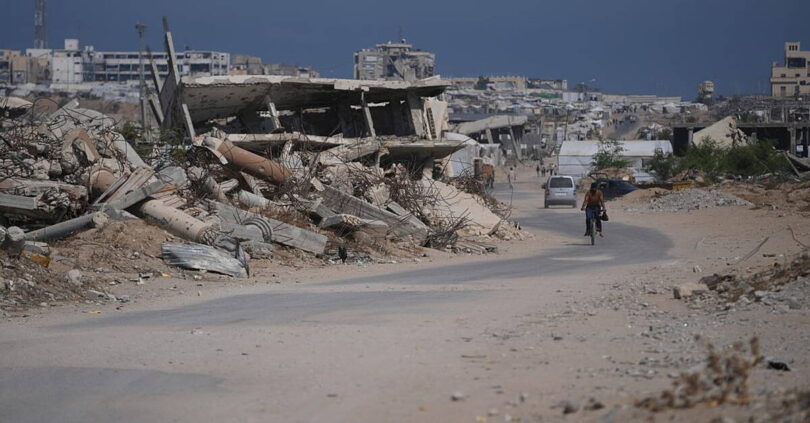
Israel currently controls around 60% of Gaza, areas that have been mostly destroyed and depopulated. Most of the territory’s two million Palestinians are in the other part, where hundreds of thousands live in squalid tent camps and destroyed neighbourhoods.
In a statement on Thursday, an Israeli official said that there will be no Israeli withdrawal before the militant group is disarmed and the strip demilitarised.
A person with knowledge of the situation said that Israel is fully involved, but it is not a signatory to the deal, which is between Hamas and several countries helping to negotiate and guarantee the ceasefire. The deal’s guarantors are the US, Turkey, Egypt and Qatar.
On Thursday, US and Board of Peace officials gave an extremely optimistic assessment. The board was established by Mr Trump to oversee the ceasefire in Gaza.
While Gaza’s police force is expected to hand over its arms, that does not include the vast majority of Hamas militants, and heavy weaponry is not included in that part of the agreement, according to officials.

Instead, the surrender of heavy weapons and the decommissioning of Hamas tunnels and other infrastructure are to come later in a process that could take between 200 and 350 days, a Board of Peace official said. That timeline did not appear in the agreement obtained by AP.
The Hamas official and the regional official involved in the process said that Hamas and other groups agreed to “collect and store” arms inside Gaza under the supervision of the Palestinian technocratic committee and that weapons will not be handed to Israel or non-Palestinian parties.
The officials said this would be a gradual process linked to an Israeli withdrawal.
A US official said Israel, which has been deeply sceptical about Hamas’s willingness to give up its guns or relinquish control of Gaza, had been consulted at every step of the negotiation.
However, the official said Israel was not being asked to do anything more than what it had initially committed to when it agreed to Mr Trump’s 20-point plan, which essentially involves withdrawing its forces from Gaza and committing to ending air strikes on the territory.
A member of the Palestinian technocratic committee told AP on Friday that it was eager to enter Gaza but was concerned Israel will pose challenges. The person said they did not expect to enter Gaza for at least two months.
The committee welcomed the progress on Friday, but said the work to restore public institutions and services and rebuild the territory would be immense.

The war in Gaza began after the Hamas-led attack on southern Israel in October 2023 that killed around 1,200 people and saw 251 taken hostage.
Israel’s retaliatory offensive in Gaza has killed more than 73,000 Palestinians, including those killed since the ceasefire, Gaza’s Health Ministry said.
The ministry, which is part of the Hamas-led government and is staffed by medical professionals, does not distinguish between civilians and militants in its toll but says women and children make up around half of all deaths.