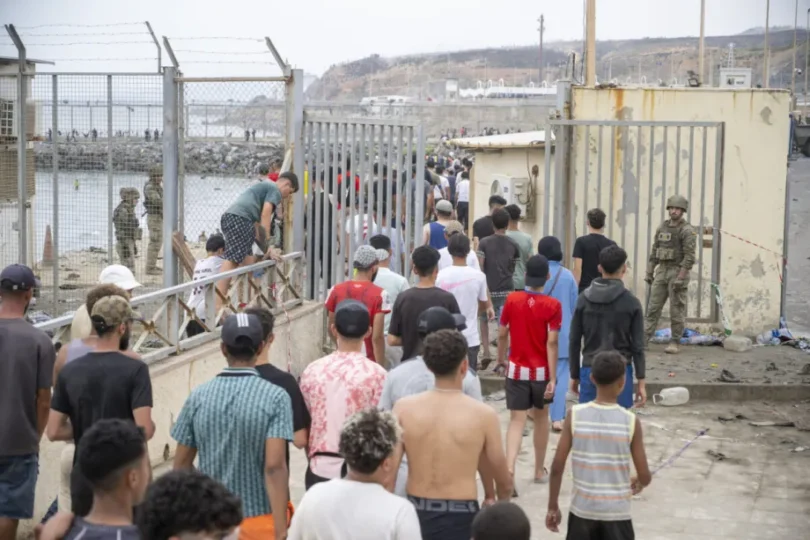
The emergency in Spain’s North African enclave of Ceuta has sparked an intense online debate over Israel’s possible role in efforts to punish Madrid over its outspoken support for Palestine.
The speculation intensified after social media users resurfaced articles published earlier this year by pro-Israel analysts who argued that Israel and the US should aid Morocco over its claim to Ceuta and Melilla as a means of pressuring Spain.
Israeli sources revealed that in March, Michael Rubin, a senior fellow at the American Enterprise Institute, called on Morocco to organise a new “Green March” into the Spanish enclaves. Writing for the US-based Middle East Forum, Rubin suggested that Moroccans approach Ceuta and Melilla with bulldozers, cross into the territories unarmed and raise the Moroccan flag. He framed the proposal as a response to what he portrayed as Spain’s anti-colonial hypocrisy.
A separate article published by the Israeli outlet Ynet in April recommend that Israel could use its influence in Washington to help Morocco “recover” Ceuta and Melilla. The author, Middle East Forum fellow Amine Ayoub, presented support for Rabat’s territorial claim as a means of punishing Spain for challenging US and Israeli policies.
Ayoub proposed three ways for Israel to apply pressure: direct diplomatic signals to support Morocco, lobbying through Washington and repeatedly accusing Spain of hypocrisy over its recognition of Palestine. He concluded that helping Morocco “recover” Ceuta and Melilla would “punish” a NATO member which had challenged US and Israeli policies.
Read: Morocco allows Israeli warship to dock after Spain refused
These earlier proposals have fuelled online debate over the latest crisis. Commentator Bruno Maçães drew attention to the April article, noting that pro-Israel analysts had urged Israel to help Morocco take control of Ceuta as a way of punishing Spain for its support for Palestine.
Analysts at Israel-funded think tanks argued back in April that Israel should help Morocco take over Ceuta in order to punish Spainhttps://t.co/VkV4Gx2qpP
— Bruno Maçães (@MacaesBruno) July 31, 2026
Social media users also shared a 2019 tweet by Yair Netenyahu the son of Israeli Prime Minister Benjamin Netenyahu. “If the situation in Ceuta is the result of the “anti-Israel Spanish Left” why was Yair Netanyahu calling for Arabs and Muslims to “free Ceuta” in 2019?” asked a popular commentator on X sharing Netanyahu’s tweet calling for Muslims to take over Ceuta.
If the situation in Ceuta is the result of the “anti-Israel Spanish Left” why was Yair Netanyahu calling for Arabs and Muslims to “free Ceuta” in 2019?
Why has the Times of Israel continually ran opinion pieces pretending like Ceuta was in need of liberation?
This entire… https://t.co/H6yKSlQ2Cr pic.twitter.com/1Pqkcpy4ff
— Mel (@Villgecrazylady) July 31, 2026
“This entire charade was orchestrated by Zionists to teach Spain a lesson and set an example for other nations if they don’t get in line.”
Details also emerged of Israel’s top diplomat in Spain, Dana Erlich, denying in April that the Israeli government was considering supporting Morocco’s claims over Ceuta and Melilla. She maintained that the matter was not among the Netanyahu government’s priorities.
The resurfacing of the articles coincided with thousands of people crossing from Morocco by land and sea, overwhelming the enclave’s reception system and prompting Spain to deploy police and military reinforcements. At least 19 bodies were recovered from the water as Spanish and Moroccan forces moved to halt further crossings.
These suspicions also drew heavily on a May 2021row, when around 8,000 people entered Ceuta after Moroccan border controls appeared to have been relaxed during a diplomatic dispute with Spain. Spain’s defence minister at the time accused Morocco of “blackmail”, while the influx was widely interpreted as retaliation for Madrid’s decision to provide medical treatment to Western Sahara’s Polisario Front leader, Brahim Ghali.
Morocco’s close military and intelligence relationship with Israel has added to the speculation. The two countries signed a defence agreement in 2021 covering intelligence cooperation, military procurement and defence industries. Israeli-made drones and other weapons have since become an increasingly important part of Morocco’s military modernisation.
Spain, meanwhile, has become one of Israel’s most vocal critics in Europe. Madrid recognised the State of Palestine in May 2024 and subsequently imposed an arms embargo on Israel, prohibited vessels carrying fuel for the Israeli military from using Spanish ports and barred aircraft transporting weapons to Israel from Spanish airspace. Israel denounced the measures as anti-Semitic, prompting Spain to recall its ambassador for consultations.