For several years, officials in Baghdad have maintained a careful balancing act – taking some measures in response to US pressure to reduce Iran’s informal influence in Iraq, while maintaining strong bilateral ties with neighbouring Tehran.
This dynamic has constrained Baghdad’s ability to pursue domestic economic and security reforms, or chart a more autonomous foreign policy.
However, a combination of recent attempts to strengthen Iraqi state institutions, the upcoming withdrawal of US-led Coalition troops from Federal Iraq and the prospect of a US-Iran settlement could allow Baghdad to redefine its relationship with both Iran and the United States.
According to Iraq’s Prime Minister Ali Falih Kadhim al-Zaidi, the new administration’s priority is strengthening the Iraqi state through a programme of institutional reform.
This includes improving Iraq’s access to the international banking system, strengthening the energy sector and trying to enforce a state monopoly over arms.
CLICK FOLLOW: TO FOLLOW US
Sign up to get the latest insights and analysis on
Israel-Palestine, alongside Turkey Unpacked and other eSPORTY
Zaidi, the current prime minister of Iraq since April, is a former banker. He was chairman of Al-Watania Holding Group, a multinational conglomerate, and the former chairman of Al-Janoob Islamic Bank, one of the country’s larger private financial institutions.
Some of these reforms are also likely to restrain parts of Iran’s influence in the country.
Baghdad’s push to reform its banking sector – which began under the previous administration – aims to reduce corruption and improve access to the international banking system.
“While this is not Baghdad’s stated objective, these banking reforms constrain channels through which Iran and Iran-aligned networks exercise influence,” affirmed Hayder al-Shakeri, research fellow at Chatham House.
Iraq has also used its relationship with the US to expand energy partnerships and reduce its reliance on Iranian gas imports.
Diversifying energy partnerships
During his recent visit to Washington, the Iraqi premier signed dozens of partnerships and agreements with US firms, including investments in associated gas projects that would allow Baghdad to capture gas that is otherwise flared during oil production.
Such projects contribute to reducing Iraq’s reliance on Iranian gas imports, which have historically met around 40 percent of Iraq’s gas and electricity requirements.
Iraq and Syria sign deal to rehabilitate Mediterranean pipeline, bypass Strait of Hormuz
Read More »
However, reforming Iraq’s security sector presents a different challenge.
Zaidi has announced a 30 September deadline for the disarmament of all militias in Iraq, and called for the reintegration of these groups into the state apparatus.
However, even if these groups were to fully disarm, they would likely retain significant influence in Baghdad.
“These actors and their political networks are deeply embedded in parliament, government, and in state institutions,” Shakeri told MEE.
Still, even partial success in centralising authority within the state – an objective pursued by successive administrations since 2005 – would likely enable Baghdad to both enact domestic reforms and pursue a foreign policy with greater autonomy from Iranian influence.
Baghdad has also sought greater control over its relationship with the US.
The US-led Coalition is expected to complete its withdrawal from Federal Iraq by 30 September.
The planned withdrawal, which coincides with the deadline for militia disarmament, reflects Baghdad’s effort to redefine US-Iraq relations.
Baghdad envisions this new chapter being defined by deeper economic ties between the two states.
During his recent visit to Washington, the Iraqi premier signed 48 economic agreements and partnerships with US firms, and stated that he anticipates a growing American economic presence in the country.
Lasting end to war
Iraq’s economic ties with the US are unlikely to progress significantly while the threat of militia attacks on US commercial interests persists.

Iraq’s new PM wants business deals with Trump, but militias cloud visit
Read More »
Several Iraqi militias, including Kataib Hezbollah and Harakat Hezbollah al-Nujaba, entered the Iran-US-Israel war in support of Iran, perceiving the potential fall of the Islamic Republic as a threat to their own interests.
According to a senior US State Department official, Tehran and associated Iraqi armed groups launched approximately 600 attacks on US interests in Iraq during the war, including on diplomatic facilities, military installations and energy infrastructure.
While an end to the US-Iran conflict would not automatically see these groups disarm, a lasting end of the war would likely make the disarmament process smoother.
“It’s not the only factor, but Tehran’s acquiescence would make the disarmament process easier,” Shakeri said.
Still, US security concerns now extend beyond militia activity. In recent months, Iran has demonstrated its willingness and capability to launch attacks across Iraq, Jordan and the GCC.
As a result, the growing economic partnerships seemingly envisaged in both Baghdad and Washington will likely require the US and Iran to first come to some sort of agreement for a lasting end to the conflict.
Way forward
An end to the war under the framework of the Memorandum of Understanding (MoU) signed in June – which would lift primary and secondary sanctions on Iran – presents an opportunity for Baghdad to manage Iran’s deep cultural, economic and political ties through formal channels.

Iraq returns to the World Cup after 40 years as fans unite from Basra to Boston
Read More »
Bilateral trade between Iran and Iraq – valued at approximately $12bn annually – has historically been robust, and both countries collaborate extensively on religious tourism, healthcare and banking.
However, US sanctions have complicated wider economic cooperation.
“Sanctions relief would have implications beyond energy and trade. It could restore Iran’s access to international contractors, insurers and financing, allowing long-stalled projects to move forward,” Zahraa Albachachy, an Iraqi economist, told MEE.
“The Shalamcheh-Basra railway is a good example,” she added. “Despite five MoU’s since 2011, the project has yet to progress, pointing to structural constraints rather than a lack of political will.”
Iraq’s new premier also appears to be thinking beyond just balancing Baghdad’s relations with Iran and the US.
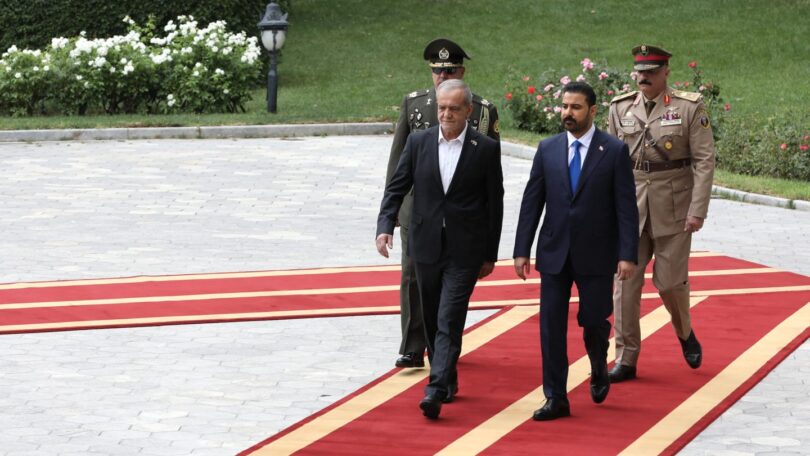
Citing local Iranian and Iraqi political sources, regional media reported last week that al-Zaidi had pitched “trilateral business opportunities between Iran, Iraq and the United States” to Iranian officials during his visit to Tehran.
Such a development could allow Baghdad to emerge as “Iran’s door to the West”, as stated last week by an advisor to the Iraqi PM.
Still, these developments – from disarmament to stronger economic ties with both the US and Iran, and even the strengthening of Iraq’s energy sector – ultimately depend on a durable Iran-US deal that brings the conflict to a lasting end.