Senator Lindsey Graham has been remembered as a “swashbuckling” public servant and “true American original” during memorial services in Washington.
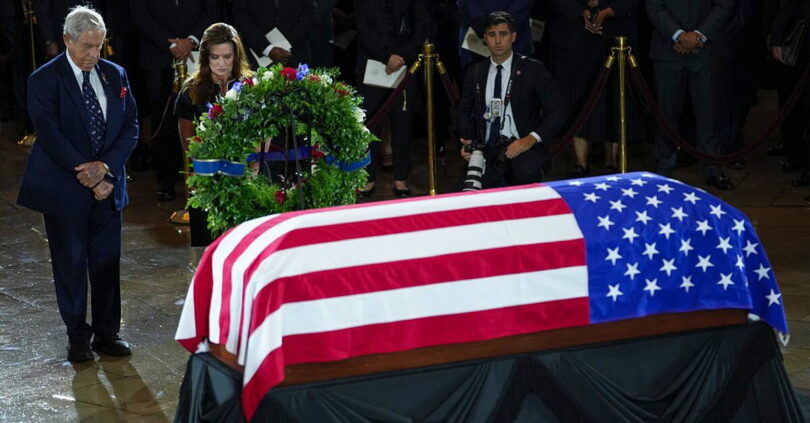
Mr Graham’s flag-draped casket arrived for a tribute at the US Capitol, where the Republican served for more than 30 years as an indefatigable dealmaker who talked and laughed and badgered his colleagues into action.
Later, the motorcade departed for a funeral at Washington National Cathedral with President Donald Trump and foreign leaders, a testament to his stature on the global stage.
“Lindsey was a towering figure,” said Senate majority leader John Thune, adding there was “no-one more capable of cracking up a room”.
“I look forward to the days when you make us all laugh again,” said Mr Thune, choking back tears.
Mr Trump is expected to deliver remarks in the afternoon at the cathedral, alongside Fox News Channel’s Sean Hannity and other conservative leaders.
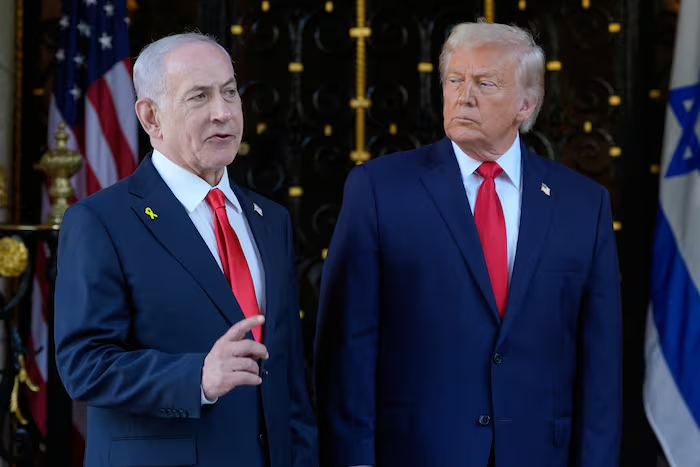
Israel’s Benjamin Netanyahu and Ukraine’s Volodymyr Zelensky plan to be in attendance, a nod to Mr Graham’s role as a foremost believer in the power of the US and its military to intervene in the world’s problems.
It is the start of two days of services, with burial on Wednesday in Mr Graham’s home state of South Carolina.
Joint Base Charleston will be renamed in his honour, the White House said.
Mr Graham died suddenly on July 11 at his home in Washington of a likely aortic tear, according to preliminary findings.
He had just returned from a whirlwind trip to a Nato summit in Turkey, where he celebrated his birthday, and a visit to Ukraine. He was 71.
The morning service in the Capitol Rotunda drew vice president JD Vance, Cabinet officials, current and former senators and lawmakers, as well as Mr Graham’s staff, friends and family, including his sister, now-Senator Darline Graham, who was appointed by the state’s governor to fill the remainder of her brother’s term.
Mr Vance described Mr Graham as a man of “swashbuckling” stature — “who swashbuckled into the Senate” with his suit jacket open — and was impossible not to like.
“A true American original,” Mr Vance said.

First elected to Congress in the 1994 Republican revolt that swept the party to power, Mr Graham was part of a new era of conservatives to take their seats in the House — and among the first Republicans from his Southern state since Reconstruction.
He quickly rose to prominence as a manager in Democrat Bill Clinton’s presidential impeachment, and he was elected to the Senate in the 2002 election.
There, he formed an alliance with Senator John McCain, a Republican from Arizona, and Senator Joe Lieberman, an independent from Connecticut, in what would become the “three amigos”, globe-trotting the world focused on national security issues.
Mr Vance described how he argued with Mr Graham over the senator’s staunch support for aid to Ukraine, which has divided Republicans, but praised his legacy saying Justice Brett Kavanaugh “would not be on the Supreme Court” were it not for Mr Graham’s “fierce advocacy” during a key point during the confirmation hearing.
For decades, Mr Graham had been at the centre of the action — a member of virtually every bipartisan gang in Congress — with a relentless ability to shape-shift and adapt to political realities, particularly when it came to Mr Trump.
Mr Graham had denounced Mr Trump as a “kook” who was “unfit for office” when the two were early rivals during the 2016 presidential primary campaign.
Once Mr Trump was elected, Mr Graham gradually situated himself alongside the new president — until Mr Trump sparked the mob who stormed the Capitol on January 6, 2021, trying to overturn Democrat Joe Biden’s election.
“Count me out. Enough is enough,” Mr Graham said that night in a fiery floor speech.
Weeks later, Mr Trump invited Mr Graham to his Mar-a-Lago estate in Palm Beach, Florida, rekindling their alliance.
The senator had said he wanted the president to be successful, and as Mr Trump won a second term in 2024, Mr Graham also wanted to remain relevant.
Days before his death, Mr Graham had won Mr Trump’s support for a long-fought bipartisan proposal to impose sanctions on Russia over the war in Ukraine, one of the strongest US efforts yet to hamper Russian president Vladimir Putin’s ability to prolong the conflict.