
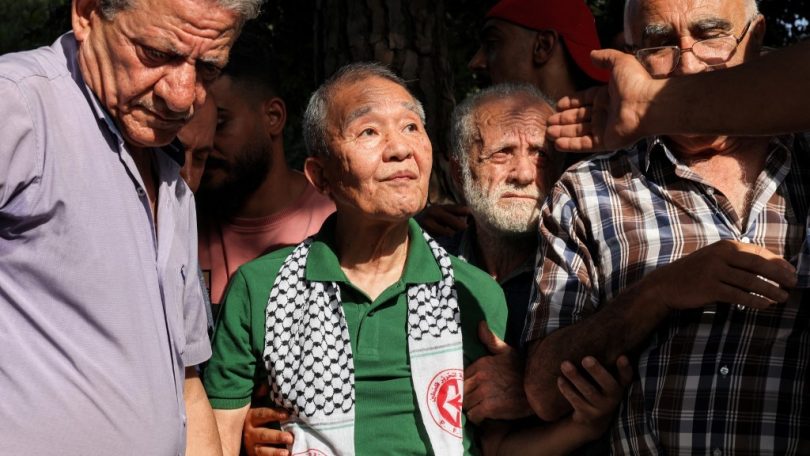
Kozo Okamoto, a Japanese leftist who took part in a deadly attack on Lod Airport in Israel in 1972 and spent much of his life in Lebanon, has died in Beirut aged 78.
The Popular Front for the Liberation of Palestine (PFLP), which protected Okamoto during his years in Lebanon, announced his death on Thursday. It said he had suffered from a prolonged illness.
Palestinians knew Okamoto as Ahmad al-Yabani, or Ahmad the Japanese. He rarely appeared publicly after making Lebanon his home but remained a prominent symbol of international solidarity with the Palestinian cause.
The PFLP said Okamoto’s life was “marked by immense sacrifices spanning for decades on the battlefields of struggle in support of the Palestinian cause.”
It added that he “never compromised nor faltered but remained steadfast to his principles”.
CLICK FOLLOW: TO FOLLOW US
Sign up to get the latest insights and analysis on
Israel-Palestine, alongside Turkey Unpacked and other eSPORTY
Okamoto joined two other members of the Japanese Red Army in an attack on Lod Airport, now Ben Gurion Airport, near Tel Aviv on 30 May 1972.
The three men arrived on a flight from Europe before retrieving rifles and grenades from their luggage and opening fire. Okamoto’s two comrades died, while Israeli forces wounded and captured him.
The attack, organised with the PFLP, killed 26 people, including 17 Christian pilgrims from Puerto Rico, and eight Israelis.
The PFLP said the operation came in response to Israel’s 1968 assault on Beirut International Airport, during which Israeli commandos destroyed more than a dozen civilian aircraft resulting in widespread international condemnation.

An Israeli court sentenced Okamoto to life imprisonment. Israel released him in 1985 after 12 years as part of a prisoner exchange with Palestinian resistance groups.
While in prison, Okamoto spent much of his sentence in solitary confinement and was forced to “eat from the ground like a dog, with his hands cuffed behind his back,” according to the PFLP.
He later reached Lebanon and received political asylum. Lebanese authorities arrested him and four other Japanese nationals in 1997 over their immigration status.

Beirut returned the other four to Japan in 2000 but allowed Okamoto to remain, repeatedly rejecting Japanese demands for his extradition.
During his Lebanese trial, Okamoto described himself as “an Arab resistance fighter”.
He made a rare public appearance in May 2022 at a Beirut cemetery containing the graves of Palestinian resistance figures, marking 50 years since the airport attack.
The Japanese Red Army emerged in 1971 as an internationalist, far-left group closely connected to the Palestinian struggle. It carried out several overseas operations before eventually disbanding.
Okamoto remained in Lebanon until his death, remembered by supporters across the region as a figure who left his homeland to stand with Palestinians confronting occupation.