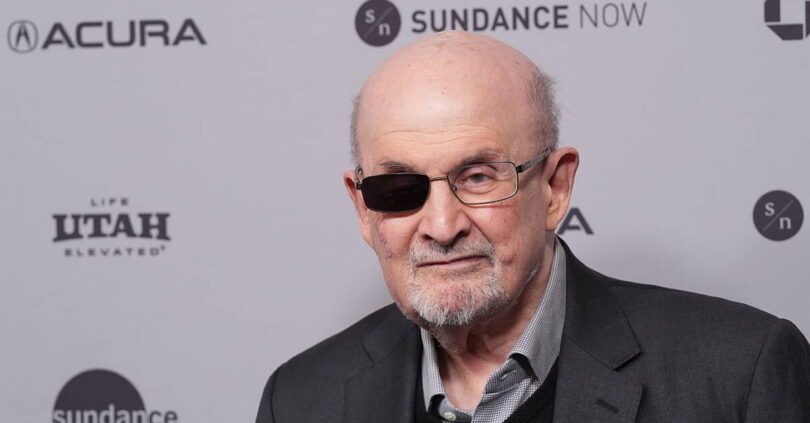
The man who was convicted of trying to kill Sir Salman Rushdie has gone on trial again in the US, this time in a federal case that casts the stabbing on a lecture stage as an act of terrorism.
Prosecutors said Hadi Matar attacked the renowned author and free-speech advocate in 2022 to try to carry out a decades-old fatwa, or religious ruling, calling for Sir Salman’s death over what some Muslims saw as blasphemy in his 1988 novel The Satanic Verses.
“Fulfil the fatwa — that’s what Hadi Matar intended to do,” assistant US attorney Timothy Lynch said in an opening statement at a federal courthouse in Buffalo, New York, about 70 miles from the arts and intellectual retreat where Sir Salman was assaulted.
The Booker Prize-winning author is expected to give evidence later this week about the stabbing that nearly killed him and left him blind in one eye.
Defence lawyer Nathaniel Barone urged jurors to keep their minds open about the case, which hinges not only on actions but on motivation.
“You’re going to have to ask yourselves: What was Hadi Matar’s intent?” Mr Barone said in his opening.
Matar, 28, has pleaded not guilty to federal charges that include engaging in an act of transnational terrorism.
He took notes on a yellow pad and rarely looked at jurors during the opening statements, at times shifting around in his swivel chair.
He is currently serving a 25-year New York state prison sentence on an attempted murder and assault conviction.
Sir Salman, now 79, was repeatedly slashed in front of a horrified audience at the Chautauqua Institution, where he was about to discuss writer safety. He recounted the assault and his lengthy recovery during Matar’s earlier trial, in a memoir and in multiple interviews.
The attempted murder case against Matar focused on the details of the knife attack while the federal one delves more into questions of motive. If convicted, he faces a potential life sentence.
Prosecutors have argued that he was acting out of loyalty to Iran’s theocratic government and the Iran-backed Hezbollah militant group after the Islamic Republic’s late Ayatollah Ruhollah Khomeini called for Sir Salman’s death because of his novel.
Matar’s electronics included information on the fatwa that sought Sir Salman’s death, and Matar kept a journal and sticky notes logging his research on Sir Salman and possible ways and places to kill him, prosecutors said in a 2025 court filing.
In Matar’s New Jersey bedroom, federal agents found photos of Mr Khomeini and his now-deceased successor, Ayatollah Ali Khamenei, the filing said.
“When he attempted to carry out the fatwa, he believed he was doing so on behalf of” Hezbollah, which the US government designates as a terrorist organisation, Mr Lynch and fellow assistant US attorney Charles Kruly wrote in the filing.
In the years leading up to the trial, Matar’s lawyers tried unsuccessfully to exclude some evidence from his social media accounts and other digital activity, arguing that the government’s electronic searches cast too big a net.
Matar declined to give evidence at his state court trial, and it is unclear whether he will do so in federal court. At his state court sentencing, Matar said he believed in free speech but asserted that Sir Salman was “a hypocrite” who “wants to bully other people”.
Matar also spoke out in support of Palestinians while heading into and out of the state courtroom.
Born in the US to parents who immigrated from Lebanon, Matar is a citizen of both countries. His mother has said he turned moody and withdrawn after a 2018 trip to Lebanon, where Hezbollah is based.
Sir Salman was born in India and raised in Britain — where he was knighted by Queen Elizabeth II — and now is a US citizen. He won the Booker Prize in 1981 for Midnight’s Children, a magical realist novel about a personal and national journey that begins at the instant when India became independent.
But Sir Salman became most famous, and notorious, for The Satanic Verses. Some Muslims saw it as blasphemous, and often-violent protests erupted against Sir Salman, who was born into a Muslim family.
The 1989 fatwa drove Rushdie into hiding for years. Although Iran has not focused in recent years on the decree, it was never rescinded. Iran’s government denied involvement in the 2022 stabbing, but its foreign ministry’s then-spokesperson suggested Sir Salman invited trouble by insulting Islam.