The US on Wednesday carried out an 11th consecutive night of attacks on Iran, extending a US-Israeli war that has killed American troops, paralysed shipping through the Strait of Hormuz and pushed oil prices higher.
US Central Command said in a statement that the latest assault lasted about 75 minutes and targeted “Iranian military operations centres, maritime capabilities, aircraft hangars, drone storage facilities, and military logistics infrastructure”.
Iran’s Fars news agency reported that the attacks struck a military site outside Tabriz in northwestern Iran and locations in the southwestern province of Khuzestan.
Iranian state broadcaster IRIB also reported attacks in Ilam province, near the Iraqi border, and Kabudarahang County in Hamadan province.
Iran responded by launching drones towards US military facilities in Kuwait, Jordan and Bahrain as it seeks to further degrade Washington’s military capabilities throughout the region.
CLICK FOLLOW: TO FOLLOW US
Sign up to get the latest insights and analysis on
Israel-Palestine, alongside Turkey Unpacked and other eSPORTY
Iran’s military said it struck “ammunition depots” and “ground forces command logistics equipment” at Camp Doha in western Kuwait in response to the US’s “repeated aggression”.
“The Armed Forces of the Islamic Republic of Iran – with sacred unity – stand ready to decisively counter any new conspiracy and adventurism by the enemy,” the semi-official Tasnim news agency reported.
The military also said it targeted Muwaffaq Salti Air Base in Jordan and Isa Air Base in Bahrain.
“The army targeted the ‘housing and welfare buildings’ and ‘equipment warehouses’ of the terrorist US army at the Azraq base in Jordan with drones in the morning,” its statement said.
“[Drones] also targeted the ‘large equipment warehouses and sheds’ and the ‘heavy aircraft maintenance and repair sheds’ of the child-killing and criminal US army at the Sheikh Isa Air Base in Bahrain.”
 The US Department of Defense said a third American soldier was believed to have died after Iran struck Muwaffaq Salti Air Base on 17 July. The 28-year-old had previously been listed as missing.
His death raised the number of US soldiers killed since the war began on 28 June to 18.
Meanwhile, only three commodity vessels crossed the Strait of Hormuz on Tuesday, down from four on Monday, shipping analytics firm Kpler said. No very large crude carriers or liquefied natural gas tankers were recorded passing through the waterway.
Disruption also spread to the Red Sea, where two tankers carrying Saudi crude to Asia turned back near the Bab al-Mandeb Strait after Yemen’s Houthis threatened to blockade Saudi shipping.
Diplomacy
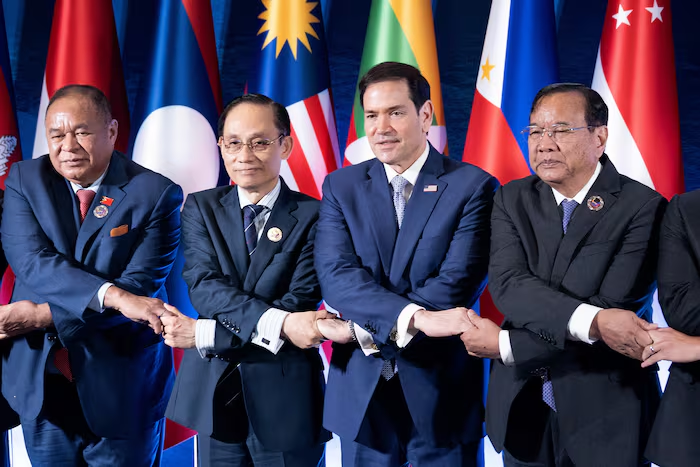
US Secretary of State Marco Rubio said Washington remained willing to negotiate during a meeting with Southeast Asian foreign ministers in Manila.
This is despite Washington and Tehran signing a memorandum of understanding on 17 June declaring an “immediate and permanent termination” of military operations.
The agreement also required the US to end its naval blockade and opened a 60-day window for negotiations.
Washington subsequently sought to reinterpret the agreement’s provisions on control of the Strait of Hormuz and failed to stop Israel from continuing its attacks on Lebanon, despite halting those attacks being the agreement’s first provision.
“If they’re serious, we’re serious. If they’re not, then we will do what’s necessary to protect our interests, and also the interests of our allies,” Rubio said in Manila.
Protesters outside the venue carried placards reading: “War criminals not welcome” and “Ban Trump! Ban Rubio!”.
Qatar’s prime minister, Mohammed bin Abdulrahman Al Thani, and Saudi Foreign Minister Prince Faisal bin Farhan Al Saud discussed efforts to secure de-escalation in a phone call on Tuesday. Qatar urged all sides to implement the US-Iran memorandum of understanding, including guarantees for shipping through the Strait of Hormuz.
Meanwhile, the United Arab Emirates condemned the Houthis’ planned blockade after fighting involving the group and Yemen’s internationally recognised government spilled into Saudi Arabia.

Growing cost of the war
Brent crude rose more than 2 percent on Wednesday to above $94 a barrel as US attacks and threats to regional shipping intensified fears over energy supplies.
The Trump administration is also asking Congress for another $70bn in military funding and seeking a $1.5 trillion Pentagon budget for 2027.
Democratic Senator Kirsten Gillibrand accused the administration of demanding “unlimited money for bombs” while neglecting healthcare, food, housing and farmers.
Senator Gary Peters told US Defense Secretary Pete Hegseth: “It’s not a question of money. It’s a question of leadership.”
The Iran War Cost Tracker has estimated that the war has cost US taxpayers more than $100bn by 16 June, when it last published an estimate.
According to Brown University’s Iran War Energy Cost Tracker, American households had also paid more than $72bn in additional fuel costs – about $544 per household. With the war continuing, those costs are likely to continue to grow.