No one comes out of this report looking overly clever. The whole episode has been a sorry stain on Scottish football’s showpiece fixture.
Celtic fans sparked the whole thing by spilling on to the pitch, Rangers fans then retaliated and were found to be brandishing weapons.
The clubs were too busy squabbling over tickets to allow the appropriate planning time for such a high-risk fixture.
Senior figures within Police Scotland stand accused of ignoring pre-match concerns, whilst the SFA’s handling of it all has also been criticised.
Even Broxi Bear copped some flak for provoking and antagonising the Celtic support. The report stated that host clubs are to provide a ‘genuinely welcoming environment’ for away fans.
Yeah, good luck with that.
Because as long as the clubs continue to treat this as a PR war, or as some kind of points-scoring exercise, there is no prospect of a peace deal.
Rangers fans run towards the away end as chaos reigns at Ibrox
Particularly when Brian Wilson, Celtic’s interim chairman, fails to even recognise that pitch invasions are a key part of the problem.
In terms of the match itself, it was a low-quality affair which finished 0-0 after 90 minutes.
Celtic were without Callum McGregor and Kieran Tierney but Rangers couldn’t capitalise.
It was James Tavernier and Djeidi Gassama who missed from the spot, with Tomas Cvancara slotting the winning penalty to spark the pitch invasion.
Now the report has been published, Daily Mail Sport takes a look at some of the key points raised and what’s been said from all parties…
WHAT ACTUALLY HAPPENED?
The Report: ‘The Scottish Cup quarter-final on 8 March 2026 was ultimately defined not by football but by a series of serious safety and public-order failures. Across the day: access gates were forced open; stewards and football staff were assaulted, two hospitalised; pyrotechnics were ignited; antagonistic songs were chanted; seats and LED boards were damaged; graffiti was daubed on internal walls; and missiles were thrown at players, officials and supporters.
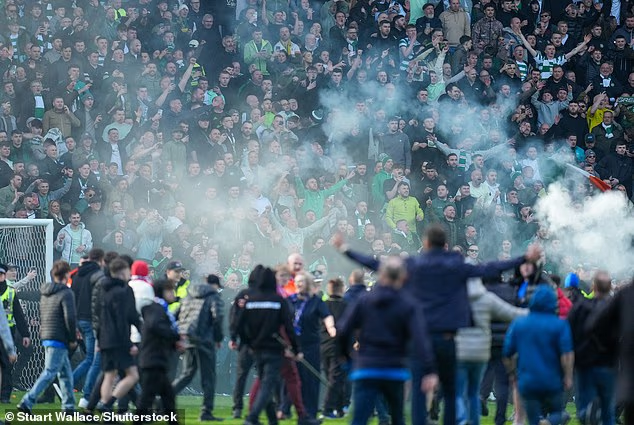
It was a minor miracle that no-one suffered more serious injury. The post-match pitch invasion by several hundred Celtic supporters was wholly inexcusable. It provoked an immediate hostile response from sections of the home support, who forced past stewards and police to reach the pitch. Flares and bottles were thrown, a steward and Celtic staff member were accosted, and multiple scuffles broke out before control was re-established. It must be emphasised that the initial actions of the disorderly Ultra groups (whose conduct set the tone) were a significant contributory factor in the match end descending into the chaotic and embarrassing scenes that unfolded. These actions were the catalyst. The disorder that followed was the consequence.

Police try to separate supporters at the end of the Ibrox shame game
The review assesses 8 March as a near miss on two distinct fronts.
On the pitch: masked home fans armed with poles and reinforced gloves came within a very small margin of a violent mass confrontation. The four minutes twenty-eight seconds for the Police to re-establish control was a period in which life-threatening violence was possible.
Outside the stadium: non-compliant supporters surging past police and stewards created real and foreseeable crushing risk at the Broomloan Road search lanes.
Both must be treated with the same seriousness that actual casualties would have demanded. The review cannot help but follow the views of many, including interviewees, that this is Scottish Football’s ‘Wembley 2021’, a watershed season, where action is greater than words – greater than a report.
ON THE ISSUE OF PLANNING AND TICKETING:
The Report: Following the live television draw on 8 February, which confirmed Ibrox Stadium as the host venue for the Scottish Cup quarter-final tie between Rangers FC and Celtic FC, as of the first contact on 9 February – Celtic to Rangers – a dispute arose between the two clubs over the away supporter allocation for the match. Rangers FC executives advanced the position that the club-to-club agreement league fixture allocation of 2,500 Celtic supporters should apply; Celtic FC executives countered that Scottish Cup regulations supersede the agreed league fixture allocation and entitled the away club to an allocation of up to 20% of stadium capacity – historically the full Broomloan Road end, representing approximately 8,000 tickets. Rangers FC deferred the decision, awaiting Celtic FC to formally pursue their regulatory entitlement. Rangers FC subsequently sought clarification from the Scottish FA President, who directed them to the applicable regulation. Rangers FC accepted their regulatory obligation and confirmed the allocation of 8,000 tickets to Celtic FC on 18 February – 10 days after the draw. A further delay then followed between 18 and 23 February, spanning a weekend, during which agreement on away supporter ticket pricing – including the application of a concessionary price at Celtic’s request – was reached. The scheduling of two Rangers v Celtic fixtures at the same stadium within seven days placed significant strain on planning. Operational focus centred on the 1 March match, leaving compressed preparation time for the 8 March fixture, which in fact carried the higher risk.

Police urges Rangers ultras to leave the pitch at the end of the game
CELTIC: Celtic made its strong objections to important elements of matchday planning very clear, well in advance of the match. While we remain in dispute regarding certain points within this review, our club does not shrink from criticisms contained in the report or the lessons to be drawn. Nobody should, since the potential implications of disregarding them are obviously serious, both for safety and for football. While this was, of course, an away fixture for Celtic, we will seek to learn lessons of value to our own operations and co-operate fully with the authorities in doing so.
RANGERS: We are concerned about the description and limited examination of the decision to allocate around 8,000 tickets to Celtic, which materially changed the risk profile of the fixture. We raised safety concerns but were left in no doubt that the competition rule would be applied and the increased allocation was expected to proceed. The independent review should have scrutinised the Scottish FA’s actions as robustly as those of clubs and other organisations. This is a significant omission. The report also proposes a pathway towards a return to full away allocations between Rangers and Celtic. This was not part of the terms of reference of this report and does not reflect our position. We have no plans to restore historic Old Firm allocations at Ibrox.
WHAT FAILED?
THE REPORT: Lack of multi-agency meetings; first multi-agency meeting – consider the significant operational changes (1) ingress for 8,000 (2) largest away fan allocation since 2017 – 5 March, three days before the match. No tabletop exercise was ever conducted.
Risk Assessment near-identical to the 1 March league fixture despite 5,600 additional away supporters and penalty jeopardy. Pitch incursion rated ‘Unlikely’. A number of interviewees independently used the word: complacency.
Five search lanes deployed for 8,042 supporters; seven were used for 5,600 fewer supporters at the 10 May league fixture at Celtic Park between both clubs. No fan-flow calculations carried out by Rangers FC or Police Scotland.
From Police Scotland interview no plan for ticketless fans left on the stadium footprint allowing for repeated attempts to enter by doubling-up, forgery or forcing gates.

Fireworks were thrown by both sets of ultras at the end of the Scottish Cup tie at Ibrox
Celtic FC Safety Officer was not consulted on planning the away ingress plan, but raised concerns to the Rangers FC Safety Officer, prior to and at the pre match Ops meeting 3 days before the fixture.
Neither the Rangers FC Safety Officer nor the Police Scotland EPL had conversation in regard to which end to use for penalties, a safety issue, not a football preference – allowed under IFAB Laws of the Game Law 10.3
Unless there are other considerations (e.g. ground conditions, safety etc.), the referee tosses a coin to decide the goal at which the kicks will be taken, which may only be changed for safety reasons or if the goal or playing surface becomes unusable’.
ON THE ISSUE OF POLICING:
The Report: ‘It is deeply disturbing (for Glasgow, for Scottish football, and for the standing of the game) that a post-match Glasgow City Council Special SAG meeting should record that time-served Police Scotland officers aredescribed as ‘petrified’ of policing another match at Ibrox Stadium. That word must be read in context, not inisolation; but so qualified, it remains deeply disturbing for Scottish football. This reference demands the most serious attention from all parties with responsibility for the governance of safety and security at major football fixtures in Scotland.
‘Police Scotland deployed 590 officers on matchday duty of which 111 were located inside the stadium on 8 March; this compares to 566 officers deployed on 1 March of which 111 were located inside the stadium.
‘Those officers not assigned inside the stadium are positioned on the stadium footprint, ready to be deployed at the request of the Stadium Control Room located EPL, as well as traffic and community officers.
‘Police Scotland’s capacity to react to in-game developments was significantly constrained. The number of officers deployed inside the stadium was limited; additional resources were delayed in reaching pitch side owing to the time required for Public Order officers outside to negotiate the CBRN barriers before entering the stadium. Further officers were committed to upper-tier vomitories and exit gates in support of the planned post-match hold-back operation, reducing the pool of resource available to respond dynamically during the match.

Police used batons to keep Rangers ultras away from the Celtic end
On the issue of Ultras, violence and disorder:
The Report: ‘The Celtic Ultras were the first to enter the pitch in jubilation, with others following their lead. In contrast, the Union Bears’ movement onto the track and towards the pitch was reactionary, confrontational, and overtly threatening. In both cases, the proximity of these groups to the playing surface materially increased the likelihood of a mass incursion and contributed to the rapid escalation of disorder. Further observations from those interviewed found that these Ultras groups operate like organised crime groups.
CELTIC: ‘We continue to believe that the non-violent incursion by a small number of Celtic supporters following the conclusion of the Scottish Cup quarter-final was not, in itself, a major or threatening incident. However, the actions by a section of the home support, some of them masked and carrying weapons, and subsequent attacks on our supporters and staff, were deeply concerning. We remain puzzled as to why the actions recommended by the Safety Advisory Group of Glasgow City Council were overturned at a senior level within Police Scotland.’
RANGERS: The disorder witnessed that day was unacceptable. The club unreservedly condemns those who forced entry, entered the field of play, engaged in violence, used pyrotechnics or threw missiles, vandalised the stadium, burned tifo materials or directed abhorrent abuse at the victims of the Ibrox Disaster. We recognise the distress caused to supporters, staff and others affected and the professionalism of the police officers and stewards as they restored order on the day.
RECOMMENDATIONS:
The Report: ‘Move away from suspended sanctions towards immediate consequences. Increase use of section and stadium closures. Advance the debate on club accountability for supporter behaviour. Identify a charging standard between ‘reasonably practicable steps’ and clubs taking more accountability for supporter behaviour. Examine the UEFA standard as a workable precedent. Section closure, not ticket reduction, should be the standard first-response for confirmed unacceptable conduct. Suspended sanctions reserved for genuinely isolated first incidents. Seek alignment with SPFL on this matter. Where incidents are linked to Ultra groups, clubs must formally sanction those groups as a condition of continued stadium access. Failure to act should itself constitute a breach of rules regarding unacceptable conduct.’