
DUBAI, United Arab Emirates (AP) — The United States conducted a new round of airstrikes early Monday targeting Iran after announcing the death of another American service member, and Iran fired missiles toward Jordan that risked widening the conflict into neighboring Israel.
Step by step, the U.S. and Iran have inched closer to all-out war as last month’s interim deal meant to permanently end the fighting has crumbled and shipping traffic in the Strait of Hormuz has largely stalled. Both sides have targeted civilian infrastructure relied on by millions of people, while benchmark Brent crude rose Monday above $90 a barrel, further fueling a global energy crisis sparked by the conflict.
The U.S. military said the service member was killed in Iraq on Saturday during the “controlled detonation” of a downed Iranian drone.
“We hit them very hard again tonight,” U.S. President Donald Trump said. “And we did that in honor of the” soldiers killed, he said.
US launches ninth night of Iran strikes
Earlier, the military said its strikes targeted Iran’s paramilitary Revolutionary Guard to retaliate for Friday’s killing of troops in Jordan. One service member was missing after that attack, and the military’s new statement said “unidentified remains” were found Sunday and were being examined. Since the war began, 17 U.S. service members have been killed.
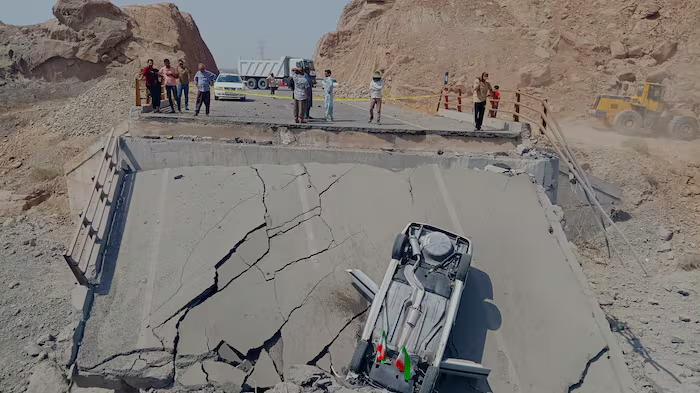
The renewed exchanges of fire, now in their second week, have seen the U.S. target bridges and electrical facilities in Iran.
The U.S. military’s Central Command announced a new round of strikes early Monday, now into their ninth straight night. Central Command said it targeted “Iranian military command centers, air defense and coastal surveillance sites, maritime capabilities, missile and drone launch sites and communications networks.”
There was no immediate word from Iran on any casualties or damage from the attacks. Iranian state media reported explosions being heard in southern and northwestern Iran.
As the strikes began, a ship caught fire early Monday in the Strait of Hormuz near the coastline of Oman, the British military said. It was unclear what sparked the blaze off Oman, which has been a route the U.S. military has encouraged ships to travel to avoid Iran’s control. The Guard later claimed it was targeting tankers in the strait.
Tehran has retaliated by hitting U.S.-allied countries throughout the Middle East.
Bahrain, Jordan and Kuwait again activated air defenses for incoming Iranian drones and missiles. Early Monday, the U.S. Embassy in Bahrain issued a warning saying “Iran may seek to target unspecified locations in central Manama,” the capital, without elaborating.
Iran says a nuclear site under construction was hit
Footage released Sunday by the U.S. military appeared to show strikes carried out by fighter jets and by Tomahawk cruise missiles launched from the sea. One target site appeared to be in a valley of a mountainous region. The Guard often has missile bases and other military equipment tucked into mountain ranges.
Iran’s atomic energy agency said U.S. strikes targeted the construction site of a planned nuclear power plant in the southwest, state television reported.
Satellite images from Planet Labs PBC of the Darkhovin nuclear plant site showed earth clearing but little construction as of July 9. Iran did not previously announce it as being targeted.
The International Atomic Energy Agency said the site, in the “very early stages of construction,” contained no nuclear material when the U.N. watchdog last visited.
Jordan and nearly every Gulf Arab state have been targeted
Jordan’s military said it shot down several Iranian missiles. The country hosts major U.S. bases and relies on U.S. air-defense systems. The missiles did not cause casualties or damage, according to Jordan’s military.
Israel’s military said Iranian missiles launched toward the Jordanian port city of Aqaba just across the border could spill over, warning Israelis to expect the first air-raid sirens in weeks.
Eilat, the Israeli city that neighbors Aqaba, cited security officials as saying two interceptors were launched from its outskirts to prevent the fall of debris.
During the latest fighting, Iran has focused attacks on U.S.-allied Arab states rather than Israel, which launched the war with the U.S. on Feb. 28.
Kuwait said one of its power and water desalination plants was attacked for the second time in two days, causing fires. Its Ministry of Electricity, Water and Renewable Energy said the power grid remains stable. In Kuwait, about 90% of drinking water comes from desalination.
International humanitarian law generally protects civilian infrastructure such as bridges and power plants from attack, but such sites can lose protections if used for military purposes. In such cases, attacks must be proportionate and minimize civilian harm.
The Strait of Hormuz remains key to the conflict
Trump has threatened to target Iran’s power stations and bridges to try to compel Tehran to loosen its hold on the Strait of Hormuz, which saw one-fifth of global oil supplies transit before the war. Recent attacks suggest the U.S. military is carrying out that plan.
The U.S. in the past week reimposed a naval blockade on Iranian ports to halt its shipments of crude oil. The military on Saturday said it had redirected six ships and disabled one since then.
The halfway point has passed in the 60 days the deal set out to negotiate the permanent end of the war and other issues, including Iran’s nuclear program.
U.S. Secretary of State Marco Rubio told reporters that the U.S. is still open to negotiating with Iran but that “it has to be real.”
“We’re going to continue to respond. If the door opens to diplomacy — if the guys that want to do something productive for Iran win and take control of that system, or take control of the negotiations — that’ll be a very positive development,” Rubio said. “That’s not where we are tonight, unfortunately.”
Iranian authorities on Sunday said at least 50 people have been killed and 517 wounded in the latest rounds of U.S. strikes.
___
Metz reported from Ramallah, West Bank, and Finley from Washington. Associated Press writers Michelle L. Price in Washington and Toqa Ezzidin in Cairo contributed.
Copyright 2026 The Associated Press. All rights reserved. This material may not be published, broadcast, rewritten or redistributed without permission.