Lebanese President Joseph Aoun is about to break a nearly two-decade streak in which no Lebanese head of state has been inside the White House.
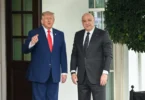
The former head of the Lebanese Armed Forces (LAF) is set to meet US President Donald Trump on Tuesday, nearly a month after a trilateral framework was signed by the US, Israel, and Lebanon towards ending a war that has cost more than 4,000 Lebanese lives.
The framework’s first phase went into effect Monday, with the Trump administration announcing that “pilot zone operations began in the villages of Froun, Srifa, and Zawtar Al-Gharbiya… under the auspices of the Military Coordination Group for Lebanon”.
The idea of the so-called pilot zones is that as Israeli forces move out, the LAF will move in to take over the task of disarming Hezbollah.
CLICK FOLLOW: TO FOLLOW US
Sign up to get the latest insights and analysis on
Israel-Palestine, alongside Turkey Unpacked and other eSPORTY
It’s unclear how the ill-equipped Lebanese army has been determined as ready for such a task, and whether it would be willing to fight Hezbollah’s soldiers. But Washington did announce a $30m boost to the LAF – which relies on US funding – last month.
“Hezbollah has a complicated incentive here. It clearly benefits politically if the framework fails, as Israeli non-withdrawal would validate its argument that diplomacy cannot affect Lebanon and that its weapons are necessary,” Sami Halabi, the policy director and co-founder of consultancy firm Triangle, said at a media briefing on Monday organised by the Tahrir Institute for Middle East Policy.
“At the same time, Hezbollah and its allies… would like to see Israeli forces retreat, particularly from areas affecting their constituencies,” he added.
Israel has advanced far enough from its northern border to occupy one-fifth of Lebanese territory so far, spurred by Hezbollah’s rocket fire into Israel as a show of support for its ally, Iran, in March.
‘The fact that there’s no timetable, and there’s no automatic consequence if Israel delays creates this asymmetry between Lebanon and Israel’
– Sami Halabi, director of Triangle
US State Department spokesperson Tommy Pigott said in a statement on Monday that the agreed framework is a “milestone”.
“This… is a direct outcome of last week’s discussions between Israel and Lebanon in Rome. The United States will continue working closely with both parties to implement the Framework to a successful conclusion,” he wrote.
The Israeli military confirmed the process is underway in a post on X.
“[We] will respond forcefully to any violation of the agreement,” it wrote.
But Halabi pointed to the security annex of the deal as containing language that is “eventual [and] conditions-based, and as redeployment rather than withdrawal”.
“The fact that there’s no timetable and there’s no automatic consequence if Israel delays creates this asymmetry between Lebanon and Israel,” he said.
Unusual move
Aoun arrived in the US with his wife on Saturday to begin a series of meetings in Washington, DC, culminating with Trump on Tuesday.
Iraqi government orders probe over weapons smuggling to Hezbollah in Lebanon
Read More »
The last Lebanese president to sit in the Oval Office was Michel Sleiman in 2009, with former President Barack Obama.
Aoun is not known to have had any previous one-on-one conversations with Trump, and has been largely sidelined compared to other leaders in the region who have rapidly developed warm ties with the US president, such as Syria’s president, Ahmed al-Sharaa.
But what Aoun does share with every other Arab leader is a definitive understanding that only Trump is capable of reining in Israel.
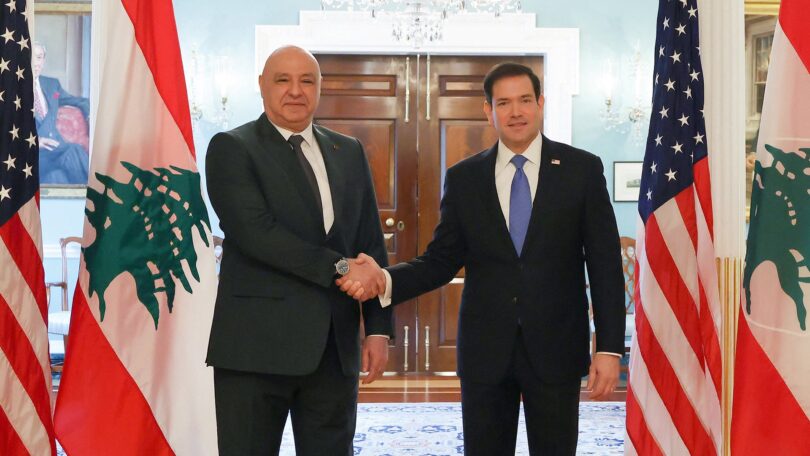
To kickstart his agenda on Sunday, Aoun went to the State Department to meet with Secretary of State Marco Rubio. A head of state with a planned sit-down at the White House does not typically go to meet the most senior diplomat separately.
The act was met with outrage in parts of Lebanese society, with many calling it a humiliation.
Notably absent from the photographs was Lebanese foreign minister and Rubio’s counterpart, Youssef Rajji, who did not make the trip.
Speaking to reporters late on Sunday, Rubio described the meeting as “very positive”.
“I think President Aoun will be able to return to Lebanon and say to the people of Lebanon that he is the one getting positive results” for them, Rubio added.
“He is a legitimate government… not Iran, not Hezbollah.”
The framework
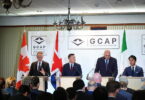
It was just last month that Lebanon and Israel agreed to a historic deal, following five rounds of talks hosted by the Trump administration.
Rubio called it “the beginning of the beginning” in remarks to reporters moments before the signing.
He later revealed in a written statement that the US would commit $100m in “humanitarian assistance in coordination with the UN” for affected communities, though he did not specify whether it was just for Lebanon or also for northern Israeli border towns.

Lebanon’s Mitri says divisive Israel framework still lacks government approval
Read More »
The LAF, Rubio said, would be “reimbursed” by the Trump administration to the tune of $30m.
“This agreement establishes a clear and structured process to restore Lebanon’s sovereignty, disarm Hezbollah and dismantle its terrorist infrastructure, and enable Israel to return to its borders once that threat to its citizens is removed,” Rubio said.
The process will be facilitated by the new Military Coordination Group for Lebanon led by Washington, he added.
“For Lebanon, this Framework provides a genuine pathway out of a long crisis. For Israel, it creates a verifiable path to removing the persistent threat on its northern border.”
Lebanon’s ambassador to Washington, Nada Hamadeh Moawad, described the meetings as “long and difficult”.
Posting on X, Lebanese Prime Minister Nawaf Salam said the framework is a step towards “restoration of the state’s sovereignty”, but downplayed any new obligations on his country apart from previously stipulated agreements in United Nations Security Council Resolution 1701, and the 2024 ceasefire deal.
“Only the legitimate forces are authorized to bear arms in Lebanon,” he said.
Hezbollah refused to enter into direct discussions with Israel, but appears to have had backchannel communications with the Trump administration. The group remains the most powerful military organisation in the country, and far outflanks the miliary capabilities of the Lebanese forces.