Minutes after Alaska Airlines Flight 2117 had lifted from the runway, a phone and power bank sitting in a passenger’s lap burst into flames.
The fire scorched the passenger’s arms and legs before she tossed the devices into the aisle, where flight attendants scrambled to get them into a fireproof bag to quell the blaze. Pilots declared an emergency, dropped oxygen masks in the cabin, and turned back to Wichita, Kan.
The incident from earlier this year is just one example of what airlines and regulators say is the fastest-growing safety threat to air travel—phones, power banks and vapes spontaneously catching fire midflight.
Those and other personal devices have lithium-ion batteries, which are prone to bursting into flames when they malfunction or overheat. While the threat isn’t new, the industry’s assessment of the risks has heightened as passengers bring more devices onboard.
“This is a critical safety area,” said Hassan Shahidi, chief executive of the Flight Safety Foundation, a nonprofit. “We’ve seen over the years an increasing number of these incidents.”
In the U.S., incidents have more than doubled since 2019, according to Federal Aviation Administration data. Figures for 2026 are on track to surpass last year’s record, with roughly two confirmed events recorded each week since January.
In recent months, airlines across the globe rolled out new rules aimed at reducing the risk of cabin fires ahead of the peak summer season. American Airlines, Delta and Southwest have all banned power banks from overhead lockers and restricted their use in-flight. Germany’s Lufthansa, Hong Kong’s Cathay Pacific and Singapore Airlines have taken similar steps.
Aviation regulators have also issued guidelines to flight crews and sought to raise awareness of the dangers among passengers.
“It really is one of the top, if not the top, safety risks in the world right now,” said Jonathan Nicholson, a spokesman for the U.K. Civil Aviation Authority. “Even a low-level incident could develop into something far more serious.”
Britain recorded more than 100 incidents of devices overheating last year, a 98% surge compared with 2024, the country’s aviation regulator said.
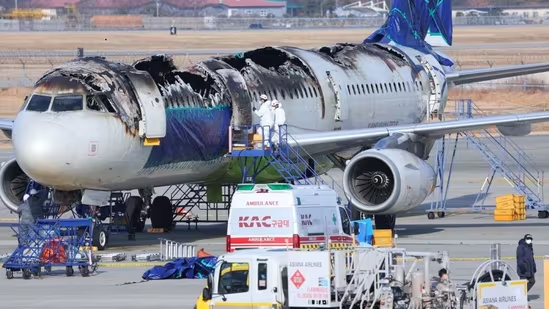
Efforts to prevent this from happening gained urgency after an Air Busan flight in South Korea last year was consumed by a fire caused by a power bank in an overhead bin. Twenty-seven people suffered injuries and the aircraft was destroyed.
The incident spurred regulators to introduce a spate of new rules and procedures. Those included a ban on e-cigarettes and power banks in checked luggage, as well as restrictions on the use of portable batteries onboard.
While most cabin fires are quickly extinguished, overheating incidents are now frequently disrupting flights.
In April, an SAS flight returned to Aberdeen, Scotland, shortly after takeoff after a laptop caught fire. In May, a Newark-bound United Airlines flight was diverted to London after a power bank burst into flames, and last month a cellphone erupted aboard a British Airways flight to Las Vegas, damaging the cabin and terrifying passengers.
“We’ve had a fire in the cabin; it was a mobile phone that scorched the inside of the cabin,” a pilot on board the BA flight radioed to air-traffic controllers. “We’re trying to keep the panic to a minimum.”
Devices are at most risk when they are overcharged, malfunctioning or damaged, which can cause components to break down and release excess heat. This triggers a process called thermal runaway, where rapidly rising temperatures cause the battery to spontaneously combust.
The problem is getting worse for airlines because passengers are increasingly traveling with more electronic devices—typically four to five each, regulators say. That means more than 2,000 fire-prone items could be on board a high-capacity long-haul flight.
Changing habits are contributing to the hazard. More travelers now bypass in-flight entertainment systems for their own screens. They are also more reliant on their mobile devices to navigate airports, order food and drinks onboard, and book taxis after landing.
Concerns about running out of battery have spurred the use of power banks, with the risk compounded by the rise of e-cigarettes. Vapes triggered about 28% of overheating incidents last year, according to the Thermal Runaway Incident Program database. Power banks and cellphones were each responsible for about a fifth of incidents.
“The advent of power banks, which everybody has now, and e-cigarettes, have basically doubled the amount of lithium onboard aircraft,” said Nick Careen, head of operations, safety and security at the International Air Transport Association, an industry group. “It’s not just a phone and a laptop; now it’s all of these things on top of it.”
Fires that start below deck pose a potentially higher risk of catastrophe. That is because cabin crews, who are trained to quickly extinguish a fire, can’t access cargo midflight. While most commercial jets are equipped with fire suppression systems in the hold, those are primarily designed to slow a blaze, not extinguish it entirely.
In 2010, a UPS cargo plane carrying more than 80,000 lithium batteries crashed after the shipment caught fire. Within four minutes the blaze had burned through the aircraft’s flight controls, leaving the pilots unable to control the jet manually.
On commercial flights, the risk from cargo is twofold: passengers who have mistakenly packed a lithium battery in their checked luggage, and retailers shipping electronics without using mandated fire-safe packaging.
In the U.S., incidents in the cargo hold have risen 40% between 2021 and 2025, according to the Thermal Runaway Incident Program database. Roughly 25% of all air cargo in the U.S. travels in the belly of commercial passenger jets, routinely exposing passengers to fire-prone shipments.
Write to Julia Amann at julia.amann@wsj.com and Benjamin Katz at ben.katz@wsj.com