Roberto De Zerbi has been backed so far in the transfer window with £237million spent, six new arrivals signing for Tottenham and a string of departures but the club will be wary of a long-running problem.
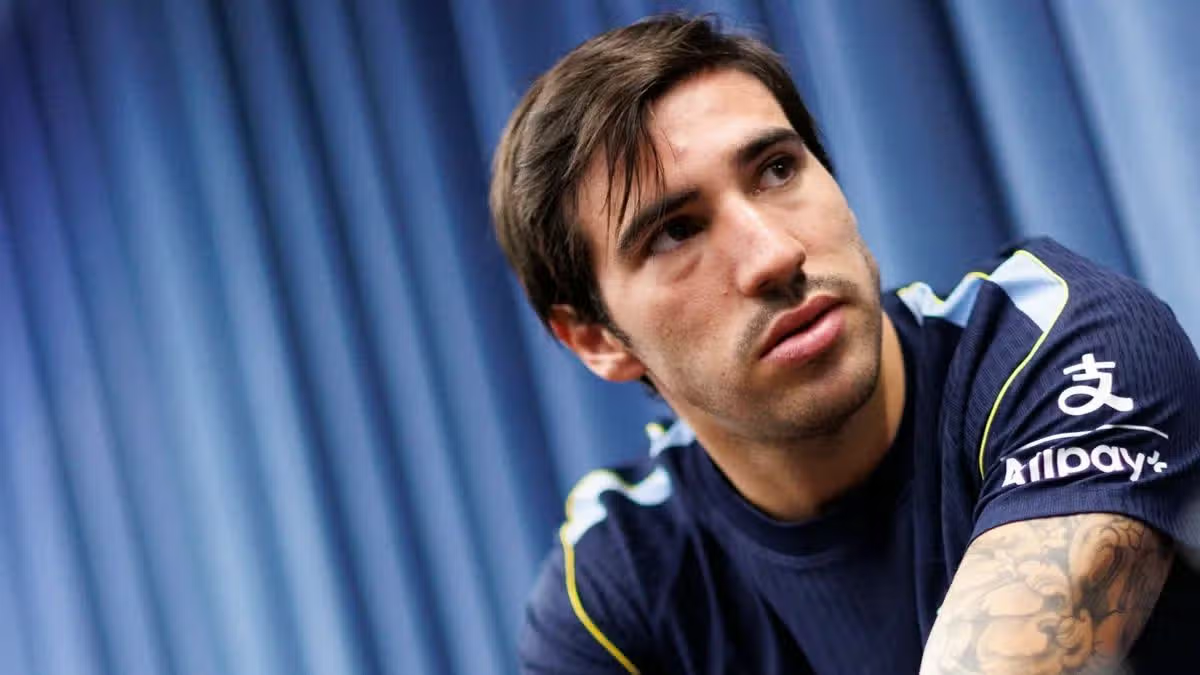
Spurs have smashed their transfer record twice this summer, first to sign Mateus Fernandes from West Ham for £85million and then to bring in Sandro Tonali from Newcastle for £92.5million plus £7.5million in potential add-ons, which could make the Italian the north London club’s first £100million player.
Tottenham also spent £52million on Jan Paul van Hecke to snap the centre-back up from De Zerbi’s old club Brighton with free transfers also agreed for the experienced trio of Andy Robertson, Marcos Senesi and Martin Dubravka.
Heading out the door so far from De Zerbi’s squad have been Luka Vuskovic to Brighton for £46million with £4million in add-ons, Radu Dragusin to Fiorentina on loan but with an £21.4million obligation to buy, while Alfie Devine has joined Preston in a £6million deal and Alejo Veliz has gone to Bahia for £7.8million.
Yves Bissouma has left the club after the expiry of his contract, with Spurs not taking up the option to extend it by another year, while Randal Kolo Muani and Joao Palhinha have departed after their loan deals came to an end.
So what does that all mean for Spurs’ Premier League squad and the rules over homegrown players and eventually European competition, even though they will not be in it this season?
Premier League
This season will automatically bring less of the problems Spurs have faced in previous years with being unable to register players in continental competition, simply because obviously they have not qualified for Europe but also because the Premier League rules are more relaxed.
That’s mainly because a club’s Under-21 players do not need to be included on their 25-man squad list yet are eligible to play in the Premier League.
To be considered an Under-21 player for this coming Premier League season, players must have been born on or after January 1, 2005. That means a number of players such as Souza, Mason Melia, Mikey Moore and Will Lankshear as well as Archie Gray, Lucas Bergvall and Mathys Tel can all go on that under-21s list.
For once though, all of Spurs’ signings this summer so far are too old to get on that list and all of them must instead take their spot in the non-homegrown list. We have also included the returning first team loan players for now, despite many of them being likely to move on either permanently or on another loan. Wilson Odobert is also too old to be on the under-21s list now.
Currently that means Tottenham have 21 non-homegrown players, when they are only allowed to have 17. The likes of Manor Solomon and Kota Takai will move on, while Guglielmo Vicario and Cristian Romero are among those who have been linked with a move out of the club.
However, Spurs must also be wary about this number if they are looking to bring in further foreign players, such as Savinho among others. Xavi Simons could potentially be left out of the initial squad and brought back in when January arrives as his ACL injury means he’s unlikely to play competitive football again in 2026 if he falls within the usual recovery period of at least nine months.
The Premier League rules state that “a ‘Home Grown Player’ is a player who, irrespective of nationality or age, has been registered with any club affiliated to The Football Association or the Football Association of Wales for a period, continuous or not, of three entire seasons, or 36 months, before his 21st birthday (or the end of the season during which he turns 21).”
That creates the strange situation where Kevin Danso qualifies as a homegrown player in Premier League terms because he was in the youth academies at Reading and MK Dons for years before leaving England at the age of 16 and later returning for a season at Southampton. However Robertson does not, because he was first registered with the English FA at 20 when he joined Hull.
Spurs currently have the eight homegrown players if the returning Dane Scarlett is included in that as he’s now too old for the under-21s list.
Scarlett is likely to head off but if Tottenham did go over the eight homegrown spots with new signings then they would have to choose between, for instance one of the homegrown players or one of the non-homegrown to be sacrificed.
Here’s how the club’s Premier League squad looks now:
Premier League non-homegrown players (21 currently, 17 maximum allowed): Guglielmo Vicario, Antonin Kinsky, Martin Dubravka, Andy Robertson, Pedro Porro, Destiny Udogie, Cristian Romero, Micky van de Ven, Marcos Senesi, Jan Paul van Hecke, Kota Takai, Mateus Fernandes, Sandro Tonali, Rodrigo Bentancur, Dejan Kulusevski, Richarlison, Pape Matar Sarr, Mohammed Kudus, Xavi Simons, Manor Solomon, Wilson Odobert.
Premier League homegrown players (Eight currently and eight minimum required): Dominic Solanke, Kevin Danso, Brandon Austin, Ben Davies, James Maddison, Conor Gallagher, Djed Spence, Dane Scarlett.
Notable Under-21s players: Souza, Archie Gray, Lucas Bergvall, Mathys Tel, Dane Scarlett, Mason Melia, Mikey Moore, Will Lankshear, Ashley Phillips, Yang Min-hyeok.
FOLLOW OUR TOTTENHAM FB PAGE! Latest Spurs news, analysis and much more via our dedicated Facebook page
A messy European future
It should be stressed that Tottenham do not have to worry this season about the pitfalls of the European squad selection issues that have dogged them over the years.
However, they want to get back into continental competition as soon as possible so cannot allow themselves to continue in a vein that has seen countless players had to be left out of the squad over recent seasons. They don’t want to leave themselves with a clearance sale required next summer if they get back into Europe at the end of this campaign.
The main differences between the European and domestic squads are that to go on UEFA’s U21s list you need to have been at the club for two seasons and also that the homegrown section falls into two very different and awkward – for Tottenham – categories.
First off, UEFA’s rules say that no club can have more than 25 players on their A-List during the season, of whom at least two must be goalkeepers.
The rules then state that “as a minimum, eight of those 25 places are reserved exclusively for ‘locally trained players’ and no club may have more than four ‘association-trained players’ listed among those eight places. If a club have fewer than eight locally-trained players in their squad, then the maximum number of players on List A is reduced accordingly”.
There are two different types of locally-trained player. One is a ‘club-trained player’, those who have been on a club’s books for three entire seasons or 36 months between the ages of 15 and 21. The other is an ‘association-trained player’, those who were on another club’s books in the same association for three entire seasons or 36 months between the ages of 15 and 21.
So while Danso is homegrown in the Premier League, he does not fit into that association-trained category in Europe because he left England at the age of 16.
Now for the problematic registration of new young players. In Europe, there is a B-List for players born on, or after, (for the 27/28 season) January 1, 2006 but they must have been eligible to play for the club for any uninterrupted period of two years since their 15th birthday – or for a total of three consecutive years with a maximum of one loan period to a club from the same association for a period not longer than one year. Players aged 16 may be submitted if they have been registered with the club for the previous two years without interruption.
In recent seasons, Spurs have only had one club-trained senior player in goalkeeper Brandon Austin. As they need to register four in that club-trained category, Tottenham have been required to leave three spots open, meaning what should be a 25-man squad instead shrinks to just a 22-man one.
However, if they remain in N17, both Lucas Bergvall and Archie Gray would become club-trained in the 2027/28 season and technically could also have been included on the B list from this season and next, along with Souza, if he’s not loaned out which seems likely, and Mikey Moore plus Will Lankshear (this coming season only).
In essence, in 2027/28 Spurs would have a 34-man squad from the current bunch that would need to be squeezed into 25 spots, if they are able to take Gray, Bergvall, Melia and Souza on to the B list for one season.
Here’s how it would look if the current Tottenham squad were in Europe in the 2027/28 season to give you a guide as to what needs to be fixed, hopefully, over the next 12 months:
European non-locally trained players (24 currently, 17 maximum): Guglielmo Vicario, Antonin Kinsky, Martin Dubravka, Andy Robertson, Pedro Porro, Destiny Udogie, Cristian Romero, Micky van de Ven, Marcos Senesi, Jan Paul van Hecke, Kevin Danso, Kota Takai, Mateus Fernandes, Sandro Tonali, Rodrigo Bentancur, Dejan Kulusevski, Richarlison, Pape Matar Sarr, Mohammed Kudus, Xavi Simons, Wilson Odobert, Mathys Tel, Manor Solomon, Yang Min-hyeok.
Association trained players (eight currently, only four can be used in exclusive slots): Dominic Solanke, Brandon Austin, Ben Davies, James Maddison, Conor Gallagher, Djed Spence, Dane Scarlett, Ashley Phillips.
Club trained players (five currently, four required): Brandon Austin, Archie Gray, Lucas Bergvall, Mikey Moore, Will Lankshear.
B list: Archie Gray, Lucas Bergvall, Mikey Moore, Souza (if not loaned out this season), Mason Melia.
Thousands of Tottenham Hotspur fans upgraded their matchday last season. This is how they did it.
Various Prices
Seat Unique
Buy official packages at Seat Unique
Official premium experiences at the Tottenham Hotspur Stadium are available now for the 26/27 Premier League season. Make it easier than ever to turn a regular fixture into something genuinely unforgettable.