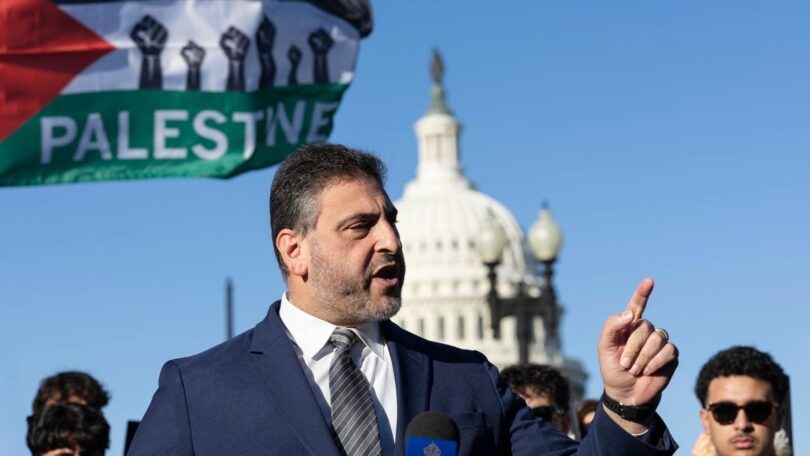
A US federal judge this week ruled in favour of a prominent Palestinian-American academic and activist in a decision that deemed the search and seizure of his phones by customs officers to be illegal.
Osama Abu Irshaid, the executive director of American Muslims for Palestine (AMP), had his phones taken from him and searched at Washington Dulles International Airport on two occasions in 2024, upon his return from trips to the Middle East.
On Wednesday, the US District Court for the Eastern District of Virginia determined that Abu Irshaid was indeed entitled to his Fourth Amendment claim, because “the evidence marshaled by Defendants… does not rise to the level of reasonable suspicion” of ongoing criminal activity, the decision read.
The Fourth Amendment to the US Constitution prohibits unreasonable searches and seizures and requires that warrants be issued by a judge based on probable cause.
“Not only is this a victory for Dr Abu Irshaid, but a victory for the pro-Palestine movement overall. For decades, allies who support Palestinian human rights have been systematically targeted by the US government for daring to speak out against Apartheid Israel,” AMP said in a statement following the ruling.
CLICK FOLLOW: TO FOLLOW US
Sign up to get the latest insights and analysis on
Israel-Palestine, alongside Turkey Unpacked and other eSPORTY
The defendants – in this case, the Customs and Border Protection (CBP) officers under the Department of Homeland Security – said they believed there was reason to search Abu Irshaid’s devices, owing to a public letter sent to him by the Republican-led House Oversight Committee in May 2024.
The committee accused AMP of “pro-Hamas propaganda” and “material support to terrorist organizations” and said it was opening an investigation into the group.
‘Constitutional separation of powers’
But the judge decided that “the letter was not directed to CBP, and Congress is neither a law enforcement entity nor a tipster in the traditional sense in the Fourth Amendment analysis as a matter of the constitutional separation of powers”.
CBP officers also pointed to a more than a decade-old photo of Abu Irshaid used on a website for the military wing of Hamas, the al-Qassam Brigades.
Hamas is a designated terrorist organisation in the US.
US pro-Palestine group faces ‘baseless’ legal challenge after winning lawsuit
Read More »
Abu Irshaid told officers the photo was published without his knowledge or consent. It was later revealed that he was shown the photo during his US citizenship interview in 2015, but that it was presumed unremarkable, as he has since successfully obtained American citizenship.
Still, it came with years of secondary screenings at US airports.
“The government didn’t admit it, but we established that he was on the watchlist for a number of years, from about 2010 to around 2017, and then since 2023, he started having issues once again,” Gadeir Abbas, the deputy litigation director with the Council on American-Islamic Relations, told Middle East Eye.
Abbas represented Abu Irshaid in the case.
“It is clearly connected to his status on this list, which dictates a certain kind of treatment that is inflicted on him every time he travels by air or crosses the border.”
That list is the “Terrorism Screening Database”, which was established in the aftermath of the 11 September 2001 attacks in New York City. The government keeps the names on the list secret.
“One by one, we eliminated their specious concerns about Dr Abu Irshaid,” Abbas said of Wednesday’s ruling. “This is a major win, and it will have wide-reaching implications for everybody else.”