DUBAI—President Trump is betting that reimposing the blockade on Iran and revoking its right to sell oil will throttle the regime’s economy and convince it to release its hold on the Strait of Hormuz. Tehran is betting it can hold out.
The danger is, in the short term at least, that the renewed economic pressure hurts ordinary Iranians and leaves a destructive stalemate in the waterway.
U.S. Central Command announced strikes on Iranian targets for a sixth straight day on Thursday. The collapse of the June deal to end the fighting has reversed economic relief for Iran, putting the squeeze on households already buying groceries on credit. Oil revenues are likely to dwindle, businesses will again delay investment and households will cut spending even further.
Iran’s leaders have historically proved willing to impose enormous costs on the population rather than accept demands they see as threatening the regime’s survival.
“Iran is prepared to pay a very, very high cost, including the continued blockade by the American side, in order to retain and sustain this control over the Strait of Hormuz going forward,” said Ellie Geranmayeh, an Iran expert at the European Council on Foreign Relations. “In the Iranian mentality, it’s just about surviving another day, and then another day.”
An Iranian diplomat said there is a deepening fracture in the regime between pragmatists who worry the return of the blockade will worsen the ailing economy and hard-liners who want to aggressively assert control of the strait as a powerful point of leverage over the U.S.
But the pressure will mount. Some analysts estimate a blockade that lasts four to five months could reduce Iran’s oil revenues to close to zero, depriving the regime of its main source of hard currency.
Tehran’s most pragmatic leaders fear the economic erosion risks shaking the regime as it did at the start of the year, triggering a deadly crackdown that contributed to Trump’s decision to start the war.
At minimum, the risk is rising of an increasingly damaging stalemate where Washington inflicts severe economic pain that fails to translate quickly into Iranian concessions over the strait, while Tehran presides over a poorer and more precarious society.
“The renewed blockade would intensify this hardship and feed into further currency depreciation, inflation, shortages, factory closures and employment losses,” said Hadi Kahalzadeh, an economist and former official in Iran’s Social Security Organization. “Perhaps the most damaging economic factor is the absence of a credible horizon for stabilization and the state of limbo.”
In the four weeks since the U.S. and Iran signed their preliminary deal, Tehran shipped almost 70 million barrels of oil worth an estimated $5 billion to $6 billion, according to data provider Kpler.
Iran also had around 100 million barrels of oil already at sea outside the blockade zone. Supplies that have made it past the blockade will let Iran cushion its impact. Eventually, though, the blockade will force Iran to store its oil and, when its tanks fill up, shut in production.
“The impact of the blockade will be similar to the U.S. blockade in April,” said Homayoun Falakshahi, head of crude oil analysis at Kpler. “Production will drop, inventories will fill up.”
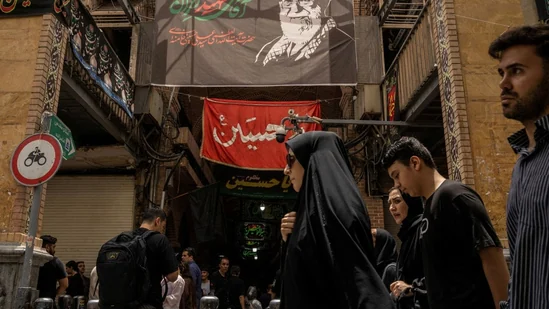
Iran’s economy is already buckling under the combined weight of years of sanctions and soaring inflation. The conflict has intensified those pressures by damaging factories, disrupting trade and payments, shutting down internet access and further weakening the currency.
Consumer prices in June were up 88.6% from a year earlier, according to official statistics. Just in the first few days of July, the price of a tray of eggs in Tehran shot up by 40%, to the equivalent of $3.30, according to Iran’s Fars news agency, which is close to the paramilitary Islamic Revolutionary Guard Corps.
Iran’s gross domestic product is expected to shrink by 5.4% this year, according to forecasts by the International Monetary Fund prepared before the recent uptick in fighting.
According to Kahalzadeh’s calculations, only the top 3% of Iranian households are able to afford the full food basket recommended by Iranian health officials. Many families are buying basic groceries like rice, meat and pasta on credit via a government program. Others are eliminating meat from meals and purchasing staples one at a time as their wages lose value.
“I’m struggling,” said one 41-year-old man in Tehran.
A 38-year-old university arts professor in Tehran said prices for supplies she needs for her work such as brushes, paints and canvases had doubled since March and although families were still buying essentials such as bread and cheaper varieties of cheese, they were doing so under intense pressure.
But her biggest fear is for her sick young child, who depends on an oxygen machine powered by unreliable electricity supply. “I am constantly worried that the power might go out and the child’s oxygen machine won’t work,” she said.
Now the blockade threatens to deepen that squeeze by attacking the principal source of the foreign exchange Iran needs to finance imports and support its currency. When oil exports decline, fewer dollars enter the economy, making imported food, medicine and industrial components more expensive.
Manufacturers facing higher costs and shortages then cut production and jobs, feeding a cycle in which recession and inflation reinforce each other. Kahalzadeh estimates that the war would lead to the loss of at least 2 million to 3 million jobs in Iran.
Iran insists that it can continue selling oil. Oil Minister Mohsen Paknejad said Tuesday that Iran has deployed systems for years that have enabled it to skirt U.S. sanctions. The U.S. Treasury has mounted a tougher crackdown on so-called shadow fleet ships, front companies and buyers that facilitate Iran’s oil sales.
Still, the April blockade showed how abruptly those flows can collapse. Iranian crude exports fell sharply before the temporary agreement allowed shipments to resume in June.
Write to Georgi Kantchev at georgi.kantchev@wsj.com and Benoit Faucon at benoit.faucon@wsj.com