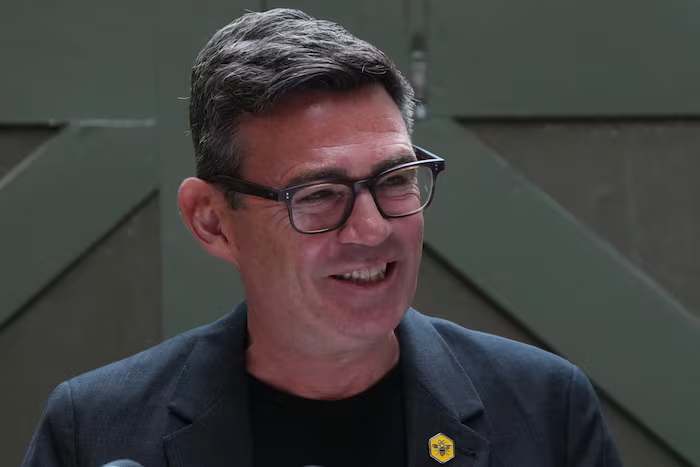
LONDON (AP) — Andy Burnham will officially become leader of Britain’s governing Labour Party on Friday, clearing his final hurdle to taking office as prime minister next week.
The center-left party will announce the result of a leadership contest to replace departing Prime Minister Keir Starmer, in which Burnham was the only contender. He had secured nominations from 379 of the 403 Labour lawmakers in the House of Commons as of Thursday night.
Burnham, the former mayor of Greater Manchester, has been prime minister-in-waiting for weeks, but he has revealed little detail about his policy priorities. After winning a special election for a seat in Parliament a month ago, he pledged to build a politics “based on unity and hope” and an economy that spreads growth evenly across the country.
He has held no press conferences and given few interviews, and will arrive in Downing Street largely unknown to voters outside Manchester.
Burnham brings a more relaxed style of leadership than the rather stern Starmer, and is regarded as one of the Labour Party’s best communicators. But he faces many of the same problems as his predecessor, including a sluggish economy, a cost-of-living squeeze fueled by wars in Ukraine and the Middle East and overstretched public services.
Burnham’s office says he plans to sketch out some of his priorities Friday in his first speech as Labour leader, and will say that he will have the “courage to fix the big things that politics has neglected.”
He’ll highlight plans to focus on economic renewal, more public control of key sectors and creating new modern industrial jobs, arguing that Britain took “a series of wrong turns in the 1980s” when “political power was centralized and economic power privatized.”
That’s the decade when Conservative Prime Minister Margaret Thatcher oversaw policies of privatization, deindustrialization and political centralization that transformed the U.K. economy.
In a social media video posted late Thursday, Burnham said he also would make a priority of tackling the patchy access to social care for those who need it because of age, illness or disability. It’s a pressing issue in a country with an aging population, and one that has foxed previous Labour and Conservative governments.
Starmer announced last month that he would resign after two years in office marred by missteps and judgment errors that eroded his standing with his party and the public.
Labour regularly trails behind anti-immigration party Reform UK in opinion polls, and the governing party had catastrophic results in local elections in May, triggering pressure on Starmer to step down that he couldn’t resist.
He will remain prime minister until Monday, when he formally tenders his resignation to King Charles III. The king will then ask Burnham to form a government.
Britain’s parliamentary democracy allows governing parties to change leaders, and thus prime ministers, without the need for a general election. The next national election doesn’t have to be held until 2029.
New prime ministers have come with increasing frequency in recent years. Burnham will be the U.K.’s seventh leader since 2016.
Copyright 2026 The Associated Press. All rights reserved. This material may not be published, broadcast, rewritten or redistributed without permission.