Most debates about the recent World Cup football match between Argentina and Egypt in the round of 16 have focused on the game itself, amid allegations that Fifa favoured Argentina in refereeing decisions.
But across the Arab world, the public reactions have reflected local politics. If social media represents a plausible barometer – albeit an unscientific one – of Arab public opinion, it would point to overwhelming support for the Egyptian team, even among those who oppose the regime’s poor human rights record.
Like football fans around the world, many Arab fans are divided into camps between those who support Lionel Messi, the captain of Argentina’s team, and Cristiano Ronaldo, the captain of Portugal’s team.
These camps have become almost cult-like. They stand by Messi or Ronaldo, regardless of tournament or team.
But the Egypt-Argentina match marked a rare occasion when such individual loyalties were cast aside, and Arab fans stood together.
CLICK FOLLOW: TO FOLLOW US
Sign up to get the latest insights and analysis on
Israel-Palestine, alongside Turkey Unpacked and other eSPORTY
This matters because over the last decade, the Arab world has witnessed growing attempts to undermine regional unity. Many regimes have worked to establish national narratives that isolate their people from the broader region, thus concealing their own failures.
But the solidarity and sympathy shown towards Egypt by fans across the region – from Mauritania to Oman – has revealed the failure of these efforts to break the region’s historical, cultural, linguistic and religious bonds.
Spotlighting Gaza
Even before the controversial match against Argentina, the Egyptian team had gained significant attention and support across the Arab world – and not only because of its impressive performance in the previous round.
Egyptian coach Hossam Hassan held the Palestinian flag on the pitch after his team defeated Australia and qualified for the round of 16. He earned the praise of many Arab commentators by dedicating his team’s victory to the Egyptian and Palestinian people.
He was not deterred when a few critics slammed him for including Palestinians, rather than focusing only on the Egyptian people.
Despite years of political fragmentation, Arabs across the region still share a common identity and common causes
In a subsequent news conference prior to the match with Argentina, Hassan called on the world to support the Palestinian people and to end their suffering, bringing renewed global attention to the humanitarian disaster in Gaza.
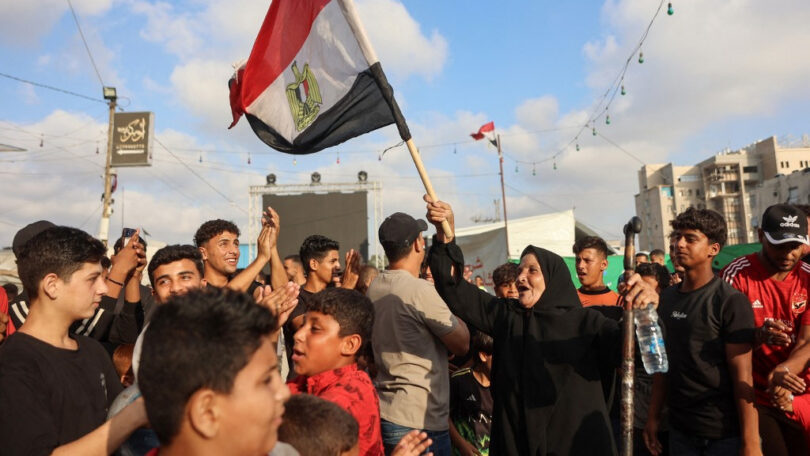
Palestinians in Gaza celebrated Hassan’s gesture, gathering near the ruins of their homes to watch on big screens the match between Egypt and Argentina. Underscoring the ongoing tragedy, Israeli forces killed Mohamed al-Wahidi, a Palestinian aid worker who organised the screenings, just moments before the kickoff.
These events highlighted the special relationship between Egyptians and Gaza’s Palestinians, and the centrality of the Palestinian cause to all Arabs.
Some observers noted on social media that Hassan’s decision to dedicate the victory to the Palestinian people, and to raise the Palestinian flag, mattered more than the outcome of the Egypt-Argentina match.
Egyptian injustice
In addition to bringing pan-Arab unity to the forefront, Egypt’s final World Cup match – and the sense of injustice felt by the Egyptian team and its fans – cast a spotlight on another injustice, this time on the domestic front.
Former political prisoners in Egypt, and the families of current prisoners, extended their sympathies to the national team, but they also seized the opportunity to remind Egyptians about the challenges they are facing in their own homeland.
World Cup 2026: Arab teams offer a master class in grace and solidarity
Read More »
As fans expressed their indignation over the results of the Egypt-Argentina game, Gamal Eid, one of Egypt’s most prominent human rights lawyers, posted on Facebook to ask why the same level of public outrage could not be brought to bear on the ongoing injustices inside the country’s prisons.
At the same time, Egyptians in exile had to ask why they were being deprived of their right to celebrate their national team’s World Cup run inside Egypt.
Many western commentators argue that sport should be kept separate from politics. Yet after Russia invaded Ukraine, European teams and sporting organisations used the 2022 World Cup and other tournaments to express solidarity with the Ukrainian people.
For many Arabs, sport has always been intertwined with politics. The 2026 World Cup provided an opportunity for a public expression of “Arabness”, showing that despite years of political fragmentation, Arabs across the region still share a common identity and common causes: above all, Palestine.
The views expressed in this article belong to the author and do not necessarily reflect the editorial policy of Middle East Eye.